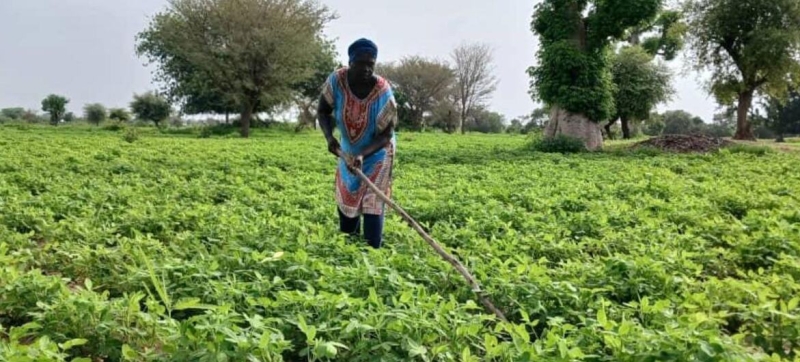

© UNDP A Senegalese woman works on her farm. UN: Hunger in Africa rises for eighth year in a row Humanitarian aid
Hunger levels are rising in Africa for the eighth year in a row, and without urgent and coordinated financial action the situation will only get worse. This is according to a new joint report by the Food and Agriculture Organization (FAO), the United Nations Economic Commission for Africa (ECA), the World Food Program (WFP) and the African Union Commission.
The authors estimate that there are about 306 million undernourished people in Africa—more than 45 percent of the world’s total. Another 892 million people face moderate or severe food insecurity. The main causes are conflicts, climate shocks, economic downturns and growing inequality.
Healthy eating becomes unaffordable
The average cost of a healthy diet in Africa reached $4.41 per day (at purchasing power parity), up 5.5 percent from 2023 levels. This is well above the international extreme poverty threshold of $2.15 per person per day. As a result, 67 percent of the continent’s population could not afford adequate nutrition in 2024, more than double the global rate of about 32 percent.
More than 30 percent of children under five in Africa suffer from stunting, a sign of chronic malnutrition. Although this figure is gradually decreasing, it remains high.
Lack of funding
The report highlights the significant gap between current investments and real needs to transform agri-food systems. Although public spending on agriculture in Africa has been rising since 2018, it is not enough to achieve hunger-eradication goals.
International aid is increasing only slightly, with less than 27 percent of such funds going towards food security and food.
Private investment remains extremely low. Bank lending to agriculture is less than 4 percent of the total, and foreign direct investment in the sector often does not exceed $2 billion per year.
Small and medium-sized enterprises are especially starved of financing: they are too large for microfinance, but not significant enough to receive bank loans.
New sources are needed funds
The report’s authors call for a more enabling policy and institutional environment to attract investment, including through public-private partnerships. The report also highlights the importance of inclusive solutions, with a particular focus on the interests of women, youth and small farmers.
The potential of blended finance is highlighted: in 2020–2023, 99 such transactions worth about $3 billion were implemented in Africa. However, most of them are focused on large companies, while small businesses still lack capital.
Climate Finance – an Underutilized Resource
Africa is also underserved in climate finance. In 2021-2022, it was $44 billion, up 48 percent from previous years but well below the $250 billion needed annually. Experts stress that linking climate finance to food system development will be key to increasing sustainability.
Governments and development partners are encouraged to coordinate investments, promote sustainable and inclusive policies and consider agri-food systems as the foundation of economic growth, health and resilience.