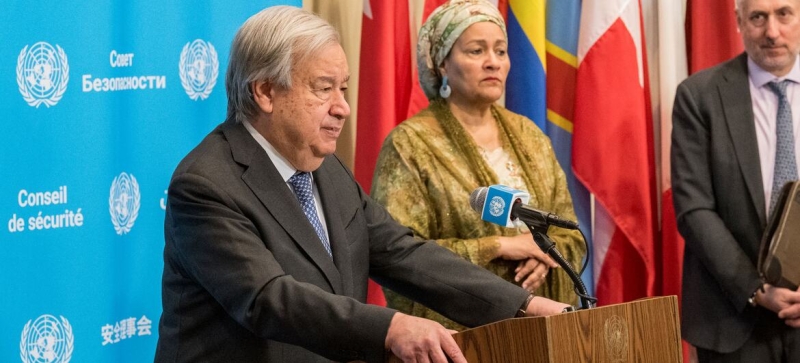

UN Photo Secretary-General Antonio Guterres at a press conference on the Middle East. The UN Secretary General presented three scenarios for the development of the crisis in the Strait of Hormuz Peace and Security
Despite the ceasefire, the situation in the Strait of Hormuz area remains critical. UN Secretary-General Antonio Guterres stated this at a press conference at the UN headquarters in New York.
Restrictions on freedom of navigation, the UN chief recalled, impede the supply of oil, gas and fertilizers, which was a heavy blow to the global economy. The Secretary General emphasized that all of humanity is paying for the conflict.
He presented three scenarios for the development of events. In a best-case scenario, if restrictions are lifted today, global economic growth this year will still fall from 3.4 percent to 3.1 percent, and inflation will rise to 4.4 percent. Supply chains will take months to recover.
“The growth rate of global merchandise trade will slow, from 4.7 percent last year to about 2 percent [this year],” Guterres said.
The second scenario assumes that supply disruptions will last until mid-year. In this case, economic growth will decline to 2.5 percent and inflation will reach 5.4 percent. About 32 million people will fall below the poverty line, and another 45 million will face extreme hunger due to fertilizer shortages and low harvests.
The third scenario is the most pessimistic. If restrictions on shipping in the Strait of Hormuz are not lifted by the end of the year, inflation will exceed 6 percent and economic growth will decline to 2 percent. The world could be at risk of a global recession, with dire consequences for the world’s population.
“Every day ships remain idle increases costs and increases their impact on the global economy,” Guterres said.
“My message to all parties is very clear: freedom and rights shipping must be restored immediately, as required by Security Council Resolution 2817. Open the strait. Let all ships pass. Let the world economy breathe,” he added.
The Secretary-General also called on the parties to avoid any actions that could undermine the ceasefire.
The UN chief recalled that the International Maritime Organization (IMO) is developing a plan for the evacuation of ships and sailors, and the head of the UN Office for Project Services (UNOPS) Jorge Moreira da Silva is heading to the region for consultations on the creation of a humanitarian corridor. The Secretary General’s personal envoy for the Middle East conflict, Jean Arnault, also continues negotiations with all parties to find a peaceful solution.
“Now is the time for dialogue. For solutions that will prevent us from falling into the abyss. And for measures that can pave the way for peace,” Guterres said.