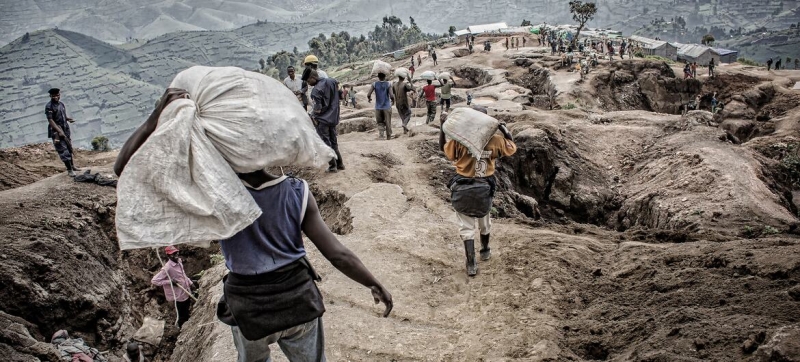

© Adobe Stock/E. Zani Cobalt mining in the east of the Democratic Republic of the Congo is an area controlled by armed groups. UN Secretary General: natural resources should become the basis of peace, not conflicts Peace and Security
Illegal extraction and exploitation of natural resources fuels armed conflicts, strengthens the influence of criminal groups and deprives countries of the ability to use their own wealth for development purposes. This was stated by UN Secretary-General Antonio Guterres, speaking on Wednesday at the Security Council open debate on the role of natural resource management in ensuring peace, security and prosperity.
The high-level meeting is chaired by the Foreign Minister of the Democratic Republic of the Congo, Therese Kayikwamba Wagner.
According to the UN chief, growing global demand for fossils used in electronics and clean energy, such as lithium, cobalt, nickel and rare earth elements, opens up new opportunities for development for producing countries. At the same time, it increases geopolitical competition, puts pressure on global supply chains and, in some cases, becomes a factor fueling armed conflicts.
“Too often, proceeds from the illegal exploitation of natural resources delay the prospect of peace,” the Secretary General emphasized.
From DR Congo to Sudan
Guterres cited the example of the eastern parts of the Democratic Republic of the Congo, where armed groups profit from illegal mining and smuggling, while civilians continue to suffer violence.
He said a similar situation is observed in Sudan, where the struggle for political and territorial dominance is fueled by the exploitation of natural resources, especially gold and gum arabic. This, he noted, led to mass atrocities and the forced displacement of millions of people.
The greatest price, according to the Secretary-General, is being paid by the most vulnerable groups of people – women, children and communities dispossessed of their lands. UN.
Four priorities
Guterres outlined four key areas that, in his opinion, should form the basis of international efforts. The first he named was ensuring justice. According to the Secretary-General, countries and local communities must first benefit from the natural resources they have.
“It is time to put an end to the long-standing practice of extracting resources in one country and creating most of the value added in another, while leaving local people in poverty to face the environmental and socio-economic consequences,” he said. manage your natural resources.
Read also:
Why critical minerals suddenly found themselves at the center of world politics?
The UN, he said, helps states strengthen governance institutions, improve legislation, conclude fairer agreements in the mining industry, develop domestic processing of raw materials and more efficiently use revenues from mining. Such support is already being provided, in particular, to the Democratic Republic of the Congo, Mozambique, Uganda and Zambia.
The Secretary-General identified the prevention of illicit trade as a second priority. He emphasized that the fight against the illegal exploitation of natural resources should cover the entire chain – from production to the release of products to world markets. This requires closer cooperation between producing countries, transit countries and consuming countries, as well as increased transparency, development of systems for traceability of raw materials and information exchange.
As an example, Guterres mentioned the recent decision of the European Union to ban the purchase, import and transfer of gold from Sudan, as well as the export to this country of mercury and cyanide used in gold mining.
The third direction, according to the Secretary General’s speech, should be the peaceful resolution of disputes. According to him, issues of access to natural resources, their ownership, distribution of income and control over territories often lie at the core of political conflicts and must be taken into account in the process of mediation and peace negotiations. Droughts, floods, environmental degradation and the destruction of ecosystems reduce access to land, water and minerals, which increases social tensions, weakens state institutions and can lead to outbreaks of violence, he noted. resources.
“No more exploitation. No more looting,” he said.
Armed groups and criminal networks must be deprived of the income that allows them to continue conflicts, Guterres said. Instead, natural resources should be used to finance inclusive and sustainable development, strengthen government institutions and achieve peace and prosperity.
“Ultimately, this is a political choice. And I call on the members of the Security Council to choose peace,” concluded the Secretary-General.