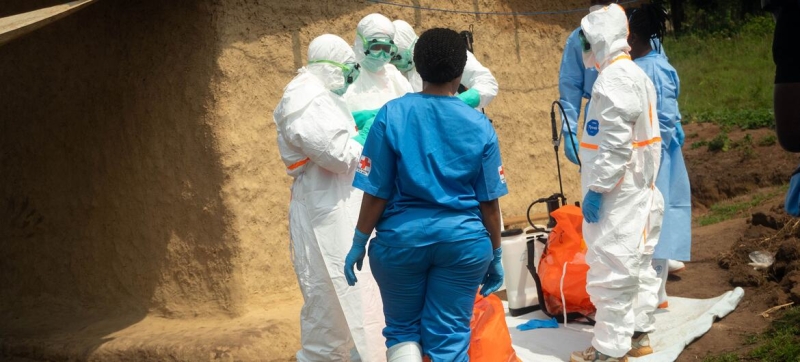

© OCHA/P. Lecomte Health workers prepare to bury a baby during an Ebola outbreak in the Democratic Republic of Congo. Ebola outbreak in DR Congo: a massive crisis requires a massive response Health
Under-Secretary-General for Humanitarian Affairs and UN Emergency Relief Coordinator Tom Fletcher called on the international community to urgently scale up assistance to the Democratic Republic of the Congo (DRC) in response to the fastest-growing Ebola epidemic in history.
The severity of the outbreak has been repeatedly warned in recent weeks by the UN Secretary-General, the head of the World Health Organization (WHO) and Fletcher himself. “We must turn this concern into action,” he said.
The epidemic has engulfed a country already facing a deep humanitarian crisis, with nearly 11 million people in need of assistance and armed conflict forcing families to flee their homes amid severe food shortages.
The scale of the response is growing, but the virus is spreading even faster, Fletcher warned. The outbreak has already been recorded in six provinces, including where insecurity limits access for humanitarian workers and where health systems are inherently weak. In such conditions, it is more difficult to identify sick people, trace their contacts, treat patients and gain people’s trust.
The outbreak is having a particularly hard impact on women and girls, especially pregnant women. Children who have lost their parents or guardians are easy targets for traffickers.
“This is not just a health emergency. This is a humanitarian crisis on top of many that already exist,” said Fletcher.
Targeted measures are not enough
The Emergency Relief Coordinator praised the efforts of the DRC government, which is working with the support of UN agencies and other partners. Operational centers started operating, funds were mobilized, and as part of the “humanitarian reset” a unified system of coordination of efforts was built.
However, it is no longer possible to respond with targeted measures to an epidemic that is growing “exponentially,” Fletcher warned. We need a large, long-term operation that can stay ahead of the virus: more places to treat the sick, more teams to ensure safe and dignified funerals, and reliable access for aid workers and supplies.
“Fighting Ebola cannot be done in isolation,” he said. “People need functioning health services, clean water, sanitation, food, protection and livelihoods. And most importantly, trust.”
Those working on the front lines of the epidemic take enormous risks: More than 40 health workers have died from Ebola while saving others, and treatment centers and ambulances have been attacked on multiple occasions. Fletcher called for the protection of doctors.
Funds are in short supply
Preparedness measures have also been stepped up in neighboring countries, most notably South Sudan and the Central African Republic, which are themselves experiencing severe humanitarian crises. Last week, WHO announced the end of the outbreak in Uganda, which had gone 42 days without a new case.
DRC’s revised humanitarian plan for 2026 is estimated to cost $2.1 billion, of which $300 million is earmarked specifically for Ebola control. However, donors provided only about half of the required funds. “The virus will not wait for us to find that money,” Fletcher noted.
From the Central Emergency Response Fund, Fletcher has allocated more than $57 million for aid and preparation in the DRC and neighboring countries.
Fletcher made three appeals to states. The first is to use your influence to keep the crisis at the center of the international agenda. The second is to ensure the safe and rapid movement of humanitarian personnel and supplies. The third is to increase funding and make it more flexible, not only for the fight against Ebola, but for the entire humanitarian operation in the DRC.
“We have the experience, we have the means and we have wonderful people risking their lives to stop this epidemic. What is needed now is political will, access and resources,” the UN representative concluded. – We have already defeated Ebola. We can do it this time too.”