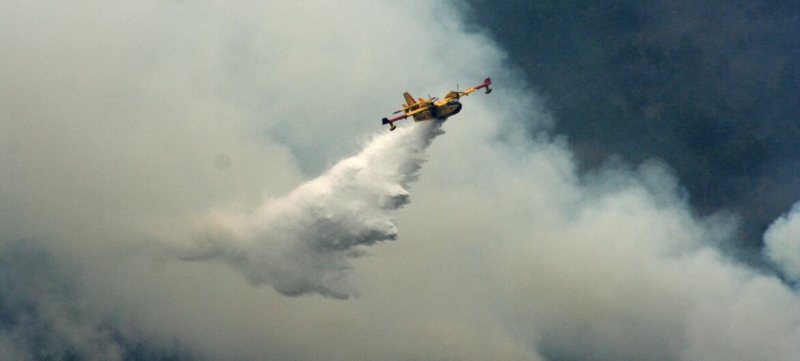

© Unsplash/K. Guerchio About 90 percent of forest fires are caused by human activity. Fires in Europe and North America: almost 6 million hectares of forest burned Climate and Environment
Since the beginning of 2026, fires have destroyed almost 6 million hectares of forest in Europe and North America. The United Nations Economic Commission for Europe (UNECE) warns that without increased investment in prevention, sustainable forest management and adaptation to climate change, it will be impossible to contain the spread of megafires.
According to the UNECE, more than 434 thousand hectares of forest have already been destroyed by fire in Europe. In France, fires in the Gironde department destroyed almost 42 thousand hectares of pine forests and forced tens of thousands of residents and tourists to leave their homes and vacation spots. In Spain, the area of burned areas has already exceeded 200 thousand hectares, which is approximately twice the annual average. The disaster is even greater: almost 1.85 million hectares of forest burned in the USA, and about 3.8 million hectares in Canada. Dozens of large fires have not yet been contained.
Nine out of ten fires are caused by humans
“Every summer reminds us that forest fires are no longer an exceptional phenomenon, but an increasingly predictable consequence of climate change,” said Paola Deda, Head of the UNECE Environment and Forestry Division. “While emergency response remains vital, the greatest benefits can come from prevention, sustainable forest management, and building the resilience of natural areas and local communities.”
According to the Commission, about 90 percent of forest fires are the result of human activity—either through carelessness or intentional action.
The UNECE notes that many fires can be prevented by increasing public awareness, tightening fire safety rules, introducing temporary restrictions during periods of high fire threat, and responsible behavior of people in forests.
The Commission calls for an integrated approach, including prevention, risk assessment, monitoring, early detection of fires, effective response and restoration of affected areas.
Climate change increases the risk of fires
The UN agency notes that rising temperatures, prolonged droughts, heat waves and changes in precipitation patterns are increasing the duration of the fire season and making vulnerable regions that previously rarely experienced large-scale forest fires fires.
The Commission warns that climate change is contributing to an increase in the number and intensity of fires, which in turn lead to additional greenhouse gas emissions.
In 2021, wildfires were responsible for the release of about 1.8 billion tons of carbon dioxide. According to UNECE, from 2001 to 2023, global emissions from wildfires rose by about 60 percent, and in the boreal forests of Europe, North America and Central Asia – nearly tripled. UNECE reminds that forest fires lead to loss of life, destroy housing and infrastructure, and force the population to leave their homes. Smoke can travel hundreds of kilometers, degrading air quality and increasing the risk of respiratory and cardiovascular diseases.
In the European Union alone, wildfires are estimated to cause around €2.5 billion in economic losses each year. However, real losses are much higher, since the consequences of fires persist long after the fire is extinguished, including loss of biodiversity, reduced land productivity and the need to restore natural ecosystems.
UNECE also emphasizes the role of new technologies in fire prevention. Early detection systems using artificial intelligence, satellite monitoring and real-time mapping of risk zones allow you to quickly identify hot spots, speed up responses and reduce the extent of damage.