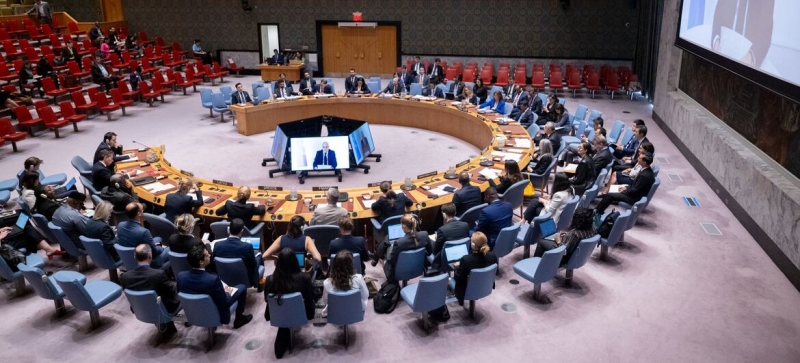

Photo UN/M. Elias UN Security Council meeting on the situation in Syria. UN: Syria enters critical stage of political transition Peace and Security
Despite ongoing security challenges, dire economic conditions and communal tensions, Syria faces real opportunities for political transition and reconstruction. However, the success of this process will depend on whether the new state institutions can earn the trust of all Syrians.
This was stated on Tuesday at a meeting of the Security Council by the Deputy Special Envoy of the UN Secretary-General for Syria, Claudio Cordone. He spoke from Damascus, where he is meeting throughout July with Syrian authorities, civil society, women’s organizations, and regional and international partners.
“Despite the challenges—as evidenced by security incidents, economic difficulties and unresolved tensions on the ground—Syria’s opportunities are real. To implement them, it is necessary to create inclusive and accountable institutions that can work for the benefit of all Syrians and build trust between the country’s different communities,” said Cordone.
Visit of the Secretary-General
A UN spokesman said that Secretary-General Antonio Guterres will visit Syria this week at the invitation of the government. This will be his first visit to the country as head of the UN.
In Damascus, Guterres will meet with President Ahmed al-Sharaa, Foreign Minister Asaad al-Shaibani and other government officials. The visit will give the Secretary-General the opportunity to see first-hand both the promise and the challenges of the country’s political transition and reconstruction, as well as the consequences of years of conflict. During the trip, he will personally listen to representatives of Syrian civil society, women’s organizations and various communities. The Secretary-General will reaffirm the UN’s commitment to supporting the Syrian government and people at this defining juncture in the country’s history. He will also emphasize the need to respect the sovereignty, unity and territorial integrity of Syria.
Institutional changes
According to Cordone, important institutional changes took place in Syria in July. The President appointed a Supreme Constitutional Court consisting of seven judges, including two women. The new People’s Council also began its work. Now it has 206 deputies representing various professional, social and political circles. Among them are former opposition representatives, tribal leaders, entrepreneurs, former members of armed groups, as well as people who survived imprisonment and chemical attacks.
At the same time, the share of women in parliament is just over ten percent. The UN notes that many Syrians remain concerned about the underrepresentation of women and certain communities in the new government.
The People’s Council will have to adopt regulations and then begin extensive legislative work. In the future, he should participate in the preparation of a permanent constitution and inclusive elections. Cordone emphasized that the most important condition for trust will be the real separation of powers and the independence of legislative and judicial institutions from the executive branch.
Northeast Syria
In the northeast of the country, the integration of military and security forces continues under the agreement of January 29. There is progress in integrating the judicial system, and the Ministry of Labor and Social Affairs has become the first department to complete the merger. However, disagreements remain on a number of issues – command authority, integration of the Women’s Protection Units, management appointments and the management of natural resources. According to Cordone, the parties’ expectations on many of these aspects differ, but the process itself continues, which the UN welcomes. Trials continue in Syria against individuals linked to the former regime, and European courts have handed down new convictions for crimes committed during the conflict.
However, as the UN has stressed, criminal trials are not enough. The country needs a comprehensive transitional justice mechanism that includes truth-telling, reparations for victims and reform of government institutions. Such a process must address violations committed by all parties, take into account the experiences of women and survivors of sexual violence, and help restore trust in the state.
Security situation
The situation in the country remains fragile. A year after serious human rights violations in Suwayda, the political impasse remains as deep as ever. At the end of June there were clashes between the Security Forces and the National Guard; Although escalation into a wider conflict was avoided, the security situation continues to deteriorate.
Intercommunal violence has reportedly killed at least five people, kidnappings and retaliatory attacks continue, and organized crime and drug trafficking remain additional sources of instability. There were bombings in Damascus in July, and terrorist groups are still trying to disrupt the transition process. The UN also expresses deep concern about Israel’s ongoing military activity in southern Syria, including incursions, shelling, drone flights and restrictions on the movement of civilians.
Economic situation
On the economic front, there are signs of revitalized international cooperation. However, Cordone warned, the success of the new agreements will be measured primarily by whether they lead to improvements in the lives of ordinary Syrians who face high prices, unemployment, falling purchasing power and limited access to basic services.
“The success of this transition period will be measured not only by the institutions created, but also by how they function,” the UN spokesman said. He said Syria needed a balanced and effective system of governance with the full participation of women and all groups in society, the further advancement of justice and real improvements in the daily lives of the population.
Humanitarian situation
Speaking at the same meeting of the Security Council on behalf of the Under-Secretary-General for Humanitarian Affairs, Tom Fletcher, Director of the Humanitarian Response Division Office for the Coordination of Humanitarian Affairs (OCHA) crisis situations Eden Wosornu noted that since December 2024, some 1.7 million Syrian refugees and a further 1.9 million internally displaced persons have returned to their home areas. However, 5.5 million people remain displaced within the country, and more than six million Syrian refugees continue to live abroad.
“Returning home is not the finish line, but only the starting point,” Vosornu emphasized. “Every family that returns needs security, basic services and confidence that they can stay.”
The UN estimates that 15.6 million people – almost two-thirds of Syria’s population – are still in need of humanitarian assistance. Millions of people are food insecure, have no stable income, no access to clean water, medical care and education. services.
“Reconstruction is measured not by the number of people who return, but by whether they can stay, rebuild their lives and live well,” she said.
Events in southern Syria are of particular concern to the UN. Continued incursions, restrictions on movement and a fragile security situation complicate the delivery of humanitarian aid and increase risks for civilians. In the southern regions of the country, about 80 percent of the population still requires some form of support. The UN stressed that humanitarian access must remain safe and unhindered, and civilians must be protected.