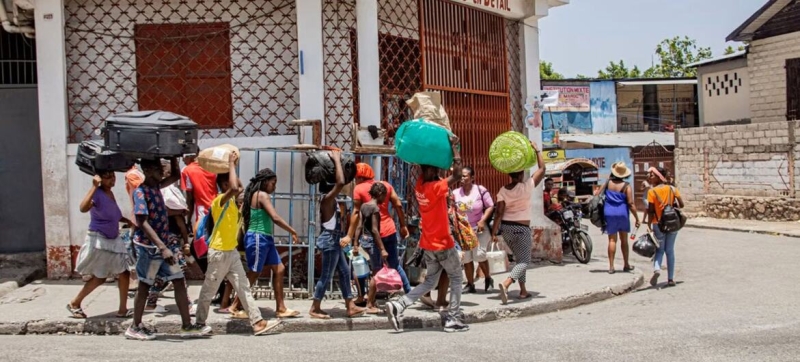

Photo PAHO Residents of Port-au-Prince are leaving their homes in droves; schools and health centers are closed. Haiti: First signs of hope amid gang violence and political uncertainty Daniel Dickinson Peace and Security
For millions of Haitians, daily life has turned into an endless struggle for existence: they are in constant search of food and dream of being able to move around their own neighborhood without risking their lives. Well-armed gangs control many areas of the capital and are expanding their influence to other parts of the country.
Residents of Port-au-Prince are leaving their homes en masse; schools and health centers are closed; Humanitarian organizations are struggling to cope with growing needs due to rapidly declining funding.
One major outbreak of violence in the Cité Soleil area of Port-au-Prince earlier this year killed at least 542 people and injured 355. At least 176 women and girls were raped during these clashes. Increasingly, children are being caught up in the crisis, many of whom have been forced to leave their homes. They are recruited into gangs or subjected to brutal violence.
Nevertheless, against the backdrop of the general crisis, there are also individual signs of progress. Haitian authorities are pushing ahead with long-delayed plans to restore democratic rule through elections; security forces have begun to push gangs out of some strategic areas; International aid is pouring into the country to combat violence.
Millions in need of dwindling aid
The humanitarian crisis is worsening as violence, displacement and economic hardship continue to reinforce each other. Some 6.4 million people – more than half the country’s population – are in need of humanitarian assistance. An estimated 1.47 million Haitians have been forced to flee their homes due to violence that is disrupting health care, clean water supplies and schooling. More than 5.8 million people in the country are expected to suffer from hunger this year.
Humanitarian programs for Haiti by 2026 are severely short of funding. By mid-June, only 25 percent of the $880 million needed had been received, limiting life-saving operations.
Can Haiti hold elections?
Due to prolonged instability and insecurity, Haiti has not had an elected president since the assassination of Jovenel Moïse in July 2021 years.
Restoring democratic governance remains one of the country’s main challenges, but holding fair elections is impossible without significant improvements in the situation on the ground. Armed gangs continue to control many neighborhoods and major roads, making it difficult to register voters, transport election materials, and ensure public safety.
Even so, preparations for the elections have accelerated in recent months. With an approved voting budget of $120 million, it is hoped that the first round of elections will take place before the end of 2026, allowing the president-elect to take office in February next year.For the first time in months, Haitian security forces are beginning to make some, if limited, progress against armed gangs.
Specialized police units have driven criminal gangs out of several strategic areas of Port-au-Prince, allowing traffic to resume on some main roads and government offices in parts of the center city.
An important event was the creation of the Anti-Banditry Force, an international security mission in Haiti with UN support. It is designed to help Haiti regain control over areas under the control of criminal gangs. In June, the mission began patrolling Port-au-Prince. In one of its first operations, the Anti-Gang Force arrested 14 suspects and seized hundreds of Molotov cocktails.
At the same time, two specialized judicial units began to work to investigate mass crimes, cases of sexual violence and major financial fraud. Armed gangs commit murder, kidnapping, rape and forced displacement of entire communities. Sexual violence is increasingly being used to intimidate residents of gang-controlled areas.
Vigilante groups and angry mobs have killed dozens of people suspected of collaborating with gangs. According to available data, at least 87 people were killed during such massacres. Some of these people were beaten to death and their bodies were burned.
There are also reports of alleged abuses by Haitian security forces, including 40 cases of extrajudicial killings by police.
Path forward
The political, humanitarian and security crises in Haiti are deeply interconnected. Without an improvement in the security situation, it will be difficult to hold elections. Without strengthening governance, it will be difficult to maintain the security gains achieved. And none of this will work if millions of people continue to suffer from hunger, displacement and violence.