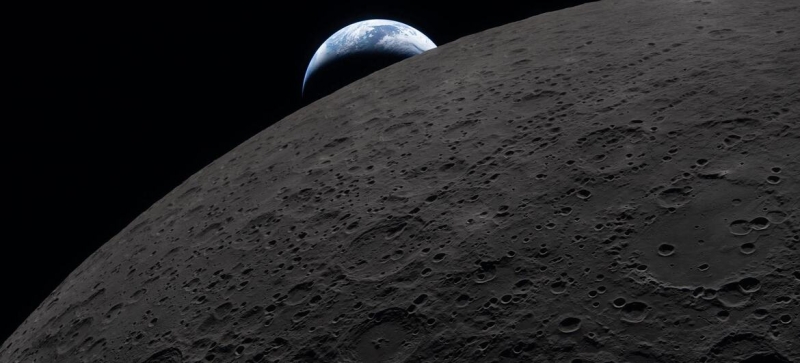

© NASA View of the Moon and Earth from the Artemis 2 spacecraft. On International Moon Day, the UN calls for attention to the problem of space debris Climate and Environment
Amid the rapid development of lunar programs, the UN has called on countries to ensure that man’s return to the Moon does not have negative consequences for the Earth and the future of space activities.
“Decades of rapid development in space activities have shown that every launch leaves an environmental footprint, and it can take a long time to fully assess its consequences. This is why it is so important to consider the environmental sustainability of these programs at an early stage,” said Jason Jabbour, a senior official at the United Nations Environment Program (UNEP). orbit is growing rapidly.
Despite existing international agreements aimed at preventing space pollution, the Earth today is estimated to orbit about 140 million fragments of space debris larger than one millimeter. However, most of them are too small to be tracked, but even they are capable of damaging satellites and spacecraft.Failed satellites eventually enter the Earth’s atmosphere, releasing metals such as aluminum, lithium and copper. Scientists are studying whether these substances can affect atmospheric chemistry, cloud formation and the ozone layer.
Rocket separable stages also pose an additional threat. So, some of them remain in orbit for many years and then disintegrate or fall to Earth, while others are destroyed into thousands of fragments. It is estimated that several hundred tons of spacecraft and rocket bodies enter the atmosphere each year. This volume is expected to grow as satellite constellations expand.
Orbital congestion is also affected by smaller objects left behind from space missions, including bolts, lens caps, and protective housings.
In addition, collisions and explosions produce small particles that are believed to scientists are already making the night sky brighter.
Ongoing risks
Although most spacecraft burn up upon reentry, larger heat-resistant components can reach the Earth’s surface, posing a threat to people, infrastructure, and marine life.
For millennia, the Moon has fascinated humanity, inspiring mythology and science and helping people navigate space. At the same time, its powerful gravitational influence was quietly shaping the conditions of life on Earth.
On the occasion of International Moon Day, which is celebrated on July 20, the United Nations draws attention not only to the significance of Earth’s closest celestial neighbor, but also to the environmental problems accompanying the new era of exploration space.
The role of the Moon in supporting life on Earth
Almost 400,000 kilometers from Earth, the Moon produces tides that oxygenate coastal waters, transport nutrients and help support rich marine ecosystems such as the Great Barrier Reef. Studying the Moon also provides important clues about the origin and evolution of the solar system, scientists say.
Interest in lunar exploration has increased dramatically in recent years. So, this year, as part of NASA’s Artemis 2 mission, four astronauts completed a ten-day flyby of the Moon. The mission was part of plans to establish a long-term human presence on its surface in the 2030s. China, India, Japan and several private companies are also pursuing large-scale lunar programs. However, as space activities expand, so do concerns about their environmental consequences.
The concept of environmentally sustainable use of outer space suggests that space exploration and activities beyond the Earth should be carried out in such a way as to preserve the space environment for future generations. adopted guidelines to limit the creation of space debris. They include reducing waste, preventing explosions and deliberate destruction of spacecraft, and the safe removal from orbit of spent satellites and rocket stages.
Under the 1972 UN Convention on International Liability for Damage Caused by Space Objects, launching states are jointly liable for damage caused by their space objects on Earth, including during launches. carried out by several countries.
To address new risks, UNEP and the United Nations Office for Outer Space Affairs are working together to enhance scientific understanding of the environmental impacts of space activities and to integrate environmental measures into future space governance.
The UN emphasizes: as humanity prepares for long-term return to the Moon, the protection of outer space and the Earth’s environment must remain a top priority for the new phase of exploration.