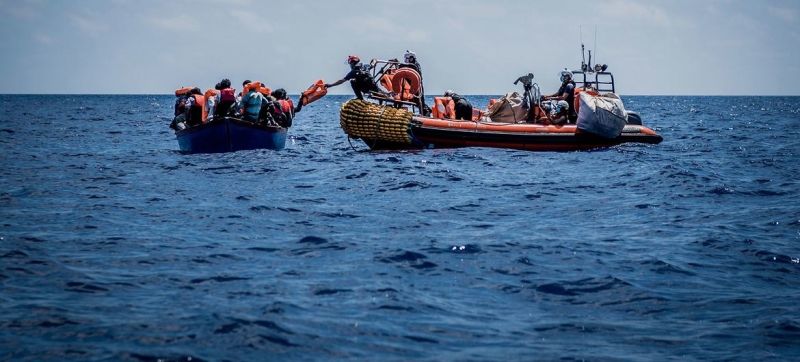

© SOS Méditerranée/F. Gasperini In the first four months of this year, 821 migrants died or went missing on the central Mediterranean route. Migration routes leading to Europe are becoming increasingly dangerous Refugees and migrants
The death toll of migrants on central and eastern Mediterranean routes has risen sharply in the first four months of 2026 – despite the fact that overall the number of migrants arriving in Europe has fallen significantly. The International Organization for Migration (IOM) announced this on Wednesday.
According to the IOM, severe weather, conflict, economic pressure and changes in migration policies have significantly altered travel patterns and patterns in different regions of the world.
In the first four months of this year, 821 people died or went missing on the central Mediterranean route, a figure up 111 percent from the same period in 2025. At the same time, the number of arrivals fell by 46 percent to 8,577 people. More than half of all deaths – 430 – occurred in January, when the region was hit by Cyclone Harry.
The eastern Mediterranean route recorded 244 fatalities in the first four months of this year, up 259 percent on the same period last year. Many of the tragedies along this route occurred off the island of Crete.
“Fewer arrivals does not mean safer travel,” said IOM Deputy Director-General Ugochi Daniels. “Behind every number like this there is a family waiting for news that will never come. As routes become longer and more dangerous, saving lives at sea and on land remains a shared responsibility—and a challenge that no one country can accomplish alone.”
The West African Atlantic route saw arrivals to Spain fall by 78 percent to 2,276 – the steepest drop of any destination to Europe. Departure points continue to move further south along the West African coast, lengthening the sea route and increasing risks.
However, the decline is not observed everywhere. On the western Mediterranean route, arrivals to Spain rose 66 percent to 5,647, mainly due to a tripling of land crossings to Ceuta and Melilla. On the Horn of Africa-Yemen route, arrivals increased by nine percent to 70,200, in line with seasonal trends. In Central America, movement north through the Darien mountain region of Panama has come to a near standstill, with only 135 recorded crossings.
Combat in the Middle East has also affected mobility in the region and beyond. Following the escalation that began in late February, large-scale population displacement has been recorded in Lebanon. Cross-border returns to the Syrian Arab Republic rose significantly in March and April.
“Attention is often focused on a few routes, but nearly half of the 304 million international migrants live within their region, moving for work, family reunification, education and security,” Daniels noted.