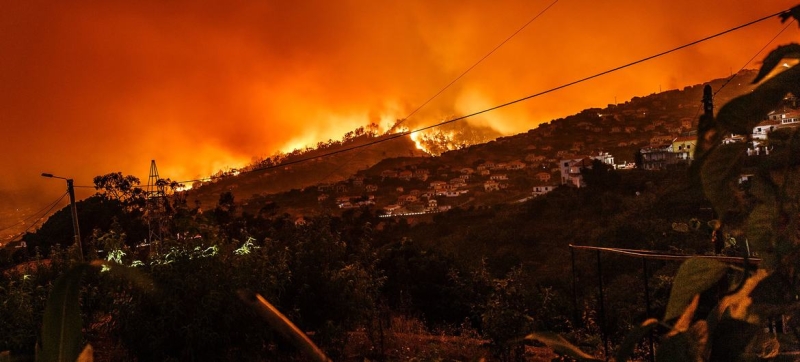

© Unsplash/M. Held Forest fire in Portugal. WHO: how to protect health from the consequences of forest fires Healthcare
Forest fires pose a danger not only to residents of areas near fires. Smoke can travel hundreds or even thousands of kilometers, crossing borders, degrading air quality and creating health risks far beyond the fire zone. The World Health Organization (WHO) warns that the risk of large wildfires continues to increase as climate change occurs.
The massive fires that have ravaged Europe and other parts of the world this summer have once again served as a reminder that it is not just fire itself that poses a threat, but also air pollution.
Health Effects
Smoke from forest fires is a complex mixture of gases and tiny particulate matter produced by burning of trees, vegetation and buildings. If fires affect cities or industrial areas, the smoke composition can become even more dangerous.
A particular threat is posed by fine particles PM2.5, which can penetrate deep into the lungs and enter the bloodstream. Exposure can cause coughing, eye and throat irritation, headache, wheezing and shortness of breath.
For people with asthma, chronic lung or cardiovascular disease, exposure to smoke from even remote fires can lead to worsening illnesses and, in severe cases, hospitalization and emergency medical treatment. help.
Who is at risk
The WHO notes that for some groups of the population, exposure to smoke is especially dangerous. These include infants and young children whose lungs are still developing, the elderly, pregnant women, people with disabilities, as well as those who live in buildings that cannot be adequately protected from smoke penetration, or those without access to shelter.
Emergency workers working near fires and people working outdoors are also at increased risk air.
Greek firefighter Konstantinos Tsigkas stresses that the effects of wildfires go beyond immediate injuries.
“Smoke can cause respiratory illnesses and aggravate pre-existing conditions such as asthma,” he said.
Greek Photojournalist Dimitris Tosidis, who covers forest fires, noted that the situation can change dramatically due to changes in wind.
“When approaching a fire, the most important thing is to understand that the wind can change. Then the smoke covers you, and it becomes impossible to breathe,” he said.
How to protect yourself and your loved ones
The WHO reminds that most forest fires are caused by humans – due to careless handling of fire, unextinguished cigarettes and barbecues, glass left behind (which can focus sunlight) or deliberate arson. However, climate change and changes in land use are creating conditions in which fires spread faster and cover larger areas.
Rising temperatures, prolonged heat waves, droughts, changes in precipitation patterns and drying out vegetation increase the likelihood of fires.
“If there are wildfires in your area, even some distance away, follow the guidance of local authorities, who have the latest information,” advises Dorota Jarosinska, a researcher at the WHO European Center for Environment, Climate Change and Health.
She notes that the smell of smoke means it is present in the air, which means it is necessary to reduce exposure, especially for people at risk. However, the absence of odor does not guarantee the absence of harmful particles, and the direction of smoke propagation can change dramatically. recommendations of local authorities;
Preparation of systems healthcare
WHO emphasizes that healthcare systems must be prepared for the consequences of forest fires. This includes quickly communicating risks, providing health advice, providing hotlines, health and social services, and providing public spaces with clean air and shelter from the heat.
The WHO Regional Office for Europe works with countries to assess risks and prepare for emergencies. The organization has also developed a package of recommendations and practical tools for health services to help protect communities from the effects of smoke and extreme heat, and to make health systems more resilient to wildfires and heat waves.