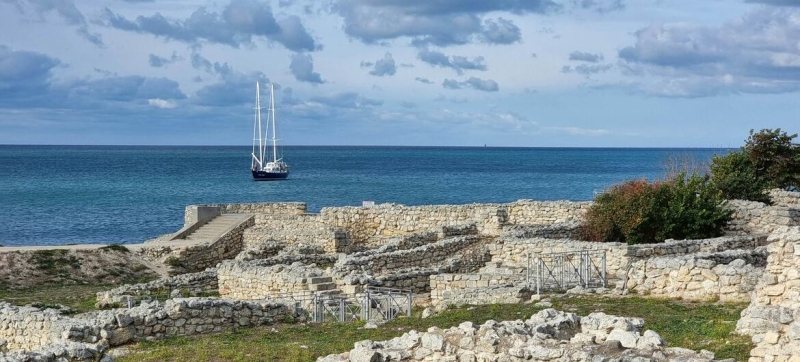

Unsplash/K. Dyadyun The ancient city of Tauride Chersonesos. Chersonese Tauride is included in the UNESCO List of World Heritage in Danger Culture and education
Three sites already on the UNESCO World Heritage List, including Tauride Chersonesos, are inscribed on the List of World Heritage in Danger. This decision was made by the UNESCO World Heritage Committee at its session in Busan (Republic of Korea).
The ancient city of Tauride Chersonesus and its choir (Ukraine)
The Committee noted with deepest concern that due to the temporary occupation of the Autonomous Republic of Crimea (Ukraine) by the Russian Federation, Ukraine is unable to provide protection for this site or guarantee its preservation. In this context, the Committee welcomed the partnership between UNESCO and the United Nations Institute for Training and Research (UNITAR), which since 2014 has enabled regular monitoring of the site’s state of conservation using satellite imagery. These observations revealed significant deterioration in terms of the integrity of the site – as a result of construction works and large-scale archaeological excavations.
In this regard, the Committee decided to include Tauride Chersonese on the List of World Heritage in Danger. The Committee also called for strengthened international cooperation to prevent the illicit trafficking of cultural property originating from the territory of the Autonomous Republic of Crimea (Ukraine).The committee commended the progress made in managing and conserving the site, particularly through the development of new management plans and measures to mitigate fire risks. However, the Committee noted that a number of construction projects were carried out without a heritage impact assessment and without taking into account the Committee’s recommendations. Experts considered that the new building of the National Assembly and the parking lot violate the perception of the historical urban landscape and lead to a loss of its integrity.
Ancient city of Tire (Lebanon)
The Committee expressed deep concern about the ongoing hostilities in Lebanon, which continue to pose a threat to the property, and determined that the conditions necessary to preserve and protect its Outstanding Universal Value are no longer are being executed.
The Committee commended Lebanon for its efforts to strengthen security mechanisms for the site. The Committee noted that the fighting in Lebanon poses an immediate threat to the Ancient City and called on all parties to refrain from any actions that may cause further damage to the site and to comply with their obligations under international law.
The UNESCO World Heritage Committee also decided to inscribe three new sites on the World Heritage List under the emergency procedure: Boma-Badingilo Migratory Landscape (South Sudan), Castles of Mount Amel (Lebanon) and Sebastia (State of Palestine).
The application of the emergency procedure at the request of States reflects the current environment marked by multiple crises, including armed conflict and climate change, which have a negative impact on cultural heritage. These three sites have also been inscribed on the List of World Heritage in Danger.
Boma-Badingilo Migratory Landscape (South Sudan)
This property covers vast areas of the East African savannah: the most the world’s largest migration of land mammals. The unique biodiversity gives this ecosystem exceptional global significance.
The property also reflects the rich cultural and linguistic diversity of the region. Representatives of several ethnic groups live here, who for centuries and even millennia remain the custodians of this landscape, engaged in cattle breeding, agriculture and fishing.
The Committee noted a number of serious threats, such as infrastructure development, commercial poaching, and illegal wildlife smuggling and trafficking, which directly affect large populations of migratory mammals. Effective security of the site is also hampered by continued instability and limited institutional and financial capacity.
Castles of Mount Amel (Lebanon)
The five castles that make up the site indicate the evolution of the region’s defensive systems from the times of the Crusades and Muslim dynasties to the end of the 19th century. This site, which had already received “temporary enhanced protection” in November 2024 by the UNESCO Committee for the Protection of Cultural Property in the Event of Armed Conflict, is now suffering serious damage.
Sebastia (State Palestine)
This site preserves archaeological evidence of the successive development of this place by various civilizations from at least the 9th century BC. e. During this period, Samaria-Sebaste served as the capital of the northern kingdom of Israel. Subsequent archaeological layers date back to the Hellenistic, Roman, Byzantine and Islamic periods.
The main threat facing the site is the planned expropriation of land and the creation of the Samaria National Park, which could lead to the division of its territory. In addition to the consequences of the conflict in the Middle East, the site is also threatened by urban development and land use.