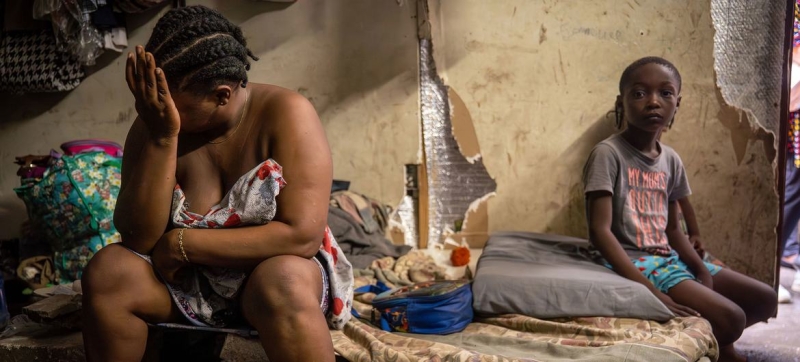

© UNOCHA/M. Compere Last year, 2,088 gross violations of children’s rights were confirmed in Haiti. UN warns: without international support, Haiti risks ending up at the mercy of gangs Peace and Security
Every morning, millions of Haitians wake up with the same question: will they be able to survive another day safely? Will parents be able to get food, children will be able to get to school, and families will be able to avoid the armed gangs that are increasingly infiltrating daily life in the country.
It was about this crisis, which has long ceased to be an exclusively internal problem of Haiti, that members of the UN Security Council and representatives of the Organization spoke on Monday. The speakers called on the world community not to miss the chance to change the situation.
According to the head of the UN Mission for Justice in Haiti, Carlos Ruiz Massier, the country is at a turning point. Despite persistent violence, a humanitarian crisis and weak government institutions, there are early signs of progress. Authorities adopted an updated electoral decree, agreed on an election budget, and voter registration began Monday, an important step toward restoring democratic governance.
“Security is essential to holding credible elections. However, security problems should not become a reason for postponing the political process,” Ruiz Massieu emphasized. According to him, preparations for the elections and improving the security situation must proceed simultaneously, since this is the only way to maintain the momentum.
The first steps of a new international power
An important topic of the meeting was the deployment in Haiti of the international Anti-Banditry Force, operating with the support of the UN. The unit’s special representative, Jack Christofides, said the mission had already moved from preparation to practical action. A headquarters, command and control system were created, the first base was deployed, regular patrols and the first operations against armed groups began.
In June, forces carried out a raid in Port-au-Prince: suspects were detained and hundreds of Molotov cocktails were destroyed. IED stockpiles were later dismantled and weapons were seized.
“The institutional foundations have already been laid and the operational model is showing potential. If the momentum can be maintained, the Anti-Gang Force will be able to expand its activities and increase pressure on gangs and their networks. Otherwise, we risk losing the progress we have made,” said Christofides.
Assistant Secretary-General Daniela Kroslak said the international force had already reached nearly 1,100 personnel representing several countries. It is expected to increase to approximately 2,400 before the end of the current mandate, allowing operations to expand beyond the capital.
Gangs are not just taking over the streets
Executive Director of the United Nations Office on Drugs and Crime Monica Juma warned that the nature of the crisis had changed. According to her, armed groups are no longer limited to fighting for territory.
“Gangs seek to take control of the systems of governance and economic arteries on which the life of communities and the functioning of state institutions depend. They are fighting for transport corridors, fuel supplies, food distribution and illegal markets,” she noted.
Juma emphasized that organized crime is actually replacing the state, holding the population and authorities hostage. At the same time, the consequences are felt far beyond the country’s borders. Haiti is home to arms, drug trafficking and illegal migration routes linking the Caribbean and North and South America.
“The crisis in Haiti is no longer just a security crisis. This is a crisis of governance, fueled by organized crime,” said the head of UNODC.
Children at the epicenter of the crisis
The situation of children is of particular concern to the meeting participants. The Secretary-General’s Special Representative for Children and Armed Conflict, Vanessa Fraser, recently visited Haiti and described what she saw as one of the most alarming situations in the world.
According to the UN, 2,088 gross violations of children’s rights were confirmed last year alone. Almost 900 boys and girls were recruited by armed groups, more than 600 were injured or killed, and hundreds were kidnapped. The organization estimates that children may now make up more than half of gang members.
“Children associated with gangs must be treated first and foremost as victims,” Fraser said, calling on authorities and the international community to focus on their rehabilitation, return to their families and education, not just criminalization “Children who have experienced violence must receive the support they need to heal, recover and rebuild their lives,” said she.
According to the meeting participants, the fate of Haiti matters not only to its 11 million inhabitants. The country remains an important part of the Caribbean region, and what happens there affects the security of neighboring states, migration flows and transnational organized crime. The UN believes that the international community has a real chance to help Haiti change its development trajectory, but this requires long-term political support, funding and close cooperation with national authorities.