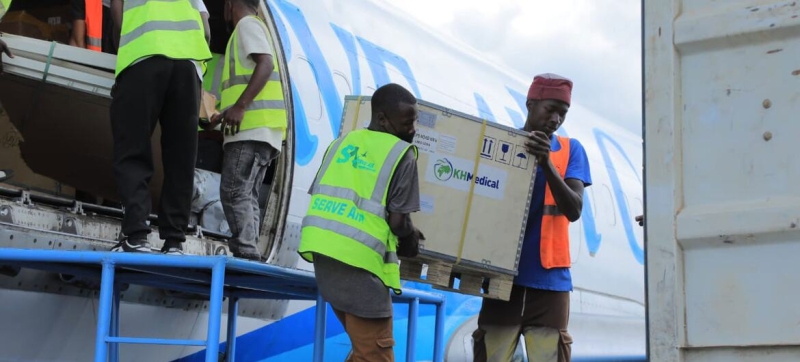

© WHO Unloading a shipment of medical supplies that arrived in the DRC as part of WHO’s efforts to combat the Ebola outbreak. WHO chief: Ebola outbreak in DR Congo is growing rapidly Health
The Ebola outbreak in the Democratic Republic of Congo is growing faster than expected, and the World Health Organization (WHO) is currently revising its risk assessments. This was stated by WHO Director-General Tedros Adhanom Ghebreyesus at a briefing in Geneva, emphasizing that the situation requires an immediate strengthening of the international response.
According to the head of the organization, the risk of the virus spreading within the DRC is now assessed as “very high”, at the regional level – “high”, and at the global level remains “low”.
To date, 82 cases of the disease and seven deaths have been confirmed in the country. At the same time, the number of suspicious cases is approaching 750, and suspicious deaths are approaching 177.
In neighboring Uganda, the situation remains stable: two cases were detected among people arriving from the DRC, one of which was fatal. WHO believes that measures taken by the Ugandan authorities, including intensive contact tracing and the cancellation of public events, helped prevent further spread of the virus.
The cases include a US citizen who worked in the DRC and was evacuated to Germany. Another American with suspected Ebola was transported to the Czech Republic for treatment.
UN agencies have allocated more than $60 million to fight the outbreak
WHO strengthens support for national authorities: 22 international specialists sent to DRC, and WHO Emergency Fund allocated $3.9 million.
Office for the Coordination of Humanitarian Affairs head Tom Fletcher has allocated $60 million from the Central Emergency Response Fund to fight Ebola.
“The humanitarian community is fully mobilized,” Fletcher said. “As in previous outbreaks, Dr. Tedros and his colleagues at the World Health Organization are leading this effort.”
WHO is helping local authorities with contact tracing, setting up treatment centers, public awareness, and other response efforts.
The outbreak is particularly challenging because the outbreak is caused by the rare Bundibugyo virus, which there are no approved vaccines or therapeutics. According to the head of WHO, options for the use of monoclonal antibodies and antiviral drugs are being considered.
The situation is also complicated by local security problems: fighting continues in the provinces of Ituri and North Kivu, due to which more than 100 thousand people were forced to flee their homes.
Yesterday, in one of the hospitals in Ituri, tents where medical materials were stored were set on fire. WHO says the incident, which occurred after relatives were not given the body of a deceased patient, reflects growing mistrust and fear amid a crisis that doctors are trying to contain with strict measures that sometimes conflict with local traditions, including funeral rites.
“Creating an atmosphere of trust with local communities is a critical task,” he stressed Ghebreyesus.
Women are at higher risk of infection than men
Women and girls are likely to face the highest risk of contracting Ebola during the current outbreak due to their roles in caregiving and active participation in communities. UN Women warned about this on Friday.
Women also die more often than men during Ebola outbreaks, the statement said Friday. The reason is not that their illness is more severe after infection, but that they become infected more often.
“The spread of Ebola follows social realities,” the statement said. – The virus is transmitted through nursing, domestic work, frontline healthcare work and funeral practices. When people are sick, it is women who take care of them.”
Supporting Radio Stations
The UN Stabilization Mission in the Democratic Republic of the Congo equipped four radio stations in Ituri province with solar power systems and new broadcast equipment worth $50,000. Radio stations RSI, Radio Candip, RTK and RTNC each received six solar panels, a battery system, an inverter and lightning protection, allowing them to provide stable broadcasting in conditions of chronic power shortages.
The project aims not only to technically strengthen local media, but also to strengthen their role in informing the population, especially against the backdrop of the Ebola outbreak in Ituri. Radio stations broadcasting in multiple local languages have become a key tool for disseminating reliable information and warnings. “We can now produce and broadcast programs all day long, including messages about Ebola in local languages,” said Radio Candip director Freddy Lorima Dz’bo, stressing that without UN support the station could cease operations.