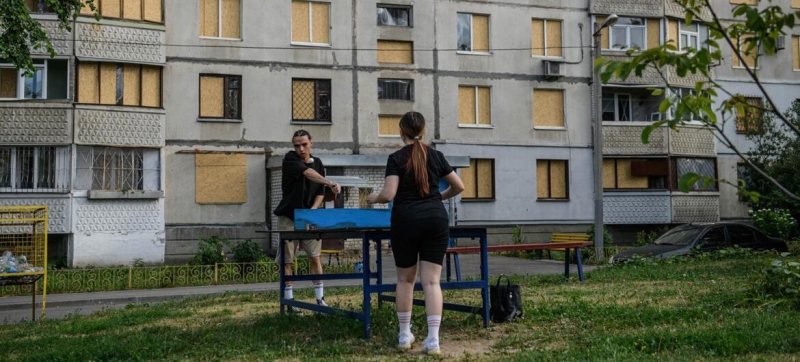

© UNICEF Residents of conflict zones are dying in their homes, in markets, in schools, at work, on the roads and while trying to escape the fighting, the UN notes. UN: wars are becoming increasingly dangerous for civilians Peace and security
In 2025, during armed conflicts one civilian died approximately every 14 minutes. Such data was provided by the representative of the UN Office for the Coordination of Humanitarian Affairs (OCHA), Edem Wosornu, speaking at an open meeting of the Security Council on behalf of Deputy Secretary General Tom Fletcher. The UN Security Council meeting on Wednesday will focus on the protection of civilians during conflicts.
According to Vosornu, we are only talking about cases of civilian deaths officially confirmed by the UN during 20 armed conflicts.
“Very often, civilians do not become collateral victims, but the direct target of attacks,” she emphasized she.
The UN representative noted that residents of conflict zones are dying in their homes, in markets, in schools, at work, on the roads and while trying to escape from hostilities. When this explosive weapons continue to destroy life support systems – electrical networks, facilities water supply, hospitals.
Hospitals under blow
According to Vosornu, ten years after the adoption of Security Council resolution 2286 on the protection of health care in conflict, the situation has only worsened. Hospitals and ambulances were hit, and doctors were killed, intimidated and criminalized.
Hunger as a weapon of war
According to the UN, 147 million people faced severe food shortages last year, mainly way related to conflicts. Two cases of mass famine were officially confirmed. As the OCHA representative emphasized, the reason was not the lack of products, but the methods of warfare.
“Food has become a weapon of war,” she said.
Violence against women and children
The UN also continues to document widespread sexual violence in conflict settings. In 2025, more than 9,300 such cases were officially recorded, the vast majority of victims were women and girls. The real number of victims, according to the Organization, is much higher.
Children, according to Vosornu, continue to be kidnapped and recruited into armed groups. Many are killed or injured due to the use of explosive weapons in densely populated areas.
In addition, information and communication technologies and social networks are used to kidnap, blackmail and recruit children.
Journalists and humanitarians employees
According to UNESCO, between 2022 and 2025, 186 journalists were killed while covering wars and conflicts, a 67 percent increase from 2018 to 2021.
Attacks against aid workers also continue. Since the Security Council’s previous briefing on the topic last month, Wosornu noted, more humanitarian deaths have been confirmed. In 2026, 144 aid workers have been killed, injured, kidnapped or detained in the line of duty.
Drones and artificial intelligence
Vosornu warned that new technologies are making wars even more destructive. According to her, the use of artificial intelligence and drones makes episodes of violence more frequent and increases their scale, especially in densely populated areas. The use of drones in conflicts increased by 4,000 percent between 2020 and 2024. “The consequences are not only physical, but also psychological – constant fear and a constant sense of instability,” said the OCHA spokeswoman, emphasizing that the situation is particularly hard on the children.
“There is another way”
Vosornu said that what is happening is not inevitable.
“These trends are the result of choice,” she emphasized, pointing to the decisions of parties to conflicts to ignore international humanitarian law, to allow impunity and placing military objectives above the protection of civilians.
“My message to this Council and the members of the UN is simple: there is another way,” said Wosornu.
She called on states to respect the UN Charter and international humanitarian law, and to renounce the use of explosive weapons in populated areas, stop the supply of weapons in situations where there is a risk of their use against civilians, and protect doctors, aid workers and journalists.
“Protecting civilians during armed conflicts is not charity. This is the minimum requirement of humanity and civilization. This is the basis of peace and security. This is the responsibility of the Security Council and each state that has signed the UN Charter,” Vosornu said.