
© Unsplash/K. Ian The main conclusion of the report’s authors is that people begin to change their behavior simply because of the very feeling that they are constantly being watched. UN report on digital surveillance systems: “The world is getting used to total surveillance” Human Rights
The world has entered an era where a smartphone in your pocket, a camera at an intersection, and even public Wi-Fi can become part of a huge surveillance system. A new UN global report, Pushed into the Shadows, warns that digital surveillance is no longer just a security tool – it is gradually changing people’s behavior, helping authorities suppress protests and destroying trust within society.
The authors of the study – UN Special Rapporteur on Freedom of Assembly and Association Gina Romero, Professor Pete Fassey and Dr. Daragh Murray – collected evidence from more than 150 activists, journalists, human rights defenders and lawyers from 84 countries, including the USA, China, Russia, Ukraine, India and Egypt.
“We behave as if we are always under our control are watching”
The main conclusion of the report’s authors is that people begin to change their behavior simply because of the very feeling that they are constantly being watched. Researchers call this phenomenon the “chilling effect.” Activists admit that they stop discussing sensitive topics online, avoid protests, change travel routes and even their appearance. In Eswatini, study participants said that during any social activity they automatically behave as if they are being watched. In China, according to the report’s interlocutors, digital platforms like WeChat and Alipay have turned people’s daily lives into a stream of data that the government can analyze in almost real time. Researchers emphasize that even in democratic countries, universities and government agencies are increasingly using the systems tracking to monitor protest activity. Thus, in Australia, some universities tracked students via university Wi-Fi during protests in support of Palestine.
. © UNICEF
Cameras, drones and artificial intelligence
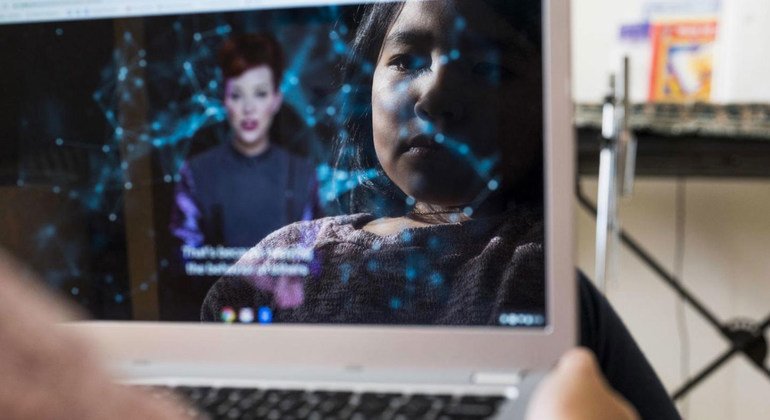
The report describes the current structure of surveillance tools as a single “ecosystem” that includes facial recognition cameras, drones, social media content analysis engines, geolocation tracking, mobile operator data collection, spyware like Pegasus and artificial intelligence-based behavioral prediction systems. What worries experts especially is the fact that these tools are starting to work together. For example, a recording from a city camera can be automatically compared with data from social networks, banking transactions and the history of a person’s movements. The authors believe that the world is moving from the principle of “minimal data collection” to a model where literally everything that can be collected is accumulated.
“Digital prison”
Illustrative evidence came from Tibetan activists in exile. They described China’s modern surveillance system as a “giant prison” where digital surveillance operates around the clock. However, Columbia University students in the United States also talk about thousands of cameras on campus, mandatory ID card scanning and drones flying over protest sites. According to them, the atmosphere at the university has changed so much that many students and professors now feel “under constant surveillance.” Because of this, protesters began to hide their faces, change clothes and avoid certain areas of the city after the protests.
© Unsplash
Why it’s dangerous
UN experts warn that mass surveillance affects more than just the right to privacy. Freedom of assembly, freedom of association and the very ability of people to unite to protect their interests are under threat. When a person is afraid to attend a rally, write a message to a colleague, or support a social movement, democracy begins to crumble from within. The authors of the report emphasize that journalists, human rights activists, LGBTQ activists, representatives of ethnic minorities and young people are especially vulnerable. In addition, artificial intelligence systems often make mistakes when classifying racial and social groups. Thus, in Brazil, biometric systems in schools recognized dark-skinned children worse, which is why they lost access to educational services.
“Normalization of surveillance”
The most alarming conclusion of the study authors is that society is gradually beginning to perceive total surveillance as the norm. Experts call this the “normalization of surveillance”: states justify increased surveillance by fighting terrorism, crime, disinformation and security threats, but the result is a new reality where every citizen is potentially viewed as an object of suspicion. “Ghosts have become monsters. And these monsters are real,” the report’s authors summarize.