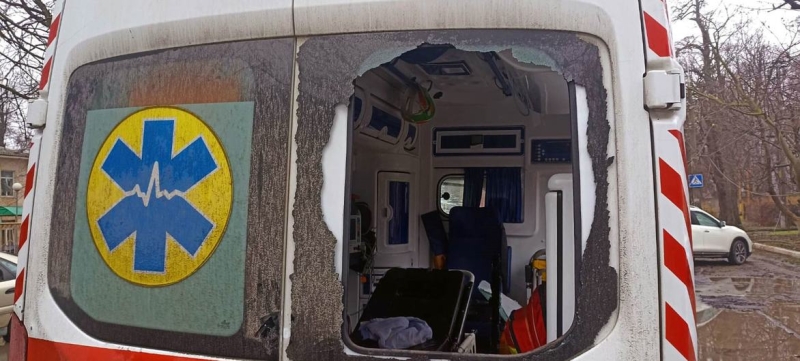

© WHO Facilities of the Ukrainian healthcare system, including ambulances, often come under fire. WHO confirmed 3,000 attacks on Ukrainian healthcare facilities since the start of the full-scale invasion International Law
During the 1,534 days of the war, Ukraine’s healthcare system was subjected to repeated blows. During this period, the World Health Organization (WHO), through its monitoring system, confirmed more than 3,000 incidents.
As noted by the WHO, patients and healthcare workers are constantly at risk. The scale and frequency of attacks undermine the delivery of assistance to the population. According to international humanitarian law, the wounded and sick, medical personnel, treatment facilities and medical transport must be protected. Countries are obliged to take all possible precautions to protect civilians and civilian objects and ensure the rapid and unhindered delivery of humanitarian aid to those in need, WHO emphasizes.
The attacks affected every part of Ukraine’s healthcare system: from primary health care centers and maternity hospitals to ambulance teams and pharmaceutical warehouses. Stationary facilities suffered the most: about 80 percent of the attacks occurred on clinics, hospitals and other medical facilities.
“Every such attack is a violation of international humanitarian law. Each of them is a patient who has not received care, a health worker in danger, or an entire community left without health care,” said Hans Kluge, WHO Regional Director for Europe.
“This should not become the norm. The healthcare sector is protected under international humanitarian law. This is not just a recommendation or a wish, but an obligation that is legally binding on all parties to any conflict. WHO will continue to document every attack and advocate for the protection of healthcare workers in Ukraine,” he added.
Medical transport under attack
Medical transport remains one of the most vulnerable elements of the healthcare system. Approximately 20 percent of reported attacks were on ambulances and other vehicles. Almost every third such incident results in injury or death, making work on ambulance transport one of the most dangerous.
“Since the beginning of this year alone, WHO has confirmed 186 attacks on healthcare facilities, resulting in 15 deaths and at least 81 injuries, and these numbers continue to rise. Compared to the same period in 2025, the number of deaths has almost quadrupled and the number of injured has almost doubled. Due to such dynamics, doctors are exposed to increased risk, and those who most need constant care are deprived of it,” said WHO representative for Ukraine Jarno Habicht.
He added that, as part of its tracking system for attacks on health facilities, WHO records the impact of attacks in order to advocate at the global level for respect for international humanitarian law and the protection of medicine. This work is carried out in accordance with UN Security Council Resolution 2286 and World Health Assembly Resolution 65.20, which condemn attacks on medical facilities and call for measures to prevent violence and ensure accountability. medical personnel, forcing humanitarian organizations to constantly adapt their operations to current conditions. The situation is complicated by growing needs: according to the UN, 9.2 million Ukrainians need medical support. Civilian casualties are up about 31 percent from last year.
“Recent estimates indicate that $23.6 billion will be needed to rebuild the health sector over the next 10 years. At the same time, we are doing everything we can to ensure that patients have access to the care they need. We are grateful to WHO and all our partners for the systemic support that helps preserve and strengthen the healthcare system in these extremely difficult conditions,” emphasized the Minister of Health of Ukraine Viktor Lyashko. services.
Last year alone, WHO provided access to essential health services to 1.9 million Ukrainians, supplied medicines and equipment to nearly 1,000 medical facilities, and supported the medical evacuation of 6,400 patients abroad.