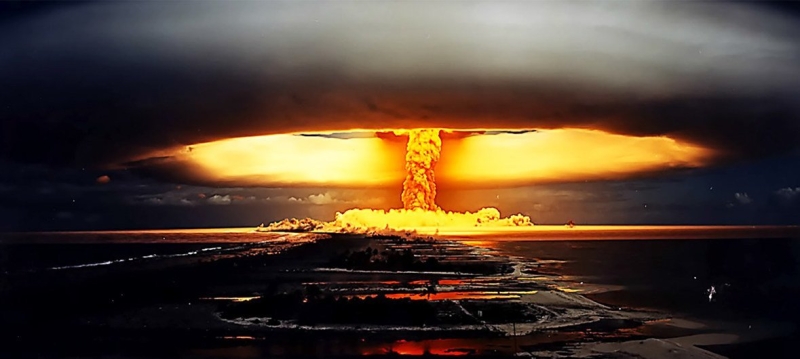

Photo CTBTO In 1971, France conducted a nuclear test on one of the islands of French Polynesia. “Test spiral”: why the world cannot afford a new round of nuclear tests Peace and Security
Comprehensive Nuclear-Test-Ban Treaty Organization (CTBTO) Executive Secretary Robert Floyd warned the international community against a “testing spiral.”
“We cannot allow this spiral to start because it may never be stopped,” he said. Floyd spoke at a press conference at UN headquarters as part of the 11th Review Conference of the Parties to the Treaty on the Non-Proliferation of Nuclear Weapons (NPT). he.
Any tests will be recorded by the international system
He explained that the CTBTO “is engaged in the implementation of the treaty, which is part of this architecture.”
The Comprehensive Nuclear-Test-Ban Treaty (CTBT), whose 30th anniversary is being celebrated at the NPT Review Conference, is a global agreement that prohibits all test explosions of nuclear weapons everywhere: in the atmosphere, under water and underground.
“The CTBT prohibits nuclear explosions of any scale, from the smallest to the largest. This is essential to stopping the proliferation of nuclear weapons around the world, state to state, and limiting further development of nuclear weapons,” Floyd said.
Floyd noted that the CTBT has not yet entered into force and, therefore, is not legally binding.
“But our international monitoring system will record the explosion of a nuclear device with a capacity of 500 tons of TNT equivalent and higher anywhere on the planet – on the surface, under water or underground. And this is the most important advantage for all humanity, because any state that decided to develop nuclear weapons would have to conduct a test, and if it decides to do so, everyone will know about it,” Floyd explained. are threatening to resume testing, and there is a possibility that if one state conducts a test, others will follow.”
To date, 187 states have signed the treaty and 178 have ratified it. However, it has not yet officially entered into force, as nine key countries with nuclear technology – China, Egypt, India, Iran, Israel, North Korea, Pakistan, Russia and the United States – have not completed the ratification procedure. At the same time, India, North Korea and Pakistan did not even sign the document.
“We need to find a way in which the United States of America, the Russian Federation and the People’s Republic of China can consider the treaty and its ratification together. I believe it is unlikely that any of them will take this step without simultaneous action by the others,” Floyd said.
“Certainly this is what I am calling on all these states to do, and such a step would be a powerful leap forward,” he added.
Since 1996, only 10 have been carried out worldwide nuclear tests, compared with more than 2 thousand in the previous five decades. In the current century, only the DPRK has conducted nuclear tests.
The main task of the Treaty Organization (CTBTO) is to create a system capable of detecting any nuclear explosions on the planet. Called the International Monitoring System (IMS), it is a global network of 337 sites that use seismic, hydroacoustic, infrasonic and radionuclide technologies to detect signs of nuclear testing.
In addition to the 321 monitoring stations, there are 16 radionuclide laboratories that help identify radioactive materials. substances.
About 90 percent of the system is already functioning; it successfully recorded all nuclear tests announced by North Korea. After the Treaty enters into force, on-site inspections will become possible.
The head of the IAEA – on the difficulties of monitoring nuclear programs
International Atomic Energy Agency (IAEA) Director General Rafael Mariano Grossi said that holding a NPT Review Conference “almost immediately” after the start of a war “based on the assumption that one of the countries could develop nuclear weapons” is a difficult task, since “there are warring parties in the war, and obviously their positions do not coincide.” that Iran announced the creation of a new uranium enrichment facility shortly before the US and Israeli strikes on Iranian nuclear facilities in June 2025. IAEA inspectors gained access to the facility, but the visit was supposed to take place on the day the attacks began – June 13 – and ultimately did not take place. he.
Grossi also stressed that the previous level of consensus on the Iranian nuclear program among members of the UN Security Council has been lost. If earlier resolutions on Iran were adopted without a vote, and the Joint Comprehensive Plan of Action united key players, now “this common denominator no longer exists.”
Speaking about the situation at the Zaporozhye nuclear power plant, the head of the IAEA emphasized that the priority remains the prevention of an accident. The agency has already negotiated five ceasefires in the area around the plant and is currently negotiating a sixth to allow for critical repairs to off-site power lines, he said.