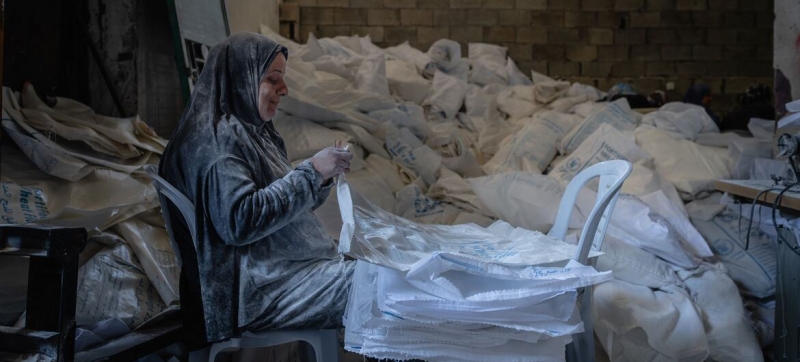

This Gaza woman sews bags and awnings from wheat flour sacks. She works and receives a salary as part of a project of the UN World Food Program (WFP). Living in the rubble: Gaza women struggle to feed their families amid humanitarian crisis Humanitarian aid
The war in the Gaza Strip has resulted in unprecedented losses for the female population of the region. More than 38,000 women and girls have been killed in Israeli airstrikes and ground operations since the fighting began following Hamas attacks in October 2023, according to UN Women data released Friday.
Tens of thousands of dead and wounded
Speaking to reporters in Geneva, agency spokeswoman Sophia Callthorpe cited frightening statistics: on average, the conflict claimed the lives of at least 47 women and girls per day.
“Behind every number on this list is someone’s mother, daughter, sister or friend,” Callthorpe said. She also noted that civilians continued to die in recent months, despite a formal ceasefire agreement between Hamas militants and the Israel Defense Forces.
About 11 thousand women and girls were wounded and injured, many of them disabled.
UN Women emphasizes that the real number of victims is most likely much higher, since many bodies still remain under the rubble. According to Gaza health authorities, total Palestinian casualties since October 2023 have exceeded 72,315 dead and 172,137 wounded.
Life in the rubble
The war provoked a protracted humanitarian crisis that radically changed the structure of society: now many families are headed by women who have to cope with all the difficulties alone. At the same time, the conditions for restoring normal life in the sector are lacking, and the population is not receiving the assistance it needs.
“Having lost their husbands, they are forced to support their families without income, support, or access to basic services,” Callthrop said.
Six months after the ceasefire came into effect, the situation of women and girls remains critical. The situation is exacerbated by the complete collapse of social infrastructure.
Callthorpe spoke of severe shortages of basic necessities, including hygiene products and reproductive health services. She shared memories of her November trip to the Gaza Strip, where she met two women who had to give birth on the street – due to the lack of transport, they simply could not be taken to the few surviving hospitals. rights. The organization emphasizes that humanitarian operations need to be expanded. And the interests of women and girls must be at the center of all peacebuilding and reconstruction efforts in Gaza.
Despite the dire conditions, the agency continues to work directly in the sector, working with local women’s organizations. Its staff is trying to provide victims with the help they need and ensure that women’s voices are taken into account in decisions about rebuilding the enclave.