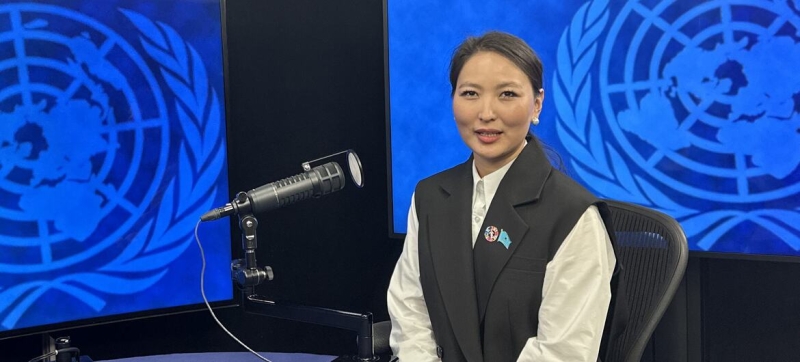

Guliskhan Nakhbaeva, Director of the Research Center “Youth” of the Ministry of Culture and Information of the Republic of Kazakhstan. INTERVIEW | From volunteering to AI: Kazakhstan promotes youth agenda at the UN Culture and Education
Director of the Research Center “Youth” of the Ministry of Culture and Information of the Republic of Kazakhstan Guliskhan Nakhbaeva is a member of the national delegation of Kazakhstan that arrived at the UN headquarters to participate in the Youth Forum of the Economic and Social Council (ECOSOC). According to her, the meeting brought together leaders, activists and experts from around the world and allowed not only to present the country’s achievements, but also to establish new connections. “The youth forum brought together a huge number of leaders and talents from all over the world, and we are pleased to be part of this event,” she noted.
The Kazakhstan delegation included ten people – representatives of public and youth organizations working with different groups of youth. The center, which is headed by Nakhbayeva, is engaged in systemic research: conducts sociological surveys, prepares analytical reports and advises government agencies on youth policy issues. This approach allows us to form decisions based on data and position Kazakhstan on the world stage as a dynamically developing country with a young population and growing potential.
Nakhbaeva named the development of the volunteer movement as one of the examples of the country’s successful policy. At the initiative of President Kassym-Jomart Tokayev, 2026 was declared the Year of Volunteering. This topic, she said, has aroused interest at the UN. Thus, during the forum, representatives of Kazakhstan have already discussed the prospects for cooperation with Assistant Secretary General for Youth Affairs Felipe Paulier, who expressed his readiness to more actively involve Central Asia in global projects.
Special attention in the conversation was paid to the demographic situation. At a time when many countries are facing declining birth rates, Kazakhstan, on the contrary, is demonstrating steady population growth. “There remains a tendency among young people to have two, three or more children, and this is considered the norm,” Nakhbaeva noted. At the same time, she emphasized that the demographic picture in the country is heterogeneous: the southern regions traditionally have a higher birth rate, while in the north the figures are significantly lower. The expert attributes such positive dynamics to a combination of state policy and cultural traditions: “This is a mixture of properly structured state policy and traditional roots,” said Nakhbaeva.
According to forecasts, by 2040 the number of youth in Kazakhstan could reach eight million people. Already today there are about 5.8 million young people in the country. At the same time, expanding the age category of youth from 14-29 to 14-35 years old allowed more citizens to receive government support and more actively participate in public life.
Against this background, the issue of employment of Kazakhstani youth is of particular importance. According to Nakhbaeva, the unemployment rate among young people is about 3.1 percent. “If we compare it with last year, when the figure was 3.2 percent, we see positive dynamics,” she noted. At the same time, according to her, a certain level of unemployment is natural, including due to the widespread practice of “gap year” among young people – a break from study or work to rethink life goals.
According to the center’s research, over the past ten years, the value orientations of Kazakhstani youth have remained relatively stable: in first place – family, followed by health, education and professional development.
Along with this, the forum discussed the impact of artificial intelligence on modern society. In Kazakhstan, artificial intelligence is viewed not as a threat, but as a tool for development. “Artificial intelligence will not replace people. People will be replaced by people who have mastered the skills of digital technologies,” says Nakhbaeva.
This is why the country is relying on the development of digital competencies and artificial intelligence. Kazakhstan strives to become one of the regional leaders in this area. The country has already created IT hubs that bring together young professionals and startups, some of which are entering international markets. In parallel with this, institutional conditions are being created: for example, 2026 has been declared the Year of Digitalization and Artificial Intelligence, and the relevant ministry has been tasked with accelerating the transformation of key industries.
However, along with technological development, social challenges remain. There are still significant regional disparities in the country, including in access to education and opportunities for girls. Government programs and civil society initiatives are aimed at making this environment more inclusive, but the process remains uneven.
Participation in the ECOSOC forum, Nakhbaeva emphasized, was an important step for the Kazakh delegation towards strengthening international cooperation. “We share our practical experience and want to strengthen communications with other countries,” she said. According to Nakhbaeva, it is the exchange of knowledge and joint initiatives that will help youth around the world better prepare for the challenges of the future.