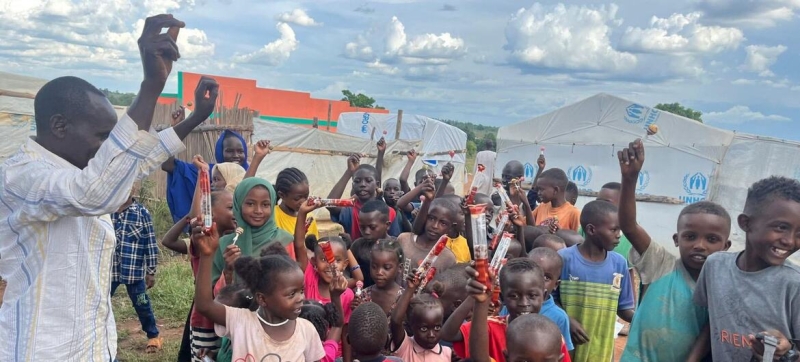

Sudanese refugee camp in Uganda. Report: How refugees from Sudan are building a new life in Uganda Abdelmonem Makki Refugees and migrants
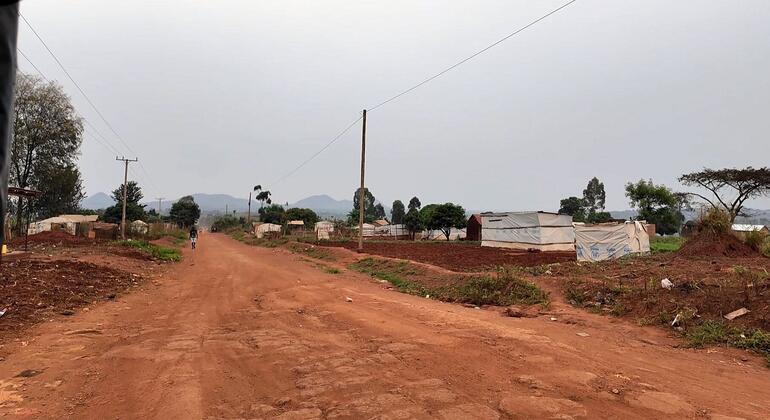
Tents are scattered along the dusty roads that cross a field on the outskirts of the Ugandan town of Bweyale – this is the Kriandongo camp, where Sudanese who fled their homes to escape the war found refuge.
Here they build a new life, trying to leave the bitterness of previous losses behind. Since war broke out in Sudan in April 2023, nearly 600,000 Sudanese refugees have arrived at the camp, many after a grueling, multi-day journey that took them through several countries. They had to leave almost all their property in their old life, so they had to start practically from scratch.
Kriandongo, located about 275 kilometers from Kampala, the capital of Uganda, hosts not only Sudanese but also refugees from South Sudan, Burundi, Kenya, the Democratic Republic of Congo and Rwanda. Many of those who have found a roof over their heads here are united by the bitter experience of violence.
Refugee with Master’s Degree
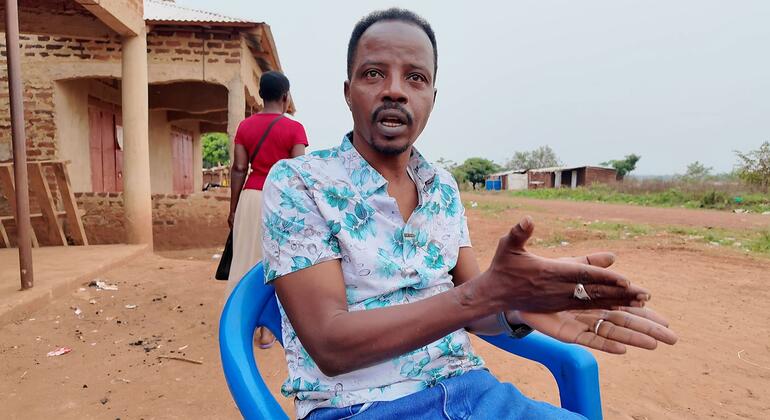
Hussein Hashim Taiman never thought he would call a ramshackle tent home. The civil engineer with a master’s degree worked for many years in the joint African Union-UN mission in Darfur. Today he lives in a camp in Uganda and leads the local community of Sudanese refugees.
Hussein left his native Sudan in May 2023. To reach Uganda, he had to travel through South Sudan, overcoming many obstacles and facing the risk of further violence. Many of his friends in misfortune followed this ill-fated route.
“When you want to complain about life, you remember that someone else’s grief can be greater than yours, and you try to forget about your own in order to alleviate someone else’s,” he shared. “We draw strength from leaning on each other.” Sometimes we get together and talk about the past. Now I live in a tent – that’s what war does.”
The situation did not improve over time as many had hoped. There is less help, and tents designed for living for six months, after more than three years, still serve as permanent housing for refugees.Hussein warns that the future of an entire generation is at stake, and calls on the UN and international community to pay more attention to Sudanese refugees in Uganda.
Food is a matter of life and death
In these difficult conditions, people are taking initiative. Organizing community kitchens is one of the most successful undertakings. Today there are already 20 such kitchens in the camp. They help fight hunger and strengthen social ties among Sudanese.
Mutasim Mohamed Ahmed, originally from Nyala, used to be a trader, traveling between Sudan, China and Dubai. The war destroyed his life, and in 2023 he arrived in Uganda. He is now active in the community kitchens.
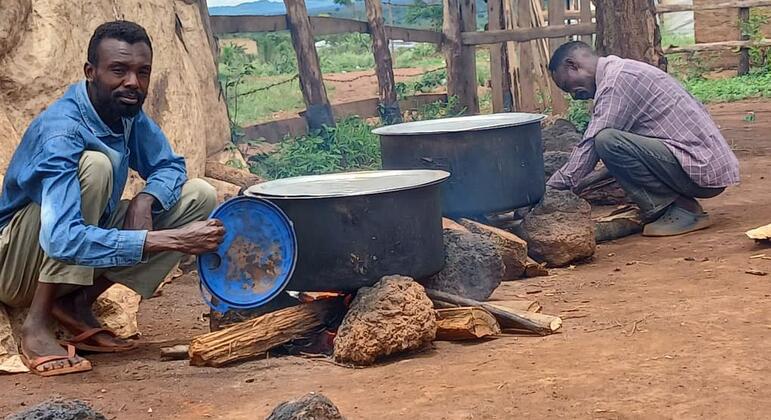
“Our kitchens came into being after the World Food Program forced food ration cuts,” he says. “We saw that people are malnourished, dying of hunger, women are not able to bear a child.”
This initiative changed Ahmed: “Working in the kitchen taught me to be a human being. If you don’t have humanity, you cannot empathize with the grief of others. Today I feel for my fellow countrymen, they are my flesh and blood.”
“We stayed alive to help others.”
Dr. Widad Makki lives in Kampala, but regularly visits the Kriandongo camp to help others. She is a former university teacher and director of the Khartoum State Department of Special Education.
Widad left her home due to the outbreak of violence: “It was difficult to lead the children through gunfire, smoke, burning cars and bodies in the streets. I asked them to turn away so they wouldn’t see the horror around them.”
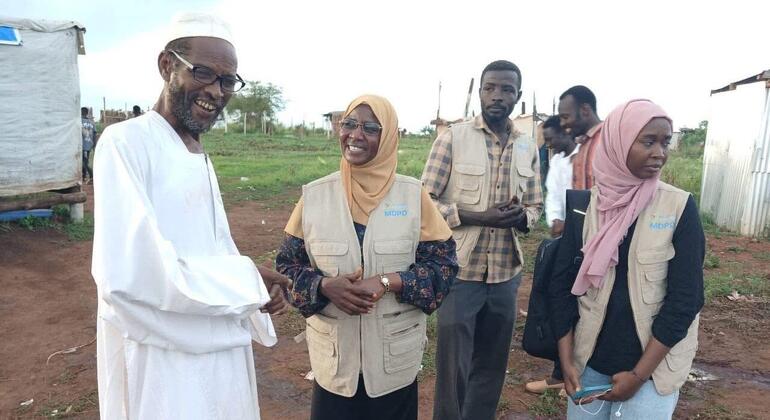
Now living in Kampala, she continues to actively help the camp, supporting community kitchens and providing food to refugees. “We survived and made it to Uganda, and now we are helping our brothers and sisters,” she says.
But she herself is having a hard time. “Our biggest fear is that the war will drag on,” she admits. “There are so many problems here: education, rent, expenses, no income, no work. We dream every day that the war will end so that we can return home.”
Refugee doctors continue to work
In Kampala, some Sudanese managed to get a job in their specialty. Dr. Abdul Jabbar Ahmed Adam sees patients at a local hospital. Before the war, he worked as a gastroenterologist in his native Khartoum, and now his skills and knowledge were useful in Uganda.
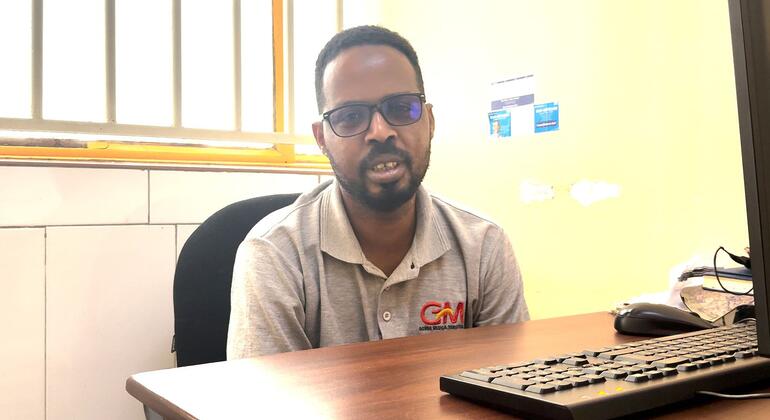
“Uganda received us warmly. There is good work here – and there is no discrimination. We don’t feel like strangers,” he said. Many Sudanese doctors continue to practice, some have opened their own clinics.
“Uganda has good hospitals but lacks staff. The Sudanese doctors were very helpful,” he added. “Not everyone who comes here lives off aid. There are many among us who have the skills needed here.”
Hotel White Heart
Ibrahim Zakaria Yahya settled in Bwiala long before the last wave of refugees. He left South Darfur in 2007 and moved to Uganda in 2008. The first years were very difficult for him, but over time life got better. Ibrahim tried to engage in trade, agriculture, real estate and eventually created his own business.
Three years ago he opened the White Heart Hotel. “I chose this name as a call to clear hearts and consciences, to overcome the bitterness that the Sudanese have gone through,” he explains. “We want people to come here with a pure heart.” We must learn to live together so that one day we can return home.”
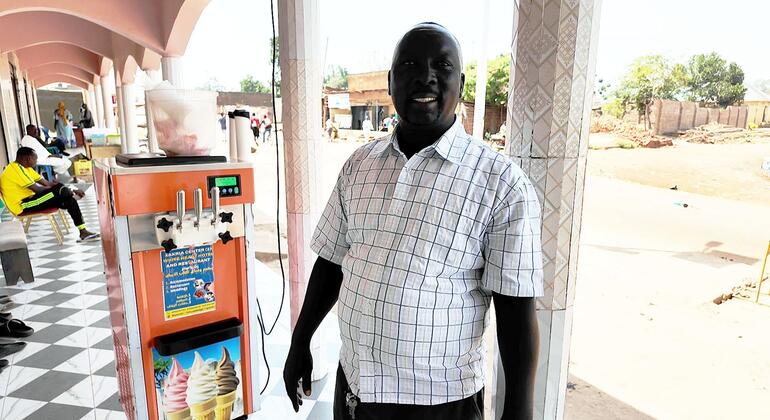
Ibrahim is grateful to Uganda: “I was received with open arms. I don’t feel like a refugee – only on paper. I have the same rights as Ugandan citizens, I even have land that Sudan didn’t have.” Nevertheless, he misses home and hopes for a quick peace.
For those who cannot yet get out of the camp, the main thing is hope: it helps people not to lose heart when the future is uncertain, and the present lacks the most necessary things.