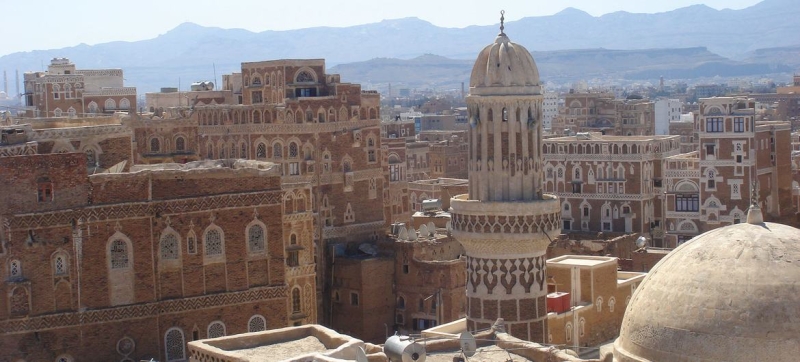

© UNESCO/M. Gropa The capital of Yemen is Sanaa. Yemen: risk of new escalation after incidents with Iranian flights Peace and Security
Recent events in Yemen have demonstrated that there is no alternative to a comprehensive, Yemeni-led political process. UN Assistant Secretary-General for the Middle East, Asia and the Pacific Khaled Khiari stated this at a meeting of the Security Council convened on Monday. According to him, a long-term resolution of the conflict is possible only through negotiations and the achievement of a political agreement through UN mediation.
The reason for discussion in the Security Council was recent incidents related to air traffic between Iran and the Houthi-controlled territories of Yemen. According to reports, on July 3, an Iranian plane flew from Tehran to Sanaa International Airport and back, taking a Houthi delegation to the funeral of Iran’s Supreme Leader. In a letter to the UN Security Council dated July 6 this year, the Yemeni government called the flight a violation of its airspace and the country’s sovereignty.
Another Iranian plane carrying a Houthi delegation returning from Tehran reportedly landed at Hodeidah airport on July 13. This was preceded by reports of airstrikes at Sanaa International Airport. The Houthis blamed the attack on Saudi Arabia, while the Yemeni government said the strikes targeted the runway to prevent an Iranian plane from landing.
Following these events, the Yemeni government again warned Tehran against unauthorized flights. The Houthis, in turn, announced the end of the period of de-escalation in relations with Saudi Arabia and launched ballistic missiles in its direction, which were intercepted.
Khiari recalled that the parties had previously managed to conclude practical agreements. In particular, the UN-brokered truce in April 2022 allowed the resumption of commercial flights between Sana’a and Amman. The UN Deputy Secretary General emphasized that such results become possible with political will, willingness to compromise and support from the international community.
Khiari called on all parties to refrain from unilateral actions that could deepen the rift and lead to renewed hostilities. In addition, he demanded the immediate and unconditional release of 73 UN staff, as well as representatives of non-governmental organizations, civil society and diplomatic missions who continue to be held by the Houthis. Khiari stressed that the United Nations remains committed to supporting the political process aimed at ending the decades-long conflict and preserving Yemen’s sovereignty and territorial integrity.
Deteriorating humanitarian situation
Speaking on behalf of UN Under-Secretary-General for Humanitarian Affairs Tom Fletcher, Acting Assistant Secretary-General Indrika Ratwatte said the humanitarian crisis in Yemen is deepening at a time when the international community’s ability to provide assistance has been sharply reduced. According to him, the country is simultaneously facing increased food insecurity, the expected impacts of the El Niño climate phenomenon on agriculture and unprecedented cuts in humanitarian funding.
More than 18 million Yemenis are food insecure, according to the UN. Malnutrition continues to threaten the lives of millions of children, pregnant women and nursing mothers. At the same time, the population faces economic decline, mass displacement, disease outbreaks and the breakdown of basic public services.
The state of the health care system is of particular concern to the UN. Chronic underfunding has forced the closure of 450 health facilities in Yemen over the past year, including 76 hospitals. Many families are forced to choose between buying food and medicine, as well as between sending their children to school or work.
A special concern, according to the speaker, is the closure of Sanaa International Airport: residents of areas controlled by the Houthis have lost the ability to freely travel abroad to receive medical care. Many patients now have to make long and potentially dangerous journeys to Aden to fly out.
“The people of Yemen have shown incredible resilience, and they deserve more – the opportunity to rebuild the country and live in decent conditions,” concluded Indrika Ratwatte.