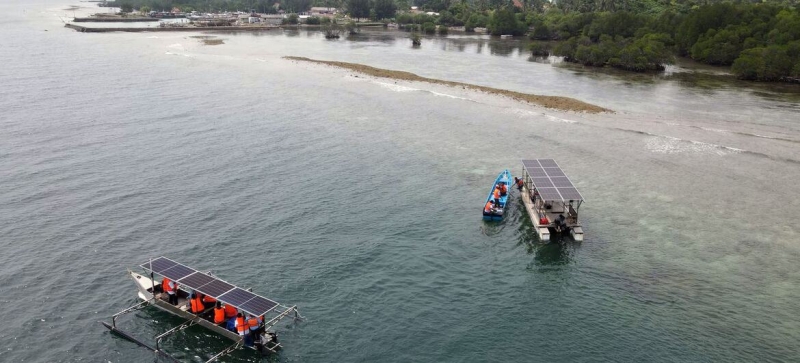

© UNDP Youth take part in solar operator training in Indonesia. UN Secretary General in London: polluting industries must finance climate action Climate and Environment
Climate change is happening faster than humanity can adapt its systems, infrastructure and institutions to it. This was stated by UN Secretary-General Antonio Guterres, speaking at the Forum on Financing for Climate and Development in London.
On the final day of his visit to the UK capital for Climate Action Week, the UN chief stressed that adapting to climate change is no longer preparation for a distant future.
“It’s about managing risk in real time, as the sweltering heat wave currently gripping London and many other parts of the world makes clear,” he said. he.
World Meteorological Organization data confirms that the past 11 years have been the hottest on record, and scientists expect average global temperatures to exceed the 1.5 degree Celsius threshold in the coming years, the Secretary-General said.
Risks to people and the economy
Guterres warned that even if temperatures can subsequently be reduced, some of the damage may be irreversible. He cited as examples the degradation of coral reefs on which at least 300 million people depend, the accelerated melting of glaciers in Greenland and West Antarctica, and the risk of irreversible changes in the Amazon ecosystem. secretary.
“Polluters must pay”
The UN chief noted that adaptation efforts remain chronically underfunded, and the most vulnerable countries face the greatest financial barriers, despite their actions having minimal climate impact.
He called on developed countries to triple adaptation funding, replenish climate funds and expand grant support, especially for small island developing states and least developed countries.
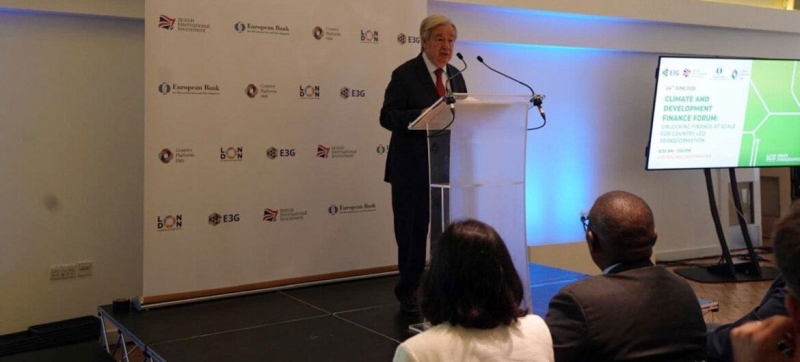
UN/F. Mondu UN Secretary-General Antonio Guterres speaks at the Forum on Climate Finance and Development in London.
Guterres also suggested looking for new sources of funding, including special levies on high-emitting industries.
“The companies creating climate chaos cannot continue to profit from destruction while vulnerable countries struggle to cope with the consequences. Polluters must pay,” he emphasized.
Methane is a major “super pollutant”
Speaking at a reception dedicated to combating so-called super pollutants, the Secretary-General said that the world is already moving towards exceeding the 1.5 degree threshold and the main challenge now is to make this period as short and safe as possible.
“This is impossible without drastic cuts in emissions now and an accelerated phase-out of fossil fuels now,” he said.
According to Guterres, nearly half of global warming is due to super pollutants—powerful greenhouse gases, of which methane is prominent.
“Methane is a super-super pollutant,” the head said UN.
Although methane remains in the atmosphere for significantly less time than carbon dioxide, it is responsible for nearly a third of the magnitude of current global warming.
“Reducing methane emissions is the fastest way to slow down the warming of the planet,” the Secretary-General stressed.
Global call for action
In this regard, Guterres announced the need to intensify efforts as part of the global call to action to reduce methane emissions. The initiative addresses three major sources of emissions: agriculture, waste and the fossil fuel sector.
Particular attention is paid to the oil and gas industry. According to data provided by the Secretary-General, 167 billion cubic meters of gas were flared in 2025 – the highest figure in the last six years and a volume comparable to the annual consumption of the entire African continent. costs.
“The era of voluntary action is over. The time has come for clear rules and standards set by governments and implemented by industry,” Guterres said.
He recalled that the international community has already been able to address similar environmental issues, including restoring the ozone layer and eliminating leaded gasoline.
“The world can—and should—do the same on methane pollution,” he stressed. head of the UN.