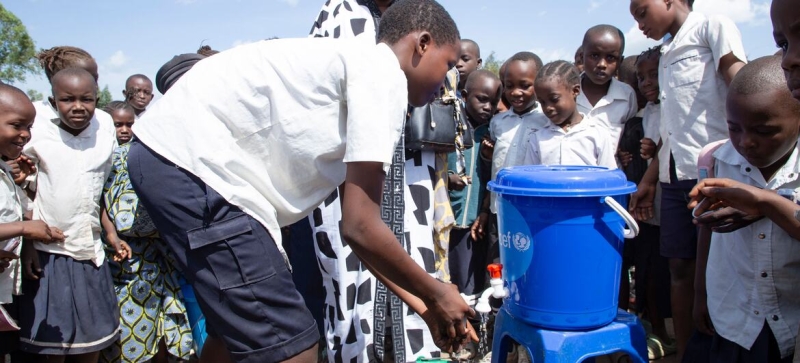

© UNICEF/K. Mbikayi In eastern Democratic Republic of Congo, schoolchildren wash their hands as part of hygiene measures aimed at preventing the spread of the Ebola virus. UN report: Progress on SDGs has improved lives for billions, but world risks missing 2030 target Sustainable Development Goals
A new UN report on the Sustainable Development Goals (SDGs) documents the “double reality” of today’s world: sustainable investment and international cooperation have already improved the lives of billions of people, but the pace of change remains insufficient, so governments must urgently accelerate action if they are to meet their own promises by 2030.
The authors of the report, published Tuesday, acknowledge the scale of the political and financial challenges that stand in the way of achieving the 17 Sustainable Development Goals. All 193 UN member states adopted the SDGs in 2015 as a call to action for global peace and prosperity. Since then, the annual review of progress has become a central part of the global agenda.
The publication of the report coincides with the opening of the High-Level Political Forum on Sustainable Development, which started on Tuesday in New York and will last until July 15. The Forum serves as the UN’s main platform for assessing the implementation of the SDGs and discussing ways to accelerate progress.
Progress is too slow
The report’s authors remind us that the world has made impressive progress over the past ten years. Nearly a billion people gained access to safe drinking water and 1.2 billion gained access to safe sanitation. The number of new HIV cases has dropped by 30 percent, electricity is now available to 92 percent of the world’s population, and the Internet to 74 percent. More than half of the world’s inhabitants are covered by social protection systems. These achievements show that global efforts work when they are backed by political will and long-term investment.
At the same time, the overall conclusion of the report sounds alarming: progress is too slow. One in 10 people live in extreme poverty, 2.3 billion face food insecurity, and maternal mortality remains nearly three times above target.
Global temperatures reached 1.43 degrees above pre-industrial levels in 2025, providing another signal that climate targets are being rushed are slipping away.
Nearly 273 million children and young people are out of school, and the number of refugees has more than doubled in a decade. Of the 139 goals for which data is available, only a third are making progress. In almost half of the cases, progress is too slow, and in 15 percent the situation has even worsened compared to 2015.
Disproportional pressure
The reasons for the lag are well known: increasing conflicts, climate shocks, slowing economic growth, rising debt burdens and record cuts in official aid to areas of development. All of this disproportionately impacts the most vulnerable countries and populations. SDG.
Opening of the Political Forum on SDGs
Meanwhile, a busy program of the High-Level Political Forum on Sustainable Development began in New York. Ministers, heads of UN agencies, representatives of civil society, business and youth organizations gathered to discuss how to accelerate achievement of the goals.
Opening the forum, Economic and Social Council (ECOSOC) President Lok Bahadur Thapa noted growing inequality and called on countries to “work differently” to achieve the goals by 2030.
“The 2030 Agenda remains our shared promise to our contemporaries, the planet and future generations,” he said. – History will not ask whether our challenges were difficult. She will ask whether we responded to them in a worthy manner.”
History will not ask whether our challenges were difficult. She will ask if we answered them in a decent manner
From July 13 to 16, the ministerial segment of the forum will be held, which will end with the adoption of a declaration. The latest draft document includes commitments to increase investment in the SDGs and develop systems for managing transformative technologies, including artificial intelligence.
In last year’s declaration, countries agreed to strengthen health systems, reduce maternal and child mortality, expand digital inclusion and increase public funding for the SDGs.
Five Key directions
This year the forum is focused on five key goals: clean water and sanitation, affordable energy, innovation and infrastructure, sustainable cities and global partnerships. Countries submit voluntary national reviews, which serve as an important accountability tool. This year, 36 countries will submit their reports, from Albania to Uruguay.
Despite the challenges, senior UN officials stress that the SDGs remain a vital guide for peace, justice and a sustainable future.
Under-Secretary-General for Economic and Social Affairs Li Junhua noted that decisive action in the areas of debt sustainability, development finance, food and water systems, basic services and inequality reduction can keep the goals within reach. “The focus must shift from promises to implementation,” he emphasized.