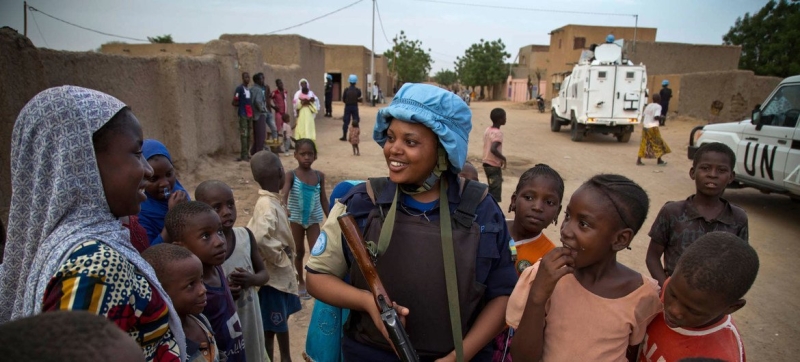

Photo UN/M. Dormino A Rwandan police officer serving with the UN peacekeeping mission in Mali talks to local residents. (archive) UN Police Chiefs Summit opens in New York Peace and Security
On Tuesday, the fifth Summit of Chiefs of Police of UN member states began at the UN headquarters in New York. The two-day forum brought together ministers, police chiefs and representatives of law enforcement organizations to discuss how UN police and national police authorities can strengthen cooperation in addressing global security challenges.
“The purpose of this summit is to discuss how the Organization can continue to effectively support UN police officers involved in peacekeeping operations and develop UN policing in response to today’s security challenges,” said UN Under-Secretary-General for Peace Operations Jean-Pierre Lacroix.
Lacroix stressed that long-term efforts to maintain peace are impossible without effective policing, strong international cooperation and support for police officers who serve every day in the most difficult conditions.
The impact of funding cuts
Lacroix also noted that recent funding cuts, caused by some Member States not paying their assessed contributions in full, had already “affected the most important areas of work.” He explained that the approved budgets remain in force, however, due to a lack of funds, it is impossible to implement them in full. As a result, expenses had to be reduced by twenty-five percent, which means fewer patrols in high-risk areas, slower responses to new crises, and cuts to training and support programs for local police, who will be left to provide security after peacekeeping missions end.
The Foundation of Sustainable Peace
Despite financial constraints, policing remains a key element of sustainable peace. This was stated by UN Police Advisor Faisal Shahkar.
Unlike military peacekeepers, UN police officers work directly with local communities. They help strengthen the capacity of national police services, restore public confidence in law enforcement and support the functioning of the criminal justice system in post-conflict periods. Their activities cover a wide range of tasks – from fighting organized crime and cybercrime to combating sexual and gender-based violence.
The results of this work are already visible in many areas where peacekeeping operations are deployed. In the Democratic Republic of the Congo, for example, UN police are involved in the protection of civilians by conducting joint patrols and supporting local police in high-risk areas. In the Central African Republic, they help authorities ensure security during the preparation and conduct of elections. And in the Abyei Region, the development of community policing, along with mediation and dialogue, has helped reduce tensions between communities and increase women’s participation in local security.According to Shahkar, the focus of the current summit is the future of UN policing, including the introduction of new technologies, strengthening partnerships and improving the effectiveness of countering transnational threats. The expert emphasized that for people living in conflict, peace is not only the cessation of armed violence.
“For people affected by conflict, peace is not only the absence of shots. It is also an opportunity to return home, send children to school, seek justice and trust the institutions designed to protect them,” he said.
The Growing Role of UN Police
UN police were first deployed to participate in UN peacekeeping operations in the Congo in 1960. At the request of the newly independent Republic of the Congo, they supported peacekeeping forces after Belgium sent troops into the country without government consent to quell post-independence unrest.
321 police officers have died in the line of duty since 1948 UN.
As the need for international police support has grown, UN police personnel have become involved in an increasing number of peacekeeping operations in regions from Cambodia to El Salvador. The maximum number of police forces was recorded in 2010, when 14,669 police officers served in UN peacekeeping missions.