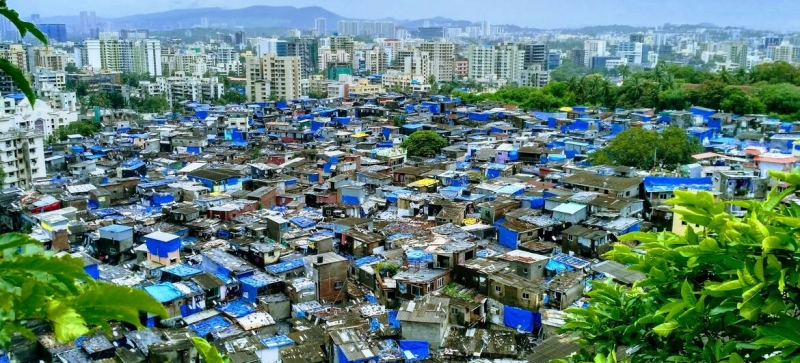

© Unsplash/A. Solkar Densely populated slum in Mumbai, India. UN introduces new approach to measuring economic progress Economic Development
Amid sustained growth in the world’s gross domestic product (GDP) and rising public discontent with political and economic systems, the United Nations unveiled Thursday a new approach to measuring progress.
The Counting what Counts report, released after a year of consultation, offers a global roadmap for moving toward more comprehensive indicators of development that reflect the real well-being of people and the state of the planet.
For decades, gross domestic product has remained the main benchmark for measuring the economic success of nations. However, as the document emphasizes, this indicator has long ceased to correspond to the complexity of modern challenges.
“In simple terms,” the report’s authors point out, “GDP is the sum of everything that a country produces and sells, but economists have known for many years that this indicator does not paint the full picture.”
The GDP calculation does not take into account important aspects such as unpaid care work for children or the elderly, levels of inequality, environmental costs and depletion of natural resources. All this leads to governments focusing on goals that do not reflect the real quality of life, the report says.
“During my tenure as Secretary-General, the size of the global economy, adjusted for inflation, grew by more than 50 percent,” recalled UN chief Antonio Guterres, commenting on the publication of the report. “However, our world has not seen commensurate improvements in many areas that benefit humanity. Healthcare. Biodiversity. Job creation. Human rights. Equality. And even peace – after all, the number of conflicts has now reached a level not seen since the Second World War.”
© ADB/A. Javellana
“A Compass for People and Planet”
To remedy the situation, the Secretary-General created a High-Level Expert Group a year ago. The result of her work was a report that its authors call “a compass for people and the planet.”
The document does not reject GDP as a tool for measuring economic activity, but it does contain a warning from the man who created it: Nobel laureate Simon Kuznets noted back in the mid-20th century that GDP by itself is insufficient to assess the well-being of a nation.
“Dashboard progress”
The central element of the system proposed by the experts is the “progress dashboard” – a set of indicators covering the fundamental principles of sustainable development, the current well-being of the population, the level of equality and inclusion, as well as the resilience and ability of society to withstand crises. This approach, according to experts, will allow states to make decisions that take into account not only economic growth, but also social, environmental and humanitarian aspects.
“In a world of deep inequality, GDP does not take into account whether income goes to billionaires or the poor, whether it goes to fight hunger, to pay for health care or to overcome poverty,” the UN Secretary-General noted.
The report offers concrete steps to implement a new system. One of the key areas will be the creation of national “progress dashboards”, tailored to the priorities of each country and built into public policy development processes. In addition, it is proposed to create a global UN reporting mechanism that will annually track countries’ progress under the new system and link it with monitoring of the Sustainable Development Goals.
“Take into account what really matters”
The authors emphasize that the transition to the new system is impossible without the participation of academia, civil society, the private sector and the media. Their role is not only to support research, but also to generate public demand for more accurate and equitable development indicators. As GDP figures continue to rise, so too does deep disillusionment with existing systems of governance, the document notes. That’s why, experts say, it’s time to “count what really matters.”