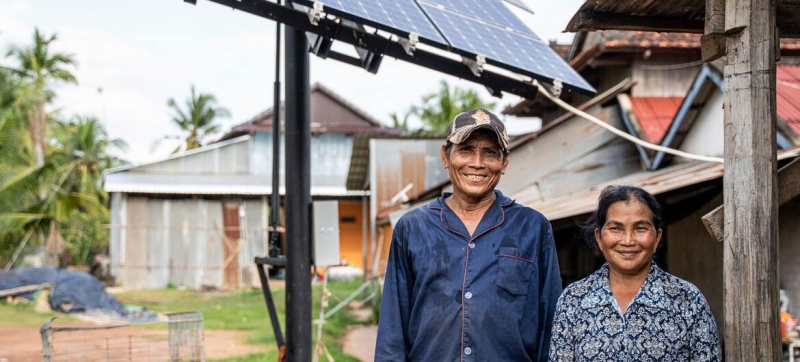

© UNDP New solar panel in a village in Cambodia. UN chief calls for $4 trillion a year to be mobilized to achieve Sustainable Development Goals by 2030 Sustainable Development Goals
A little more than ten years after the adoption of the 2030 Agenda, the world is beginning to move through the most difficult part of the road to achieving the Sustainable Development Goals (SDGs). said UN Secretary-General Antonio Guterres, opening Monday the ministerial segment of the High-Level Political Forum (HLPF) in New York.
According to him, over the past decade, noticeable progress has been achieved: infant and maternal mortality rates have decreased, access to social protection, clean drinking water, sanitation, electricity and the Internet has expanded. Harmful practices such as child marriage are being eradicated. The use of renewable energy sources has increased significantly. Guterres noted that countries have already submitted 401 voluntary national reviews of progress in implementing the SDGs, and a further 36 will be presented during the current session. Meanwhile, the UN chief acknowledged that serious obstacles have arisen in recent years.
“Conflicts are multiplying. Inequality is leading to a concentration of power at the very top, while millions of people are trapped in protracted cycles of suffering, instability and forced displacement,” he said he.
The UN chief also stressed that the conflict in the Middle East – in addition to the obvious consequences for civilians and civilian infrastructure – has led to sharp increases in fuel, fertilizer and food prices, and has also disrupted global trade, transport links and tourism. He called for full respect of the ceasefires in Gaza, Lebanon and the Persian Gulf, and for the exercise of rights and freedoms of navigation in accordance with international law.
Assessing progress
The Secretary-General recalled that of the 139 SDG targets, only 36 percent are on track or showing moderate progress, and 15 percent are on track has worsened.
“Our mission is clear: to accelerate progress—on a larger scale and at a faster pace,” he said.
This year the forum focuses on five Goals: clean water and sanitation (SDG-6), affordable and clean energy (SDG-7), industry, innovation and infrastructure (SDG-9), sustainable cities and human settlements (SDG-11), as well as partnerships for sustainable development (SDG-17). people still lack safe water supplies and 3.5 billion still lack adequate sanitation. He warned that fresh water is being used up faster than it is replenished, and this is already leading to irreversible consequences. According to him, the upcoming UN Water Conference will help mobilize collective action in this area.
Read also:
INTERVIEW | Uzbekistan shares its experience: how to cope with the water crisis in one of the driest regions of the planet
The Secretary-General also said that renewables have become the cheapest and fastest scalable source of new electricity in most countries, and last year wind and solar power met all of the growth in global electricity demand for the first time. But Guterres said four out of every five dollars spent on clean energy came from developed economies and China, while Africa receives only 2 percent of global investment in this area, despite the continent having 60 percent of the world’s best solar potential.
Artificial Intelligence and Cities
The UN chief pointed out the great opportunities that digital technologies, including artificial intelligence, offer for development, emphasizing that innovation should serve humanity, and not vice versa. He recalled that in February he called for the creation of a $3 billion global fund for this purpose, and earlier this month the first Global Dialogue on AI Governance was held in Geneva.
The Secretary-General also called for action to overcome the global housing crisis. An opportunity to advance this work, he said, would be this year’s midterm review of the New Urban Agenda.
Fiscal Gap
“We need urgent action to close the SDG funding gap, which now stands at more than $4 trillion a year,” he said he.
Developing countries, according to Guterres, face borrowing costs that are often several times higher than those of developed economies. Many are spending more on debt servicing than on investing in their own people, and foreign development assistance has seen its sharpest decline in modern history.
The future guide, according to the Secretary-General, is the Seville Agreement, under which countries agreed to mobilize resources more effectively – including combating illicit financial flows – and direct them to where the need is greatest.
He called on multilateral development banks to increase their investment through expanded lending capabilities. Every dollar of public funds, he emphasized, should attract significantly more private investment. Guterres also called for accelerating the implementation of new debt management tools, including the Borrowers’ Platform launched this year, and increasing the participation of developing countries in reforming the global financial architecture. Despite the difficulties, Guterres said he remains hopeful: “Even in this era divided, multilateralism delivers.”
The Secretary-General called next year’s SDG Summit an important opportunity to mobilize the efforts needed to achieve the goals.
“Let us keep the vision of the 2030 Agenda alive. Let’s make sure these last years [until 2030] are not wasted,” he concluded.