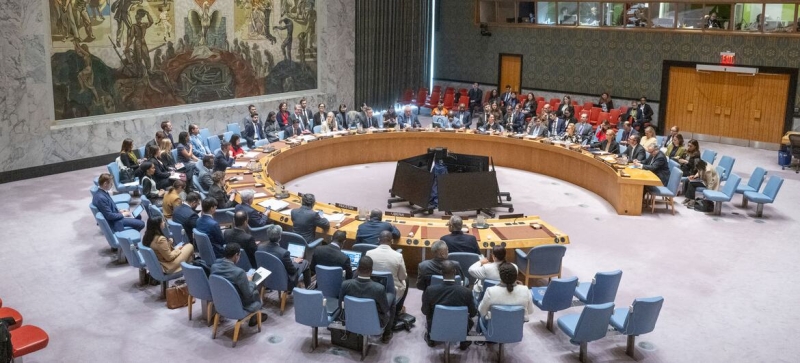

UN Photo/Eskinder Debebe Security Council meeting. Security Council: UN chief calls for immediate lifting of blockade of Strait of Hormuz Peace and Security
Maritime security issues affect every port and every country, including even landlocked states. UN Secretary-General Antonio Guterres stated this at a meeting of the Security Council.
The high-level meeting on the topic “Safety and protection of maritime waterways” was convened at the initiative of Bahrain, which holds the presidency of the Security Council in April. Representatives from dozens of countries are taking part in the meeting.The UN chief stressed that the crisis in the Strait of Hormuz directly affects the lives of ordinary people, leading to fuel and food shortages. The humanitarian sector is particularly hard hit, as supply disruptions mean people in need around the world are unable to receive it. The situation is aggravated by the fact that the blockade of the strait coincided with the planting season, when fertilizers are needed, much of which came through the strait. Guterres.
The most difficult situation will be the least developed countries and small island states, which are most dependent on maritime imports and who are most difficult to cope with current problems.
“The ocean must be a zone of peace and cooperation”
The UN chief recalled that more than 20 thousand sailors and 2 thousand commercial ships are still unable to leave the strait. He stressed that civilian workers are not parties to a conflict and their rights and safety must be protected in all circumstances.
As a practical step, the Secretary-General called on States to support the emergency evacuation plan prepared by the International Maritime Organization (IMO).
He also called on parties to the conflict to open the strait and allow all passage through ships.
“The ocean should be a zone of peace and cooperation, not confrontation or coercion,” the UN chief said.
The Secretary-General confirmed the UN’s readiness to assist countries in finding common ground.
IMO head spoke about the plan evacuation of sailors
IMO Head Arsenio Dominguez, who addressed the audience via video link, spoke in detail about the plan for the evacuation of sailors from the Strait of Hormuz.
“In accordance with the decision of the IMO Council, I have begun to develop an evacuation mechanism using the existing traffic separation scheme for the safe evacuation of ships and seafarers from the conflict zone – provided that it is safe to do so,” Dominguez said. IMO.
“I would like to take this opportunity to ask States to: support the IMO plan to facilitate the evacuation of injured seafarers; “At the appropriate time, assist in eliminating any threats to merchant shipping in the Strait of Hormuz, including mines,” Dominguez said.
Expert: Measures taken are not enough
Testing before the Security Council, maritime security expert Nick Childs said the world’s waterways have reached the end of the day. a dangerous and unstable period.
Childs, a senior fellow for maritime security at the International Institute for Strategic Studies, noted that the international response to date has been insufficient and called for more coordinated and consistent engagement among countries.
He stressed that securing key shipping lanes will require approaches based on international norms, at the same time it is necessary to adapt to the changing situation.