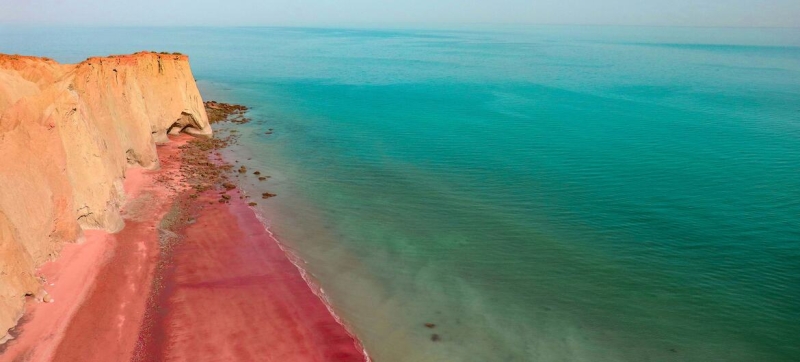

The Strait of Hormuz connects the Persian Gulf with the Gulf of Oman. INTERVIEW | Strait of Hormuz: UN prepares mechanism to prevent food crisis Peace and Security
The United Nations is developing an emergency mechanism to prevent a possible global food crisis amid disruptions to shipping in the Strait of Hormuz, one of the world’s key transport routes. This was stated by the Executive Director of the UN Office for Project Services, Jorge Moreira da Silva, in an interview with Reem Abase from the UN News Service.
According to him, the UN Secretary-General ordered the creation of an interdepartmental working group immediately after the aggravation of the situation in the region. It included representatives of the United Nations Conference on Trade and Development (UNCTAD), the International Maritime Organization (IMO), and the International Chamber of Commerce. The main challenge is to ensure an uninterrupted supply of fertilizers and the raw materials needed to produce them.
The threat to global food systems
The Strait of Hormuz plays a critical role in the global fertilizer trade, with about a third of all shipments passing through it. Shipping disruptions have already led to disruptions not only in the Gulf region, but also in global supply chains.
“We are talking not only about the fertilizers themselves, but also about the raw materials – urea, ammonia, sulfur, as well as liquefied gas. “All this is interconnected,” noted Moreira da Silva.
Countries that are already experiencing economic and humanitarian difficulties are particularly vulnerable. Among them are Sudan, Somalia, Mozambique, Kenya and Sri Lanka. These countries rely heavily on fertilizer imports from the region and are already facing the consequences of shortages.
The World Food Program estimates that further deterioration of the situation could push another 45 million people to the brink of famine.
Urgency is key factor
The fact that the crisis coincided with the planting season is of particular concern. In a number of African countries it has already begun and will end in May. If fertilizer supplies are not restored soon, this will directly affect the harvest and, as a result, food security.
“Diplomacy and agriculture live in different rhythms. We cannot wait until all political issues are resolved,” the head (UNOPS) emphasized.
According to him, if a political agreement is reached, the mechanism can be deployed in just seven days.
How it will work mechanism
The proposed system is based on the principle of building trust and transparency. It includes cargo registration, route coordination, monitoring, verification and reporting.
The UN already has experience in such operations – in particular, within the framework of the Black Sea Grain Initiative, the cargo verification mechanism for Yemen and humanitarian supplies to Gaza. The new mechanism will use a similar approach.
In this case, we are not talking about humanitarian, but about commercial supplies. However, their uninterrupted operation has direct humanitarian significance. “These are commercial vessels, but the goal is to prevent a humanitarian catastrophe,” noted Moreira da Silva.
Political will is more important than resources
The key condition for launching the mechanism remains the consent of states. According to the UN official, it is political will, not financial or technical resources, that is the main factor. “If a decision is made, resources will be available. There are already countries ready to support the initiative,” he said.
At the same time, negotiations are ongoing, and a final agreement has not yet been reached.
The role of the UN is neutrality and trust
The UN is seen as the optimal operator of such a mechanism due to its neutrality and experience. The organization is able to ensure transparency of processes and trust between the parties to the conflict.
“The main result of such a mechanism is trust. And in times of conflict, this is the most valuable resource,” Moreira da Silva emphasized.
He emphasized that the proposed mechanism in no way undermines or calls into question freedom of navigation. According to him, freedom of navigation remains an indisputable principle, and the Secretary-General, as well as himself, have repeatedly emphasized the need for its full restoration.
The main result of such a mechanism is trust. And in times of conflict, this is the most valuable resource
At the same time, the UN News Service interlocutor noted, in the context of ongoing negotiations, when this freedom is not yet fully ensured, the possibility of introducing a time-limited exclusive mechanism – exclusively for the export of fertilizers and related raw materials – should be considered. This will allow time for the planting season and thereby reduce risks to global food security.
He added that if the situation stabilizes and freedom of navigation is fully restored, the need for the mechanism will no longer be necessary. However, as long as risks remain, the UN is ready to act.
Otherwise, the Organization warns, the world may face a new wave of food crisis, the consequences of which will be especially acutely felt by the most vulnerable countries.