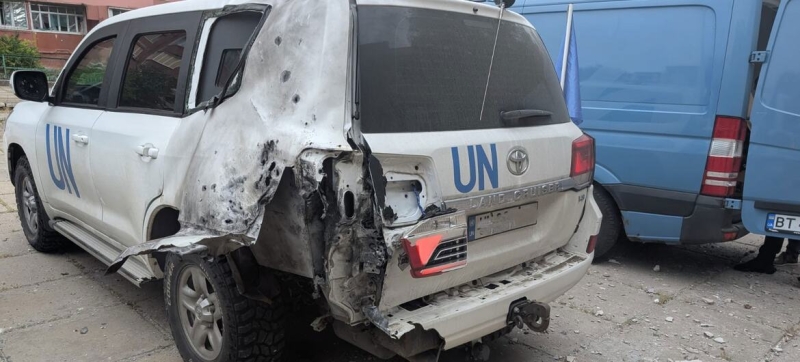

© UNDOB/A. Obukhov A UN vehicle was severely damaged in two drone strikes in Kherson, Ukraine (file photo). Deputy head of the UN following a trip to Ukraine: drones are changing the nature of war International Law
UN Emergency Relief Coordinator and Deputy Secretary General Tom Fletcher completed his trip to Ukraine today. Addressing reporters at the UN headquarters in New York via video link, Fletcher said he had spent the past two days in Kherson and described the city as one of the “ground zero” for the use of drones against civilian areas.
“I’m afraid it has become one of those places where you begin to really understand the dystopian reality that may be awaiting many of us, but for people here, as in many of the other crisis regions where we work – from Somalia and Sudan to Gaza and Lebanon – it is already everyday life,” Fletcher said.
His press conference was timed to coincide with World Humanitarian Day, which is celebrated on August 19, the anniversary of the 2003 Canal Hotel bombing in Baghdad. The attack killed 22 UN staff, including the Secretary-General’s Special Representative for Iraq, Sergio Vieira de Mello.
“This day was born out of tragedy…” Fletcher said. “However, tragedies like these continue to occur every day, and we see them increasingly triggered by a frightening marriage of technological ingenuity and modern warfare that affects civilians and humanitarian workers.”
According to the UN, in April of this year alone, 80 civilians in Ukraine were killed as a result of drone attacks. In just one week in May, four humanitarian convoys came under attack. In Russia, drone strikes also resulted in civilian deaths and damage to civilian infrastructure.
The UN emergency relief coordinator said that part of his Ukrainian route ran along the so-called “road of death” – from Nikolaev to Kherson. Some sections of this road – according to Fletcher, “long kilometers” – are protected from drones by a special mesh.
“I’ve been to a lot of places—and, you know, I’ve spent time in some very dangerous areas—but nowhere else has the conversation about drones been as prominent,” said the UN deputy chief of humanitarian affairs.
During his trip to Ukraine, Fletcher, in particular, spoke with victims, including those who were seriously injured and lost as a result of drone attacks limbs.
“The worst thing about this is that the operator of this drone knows exactly what he is doing. It flies a drone that circles around a fruit and vegetable vendor at a market or an aid worker delivering food and looks at them closely before delivering a strike that will kill or cripple them for life,” Fletcher said. world.
“From Sudan and Colombia to the Gaza Strip and Lebanon, low-cost armed drones are expanding the geography of conflicts, allowing them to kill at greater distances,” Fletcher said.
He said states need to respect international law. Fletcher also stressed that companies producing and supplying such weapons must “understand international humanitarian law, understand how their products are used, and understand what their duties and responsibilities are.”