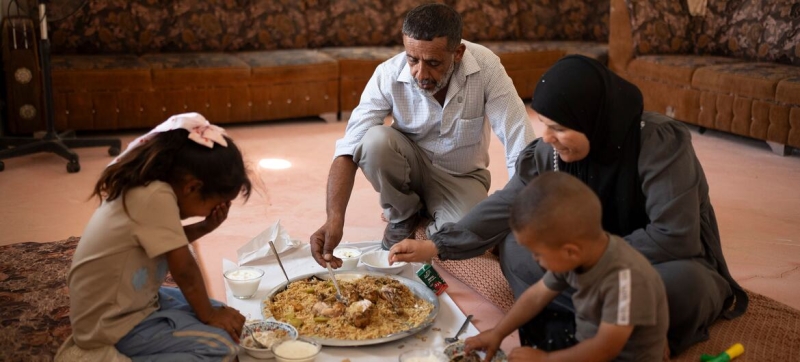

© WPP/X. Rutherford A family has lunch in the Bedouin settlement of Umm al-Khair in the West Bank. Funding shortfalls force WFP to cut aid in West Bank and Gaza Humanitarian aid
Due to severe funding shortfalls, the UN World Food Program (WFP) is forced to halve aid to families in the West Bank. This comes against the backdrop of rapidly growing humanitarian needs: they have more than doubled over the past two years.
“We are running out of resources, which means that starting today, about 200 thousand people will lose life-saving support,” said WFP representative in Palestine Sean Hughes.
According to him, a large-scale increase in food insecurity was a direct consequence of escalating settlement violence, Israeli military operations, as well as house demolitions, severe restrictions on movement and mass displacement of residents.
On the brink of survival
At the same time, the region is experiencing a severe economic crisis, brought people to the brink of survival. The unemployment rate has more than doubled, and today more than a third of the population struggles to make ends meet.
“There is food in the markets, but people simply cannot afford it,” said Hughes.
Nearly a million West Bank residents—more than a quarter of the total population—are now facing food insecurity. For comparison, two years ago this figure was 11 percent
People in a hopeless situation
On recent trips to the region, Hughes said, he has seen families who used to rely on agriculture for their livelihoods now deprived of their land, homes and livelihoods.
“These people are in a desperate situation: they cannot move freely, and this does not allow them to work the land or go to work, and as a result, they are unable to feed their families,” he noted. he.
A WFP representative explained: although the West Bank has not traditionally been considered a food crisis area, the situation is worsening every day. Even modest cash payments from the WFP – about 50 shekels (less than $20) per person per month – were the only outlet for many. Now, due to a lack of funds, these payments are also being stopped.
Food crisis in Gaza
In the Gaza Strip, WFP was forced to cut cash payments to 75,000 families back in July.
He stressed that the slight improvement in food security indicators recorded last month should not create illusions: two-thirds of the enclave’s population still faces critical, near-famine levels of food insecurity.
If humanitarian supplies stop, “Up to 90 percent of Gazans will face a severe food crisis by the end of the year,” Hughes said.
To avoid further cuts to aid programs in Gaza and the West Bank over the next six months, WFP needs $386 million. Hughes called on the global community to continue its support.
Health Challenges
Meanwhile, the WHO notes improvements in the quality of health care in Gaza, but progress is uneven.
The organization estimates that more than 6,600 amputees are in need in long-term rehabilitation. However, since May 2024, not a single prosthesis has been imported into Gaza that would allow the victims (many of whom are children) to walk again and lead a full life.
By July, only 12 percent of people who have lost limbs since October 2023 were able to receive prosthetics. They also report that a lack of clean drinking water can lead to the spread of infectious diseases.