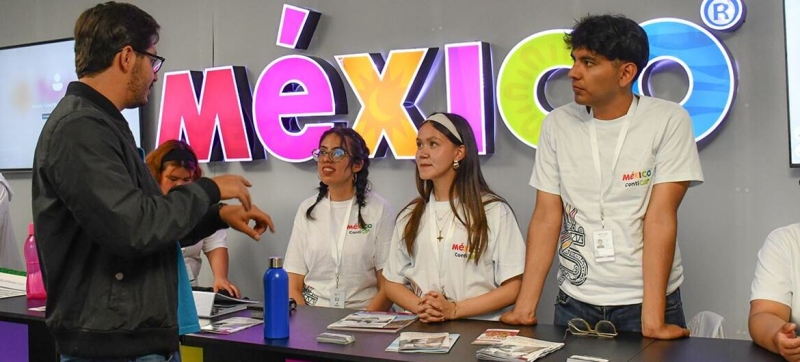

© UNODC México ContiGO tourist information kiosks have received specialized training on human trafficking, cybercrime and substance use. Beyond the sports arena: How UNODC helped secure the World Cup Peace and Security
This year, 7.8 million fans attended World Cup matches in Mexico alone. Sports events of this magnitude can increase the risk of human trafficking and a range of other crimes, which is why the United Nations Office on Drugs and Crime (UNODC) and partners conducted a series of prevention activities both before and during the tournament.
Combating human trafficking has become one of the key areas of work of the UNP during the two and a half years of preparation for the tournament. México ContiGO tourist information kiosks have received specialized training on human trafficking, cybercrime and substance use.
Fernanda Mariano, a volunteer at one such information point in Mexico City, recounted a case in which several children regularly came to play foosball with them.
“We started to worry because that they were alone, unaccompanied by adults,” Fernanda said. “It was an opportunity to put into practice everything we were taught in the training, including searching for adult family members. Later we found out that their parents worked nearby at the market and were able to find them.”
To reach workers who interact directly with the public in the transport, hospitality and health care sectors, UNP has joined forces with Uber, the anti-trafficking NGO SinTrata and Mexico City’s Citizens’ Council for Security and Justice. Together they launched the nationwide initiative Mundial Sin Trata (“World Cup without Trafficking in Persons”) as part of the UNP Blue Heart campaign. With the necessary information, ordinary citizens can play an important role in identifying such crimes,” she said, emphasizing the importance of private sector participation in such initiatives, especially companies in the travel, tourism and healthcare sectors.
UNODC also worked with Airbnb to provide training to hundreds of homeowners in Guadalajara, Mexico City and Monterrey on recognizing signs of exploitation people.
“Airbnb is actively promoting awareness programs to help hosts and guests identify potential risks and take informed responses, helping to create a safer environment for both visitors and local communities,” said Jorge Balderrama, Director of Government Relations for Airbnb in Mexico, Central America and the Caribbean.
Support Victims
Even the most thorough training cannot prevent all possible incidents, so the UNO, together with the Canadian and British embassies, trained security officials, as well as those in the justice, tourism and aviation sectors, to identify and effectively respond to cases of violence against women and girls.
“This training has helped ensure that women and girls attending major sporting and other public events receive the help they need in cases of gender-based violence, as well as other comprehensive support they need,” said Carla Lopez, an official with the Mexico City Secretariat of Public Security. airports, UNC, together with the World Customs Organization and Interpol, trained employees at Mexico City International Airport in thorough document checks, risk analysis and identification of trafficking in persons. This allowed for improved border security before and during the tournament.
Efforts to identify human trafficking did not stop at entry points into the country. To assist in the detection and prevention of money laundering associated with such crimes, the UNO, in partnership with the Mexican Bank Association and the Citizens’ Council, distributed informational materials to more than 100 thousand employees in over 11 thousand bank branches throughout the country. volunteers will ensure a long-term effect: crime prevention and safety will remain priorities after the end of the world championship.