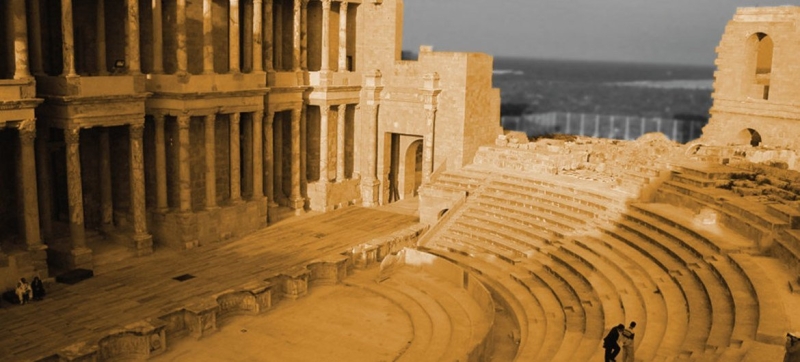

© UNESCO Archaeological site of Sabratha in Libya: Roman amphitheater with columns and tiered seats. Odyssey of the Mediterranean: a difficult path to harmony in the impermanence of the present Climate and environment
For Odysseus, the Mediterranean Sea was not just a place through which the road home passed – it was a world of trials and revelations, where love coexisted with danger, and fate spoke in the voices of monsters, sirens and capricious gods. Each island became a new page in his wanderings, each shore a new twist of fate.
Two and a half millennia after Homer first told this story, Christopher Nolan, following a galaxy of other famous directors, decided to depict the path of Odysseus on the screen. But outside the cinema there was another hero who is now experiencing his own odyssey – the sea, the stormy waters of which once carried the ship of the legendary hero.
The Mediterranean Sea is an ancient artery connecting Africa, Asia and Europe. This is the route along which cultural experiences, goods and ideas have been exchanged for centuries. The sea fed people, allowed them to earn a living, and became part of their myths and prayers.
Today, the shores of the Mediterranean Sea are home to more than half a billion people. Here ports bustle with activity, cities grow, fishing markets develop, and tourist ships navigate some of the busiest shipping lanes on the planet.
The Mediterranean Sea remains a natural treasure trove: making up just one percent of the world’s oceans, it holds up to 18 percent of known marine species, a quarter of which are never found anywhere else. nowhere.
Underwater meadows of posidonia—a seagrass named after the god Poseidon—spread over millions of hectares, harboring life, storing carbon, feeding seawater. Swamps, dunes, and wet lands along the coast protect the coast from storms and give people food, water and a sense of home. But these landscapes are increasingly suffering from pollution.
New monsters of the Mediterranean
Today, the Mediterranean Sea faces enemies that cannot be found in any ancient myth. Every day, hundreds of tons of garbage brought by rivers fall into its waters. Millions of harmful particles drift across its surface, most of them plastic, which naturally take centuries to decompose.
Sewage, chemicals, ship debris, microplastics, pharmaceutical waste are all slowly poisoning the marine environment.
The region is warming faster than the rest of the world. Heat, droughts, fires, floods, erosion – all this becomes part of the new reality. Rich marine life – turtles, dolphins, swordfish, octopuses, the rare monk seal – are retreating under pressure from construction, pollution and industrial activity.
When large varieties disappear, fishermen are forced to catch small fish, upsetting the ancient order of the food chain. Alien species brought by ships and aquaculture are displacing those who have lived here for centuries.
These ills are intertwined: weakened ecosystems are less able to protect shores; warm water helps invasive species spread; tourism is developing faster than activities aimed at protecting the sea.
Odysseus fought the monsters one by one, but the modern enemies of the sea, destroying his health, act together.
The sea has its own hero
In 1975, the Mediterranean Sea gained a protector – the Mediterranean Action Plan (UNEP/MAP), implemented by the United Nations Environment Program (UNEP). A year later, countries adopted the Barcelona Convention – the first legal shield created to preserve the sea and its shores. The convention’s seven protocols cover everything from protection from hazardous waste to biodiversity conservation, from offshore work to coastal development.
Twenty-one countries and the European Union are working together to ensure the sea does not lose its voice. The action plan helps them monitor water conditions, reduce plastic and chemical pollution, improve wastewater treatment, and prepare for possible spills oil.
Adopted in 2013, the Regional Marine Litter Plan was the first legally binding document of its kind. It supports the creation of marine protected areas, the restoration of damaged ecosystems, the protection of Posidonia and rare species, and the control of invasive organisms. Today, more than eight percent of the sea is under control special protection.
As temperatures rise UNEP/MAP is helping countries rebuild natural barriers so coasts can withstand storms. Working on sustainable production, tourism and marine planning helps economies grow without destroying what the sea makes alive.
“We strive for a sea that is alive and thriving, a sea whose natural inhabitants, entire ecosystems and industries can support the millions of people of the many cultures that call this region home,” said program coordinator Tatiana Hema.