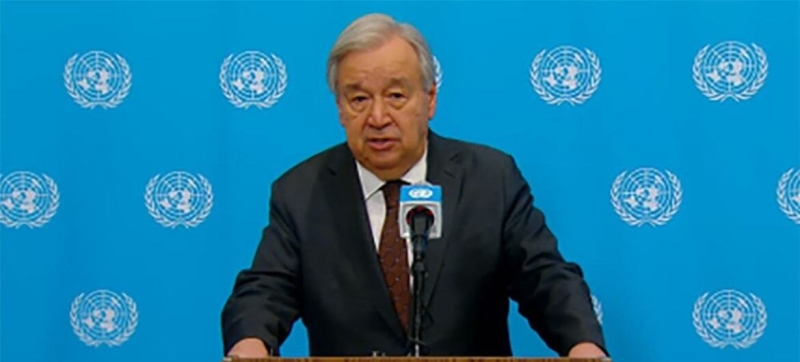

UN Photo UN Secretary-General Antonio Guterres speaks to the press at UN headquarters in New York. Middle East: UN chief once again calls for a cessation of hostilities and a return to diplomacy Peace and Security
Six months after hostilities began to escalate in the Gulf region, the conflict has become a major source of global instability, disrupting maritime trade, driving up food and energy prices, straining supply chains, and increasing the risk of hunger and poverty worldwide.
This was stated by UN Secretary-General Antonio Guterres, addressing reporters at UN headquarters in New York on Friday. The UN chief has just returned from a trip to the Middle East, during which he visited Syria and Jordan.
“The region – and the world – cannot tolerate continued war,” Guterres said.
“Combat must stop on all fronts in the region… “Diplomacy must prevail,” he emphasized. Gaza
The UN chief called the only “good news of recent days” the agreement announced by US President Donald Trump on Thursday: it provides for the disarmament of the Hamas group and the withdrawal of Israeli troops from the Gaza Strip.
Answering a journalist’s question about the prospects for implementing this agreement, Guterres said: “It has already been announced that there is a road map for the implementation of these goals. This “road map” must be implemented strictly, without allowing doubts, skepticism or attempts to undermine its implementation.”
“Now both sides must begin to implement the agreements reached,” he emphasized. shore
The situation in the Gaza Strip continues to deteriorate, UN agencies report. In particular, humanitarian organizations have recorded a significant escalation in fighting in the humanitarian zone – also known as the Green Zone – west of the so-called Yellow Line of control established by the Israeli military.
Over the past week, Israeli commanders have issued numerous evacuation orders and shelter-in-place orders. The fighting damaged several humanitarian infrastructure, including more than ten UN Relief Agency for Palestine Refugees in the Near East (UNRWA) premises.
Restrictions on the import of lubricating oil and spare parts continue to pose significant challenges to humanitarian operations. More than half of UNRWA’s vehicle fleet is out of service. In addition, due to a lack of fuel and lubricants, 62 water wells are operating with great disruption, which leads to a reduction in the production and distribution of clean water by more than 40 percent.
Earlier this week, Israeli soldiers and officials entered an UNRWA training center in East Jerusalem without permission, where they inspected the premises during training sessions. As a United Nations facility, the training center is protected by international law, UNRWA recalled.
According to the Palestinian Ministry of Health, between October 7, 2023 and July 24, 2026, 73,246 Palestinians were killed in the Gaza Strip and another 173,727 were injured. Some 1,180 deaths and 3,810 injuries were recorded between the announcement of the ceasefire on October 10, 2025, and July 22, 2026.
According to UNRWA, 311 agency staff and 82 support personnel have been killed in Gaza since the start of the war and as of July 29 UNRWA.
The number of killed and wounded children in Iran exceeded 2.5 thousand
The conflict in the Middle East is claiming more and more children’s lives. According to the United Nations Children’s Fund (UNICEF), over the past five months, more than 4,000 children have been killed or injured in six countries in the region, with more than 2,500 of them in Iran.
UNICEF Acting Regional Director for the Middle East and North Africa Abdul Fofana said children continue to be killed and seriously injured in places that should be their safest, including their homes. and schools.
The reason for the organization’s new statement was the recent incident on the island of Qeshm in southern Iran. A two-year-old child and his parents were reportedly killed when the residential building was struck. Two more children were injured.
UNICEF stressed that this incident serves as another reminder of the price that children continue to pay for armed conflicts. According to the latest data, over the past five months in Iran, 386 minors have been killed and another 2,117 injured.
“Parties to the conflict should not accept the suffering of children as something normal. It is children who are the most vulnerable victims of wars that they did not start and are unable to stop,” Fofana said.
The organization called on all parties to respect international humanitarian law. UNICEF emphasized the need to fully respect the ceasefire and take all possible measures to protect children, regardless of their location.