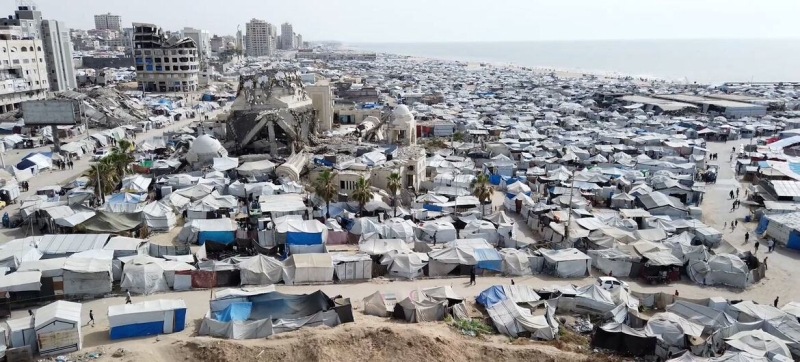

UN News Service Tent camp in Gaza. Gaza records fragile progress on food security Humanitarian assistance
New analysis released by the Food and Agriculture Organization (FAO), UNICEF and the World Food Program (WFP) shows early signs of improvements in food security and child nutrition in Gaza. However, the UN warns that progress remains extremely fragile and depends entirely on sustainable humanitarian access and the restoration of commercial supplies.
Despite the expansion of humanitarian corridors, only one crossing point, Kerem Shalom, operates in the southern part of the enclave, limiting the flow of vital goods. The number of people experiencing severe food insecurity in Gaza has fallen from 1.6 million to 1.4 million, according to the analysis. Progress was also recorded in child nutrition indicators, with programs to prevent and treat acute malnutrition reaching the majority of children under five years of age. In May 2026, food assistance reached 1.5 million people, cash support reached 700 thousand, and access to treatment for acute malnutrition increased significantly. This is a stark contrast to September 2025, when only about 500,000 people were receiving assistance and coverage of children was less than one percent. However, improvements remain limited. Diets continue to be insufficient in volume and variety, and commercial supplies of fresh produce and protein are inconsistent. Some 212 thousand people remain in extreme food insecurity, especially in areas adjacent to the Israeli-controlled line, where humanitarian access is difficult.
Prevention and treatment
Humanitarian organizations say improvements in nutrition indicators have been made possible by scaling up prevention and treatment programs. In the coming year, some 74,000 children will need treatment for acute malnutrition, and 25,000 pregnant and lactating women will need additional support. There are also early signs of a recovery in local food production: in areas where farmers have access to land, resources and veterinary care, sheep numbers have increased by 33 percent. However, more than 70 percent of farmland remains inaccessible, and only three percent is suitable for use. Restrictions on imports of agricultural goods, including seeds and fertilizers, continue to block a recovery in production. Access to the sea also remains closed, preventing people from fishing and earning money.
Funding gap
FAO, UNICEF and WFP stress that sustainable peace and security are key to rebuilding life in Gaza. Stable operation of all humanitarian corridors passing through Jordan, Israel and Egypt is necessary, as well as increased commercial access so that markets can stabilize. Restoring water, sanitation and health systems is critical; without it, disease outbreaks could reverse progress. Agencies call on the international community to increase flexible and predictable funding for food assistance, health, water, sanitation and livelihood restoration programs. The depletion of current resources threatens the progress made and could once again put the lives of 2.1 million Gazans at risk.