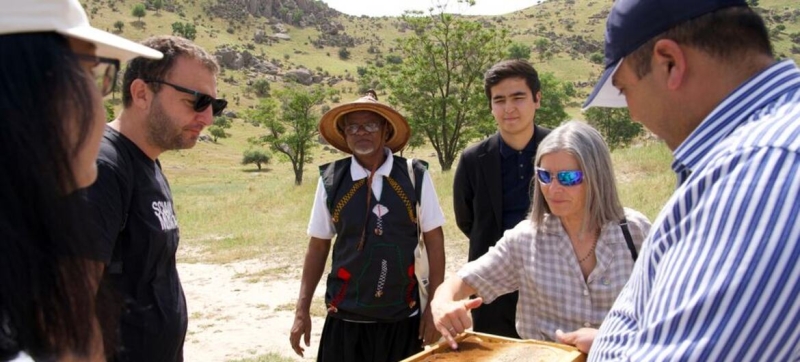

UN Photo Caravan participants visit restored pastures around Samarkand. In the Heart of the Silk Road: A Horizon of Hope for Drylands Economic development
In Samarkand, the color azure is everywhere: on the tiled domes, in the bright June sky and in the turquoise T-shirts of the Silk Road Caravan team. But in Central Asia, blue is more than a color. This is a symbol of water: rare and vital for a region where more than 80 percent of the territory is occupied by deserts and steppes, and over 26 million people suffer from drought.
Samarkand, a historic crossroads of trade and ideas, has become the Caravan’s gateway to Central Asia, a region where land degradation, drought and water shortages are increasingly changing landscapes and people’s lives.
In Central Asia, at least 20 percent of the land is already exposed, and about 80 percent is used for livestock grazing. The health of rangelands is therefore directly linked to food security, livelihoods and resilience to climate shocks. Host to the Eighth Assembly of the Global Environment Facility (GEF) in June, Samarkand also became a place where dialogues on drought, pastures and land restoration directly overlapped with what was happening on the land itself – in pastures, pistachio plantations, riparian forests, nurseries and university laboratories.
At the official arrival ceremony Caravana Aziz Abdukhakimov, advisor to the President of the Republic of Uzbekistan on environmental issues and chairman of the National Committee on Ecology and Climate Change, connected the journey to the longer history of the Silk Road. The caravan, he noted, revives the spirit of friendship, cooperation and shared responsibility for our land and environment.
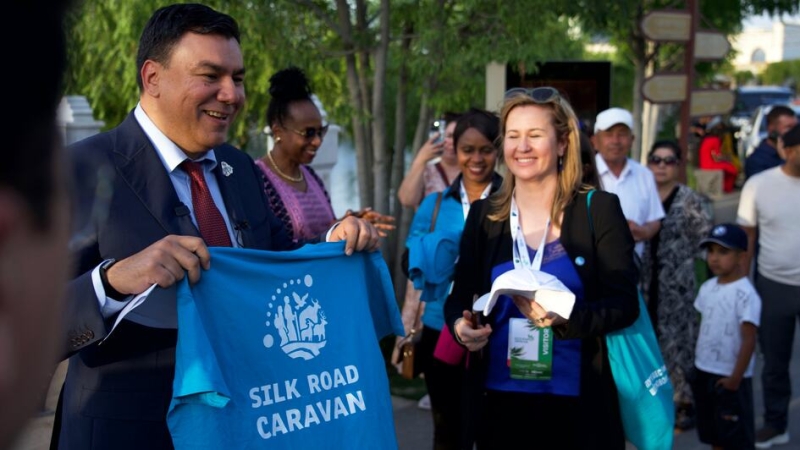
UN Photo Aziz Abdukhakimov welcomes the Silk Road Caravan.
These realities also shaped the discussions at the GEF Assembly, where the UNCCD placed the financing of drought relief, grazing lands and pastoral livelihoods at the center of the discussion – issues on which the environmental future of Central Asia largely depends. land management in Uzbekistan”, supported by the Russian Federation and implemented by the UNCCD Global Mechanism. The project will test carbon farming practices that help achieve land degradation neutrality, increase climate resilience and improve soil health. It also involves the collection of baseline data over an area of 5,000 hectares and the participation of 1,000 smallholder farmers, pastoralists and foresters.
The urgency of this work is clear: today in Central Asia, more than 152 million hectares of land are in drought conditions, which affect more than half of the region’s population. The Assembly also brought concrete investment opportunities to Uzbekistan and the entire region. On the eve of the meeting in Samarkand, it was announced the approval of $5.4 million for the regional project “Mountain Ecosystems of Central Asia”, which will be implemented jointly with the World Bank, as well as the launch of the regional program “Interconnection of Water and Land Resources in Central Asia” worth $26 million. These investments were part of a broader financial picture: GEF-8 committed $618 million to combat land degradation, an increase of 30 percent over GEF-7.
For Uzbekistan, these global priorities have already been reflected in national policy. As part of Yashil Makon, the president’s national initiative to green the country, Uzbekistan plans to plant 200 million trees and shrubs annually and increase the area of green zones by 2030. Erkin Mukhitdinov, director of the Agency for Expansion of Green Zones and Forest Funds and Combating Desertification, clearly outlined the scale of this goal: “Our goal is to increase the share of green areas in Uzbekistan to 30 percent by 2030. Today it is 15 percent. We understand that it will be more difficult to achieve this alone, so we are involving international organizations in this work.”
Amankutan: pasture as a living calendar
In Amankutan, in the Samarkand region, the Caravan visited pastures where restoration is being carried out through seasonal grazing, selection of plant species and stricter access control.
At the Bakhri site of the Urgut forestry enterprise, the land occupies about 1,600 hectares. Approximately 700 hectares are included in the forest contour, the rest of the area is used as pasture. The problem here is familiar throughout Central Asia: excessive grazing pressure, thinning vegetation and soils that are losing their ability to retain moisture.
Recovery is gradual. In dry areas, almonds and forage grasses that can survive with little water are planted. Some areas are allowed to rest for three to four years before cattle return there again. High mountain pastures are left for seasonal grazing. Gates, cameras and forestry staff help control access to prevent outside livestock from disrupting restoration efforts.
Small earthen berms and terraces retain rain and melt water, keeping moisture close to young trees. This is a powerful technique that draws on a long tradition of land stewardship. Species are selected for specific sites: almond, acacia, elm and other hardy trees with deep roots and low water requirements.
Mobile apiaries especially demonstrate the connection between land restoration and livelihoods. They are transported to places where there are more flowering plants. Bees pollinate grasses, shrubs and trees, helping vegetation regenerate. Selling honey brings income back into the forestry enterprise.
For Caravan participant Haruna Abarchi, a pastoralist from Niger, president of the pastoralists’ association A2N and coordinator of the International Year of Rangelands and Pastoralists in West and Central Africa, the similarities between the Sahel and Central Asia were obvious. The lesson, he says, is not to copy models, but to adapt what works. “What I saw here – selecting plants for specific places and planting them where they are really needed – is an experience that we can share at home, using plants adapted to our conditions,” he said. pistachios
In Saraykurgan, in the Nurabad region, restoration is embodied in trees that first require patience, then pay back a hundredfold, bringing a bountiful harvest. Here the project works with degraded and unproductive pastures: areas where there is little grass, the vegetation cover is disturbed and previously there was uncontrolled grazing. Now these lands are being prepared for pistachio plantations.
The scale reflects a broader regional focus: restore degraded land while creating long-term rural income. By 2036, it is planned to establish 50,000 hectares of pistachio plantations in the Nurabad district. There are already several thousand hectares of such plantings here, based on decades of experience in growing pistachios. Now the project is expanding with government support, using drip irrigation and the labor of local residents.
The pistachio tree is suited to this landscape because it tolerates poor soils and extreme temperatures, remaining productive for decades. The social logic of the project is no less important. While the trees are not yet producing crops, local residents are hired to dig planting holes, care for the seedlings and maintain the plantations. When the plantings begin to bear fruit, plots of five hectares will be leased to families with low incomes so that they can earn money from the harvest. After eight years, one tree can produce about four kilograms per season – approximately one ton per hectare, and after 12 years – about 10 kilograms. Expected income was estimated at approximately $50,000 with maintenance costs of approximately $10,000.
This is how the pistachio project turns into something more than just planting trees. This is restoration designed as an economic system: degraded land is transformed into a productive asset and pressure on surrounding grassland is reduced. This is a poverty reduction model built around culture, which takes time. In theory, if 50,000 hectares were divided into five-hectare plots, the project could support about 10,000 families over time. The earth turns into a resource that can long outlive the first generation of invested labor.
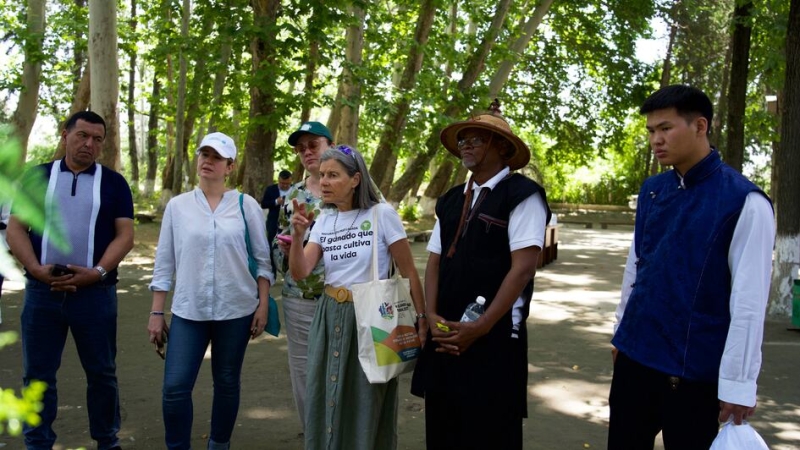
UN Photo Silk Road caravan in Zarafshan National Natural Park.
Zarafshan: the forest follows the river
From the open hills the road turned towards the cooler shores of Zarafshan.
Zarafshan National Natural Park protects one of the few remaining tugai landscapes of Uzbekistan are riverine forests that survive along watercourses in arid regions. These forests are among the most valuable dryland ecosystems in Central Asia. In a region where water stress increases, these riverine ecosystems provide natural protection against erosion, heat, and loss of biodiversity.
They hold river banks, mitigate wind erosion, cool the air, and provide shelter for wildlife, including the Bukhara deer.
Beyond the tree line there is heat, dust and open ground; under the forest canopy there is shadow, bird voices and the dense green life of the river corridor. This is the infrastructure created by the root system, moisture and habitat.
For Zarafshan, conservation does not end at the park’s borders. Employees talked about working with local schools, collaborating with artists who use natural materials and sell their work in the park, and ecotourism in neighboring villages. All this gives farmers and rural communities around the park a visible stake in the future of the forest. It is easier to preserve a forest when there are allies nearby.
Arnasay: how to live with salt
In the Jizzakh region, the Caravan saw a different type of sustainability – in the Halophyte Garden in Arnasay area.
Halophytes are plants adapted to saline soils and water stress conditions. Salinity remains one of the most prominent forms of land degradation in Central Asia, along with erosion and loss of productivity. Therefore, such plants are especially important for a country where many irrigated landscapes are affected by salinity. Uzbekistan’s saline soils reflect natural farming conditions in an arid climate, the movement of groundwater and minerals, drainage problems, and the legacy of large-scale irrigation, including a long dependence on cotton as a water-intensive crop.
The halophyte garden serves as a living laboratory, testing and breeding salt-tolerant species that can survive where conventional crops struggle. Uzbek experts have identified more than 100 native species for saline and arid landscapes, and collaboration with the Xinjiang Institute of Ecology and Geography in China has expanded testing to include dozens of additional varieties.
The garden is both a research site and a practical answer to one of the region’s greatest land restoration challenges: finding species that can strengthen the soil in harsher, saltier conditions.

UN Photo From Uzbekistan, the Caravan continued its journey overland to Kazakhstan.
Green University: a school for the dry century
In Tashkent, the Caravan visited the Central Asian University of Environmental Studies and Climate Change, known as Green University. After several days in the field, one conclusion became clear: region-wide land restoration depends not only on funding, but also on knowledge and professional capacity.
“Without a new generation of specialists capable of translating environmental objectives into the language of financial strategies, even the best-thought-out policy frameworks risk remaining on paper,” said University Rector, Professor Bakhtier Pulatov.
Green University looks at environmental work as one of the key jobs for the future of Central Asia, connecting audiences to the realities of drought, biodiversity, land restoration and climate finance.
The Path to a New Frontier: Caravan continues
From Uzbekistan, the Caravan continued its journey overland to Kazakhstan, where the azure color reappeared in the state flag and in the vast steppe skies. Throughout the journey, it became much more than the Caravan’s signature color. In Central Asia, it has become a symbol of water, resilience and the fragile systems that connect people, grasslands and dryland landscapes.