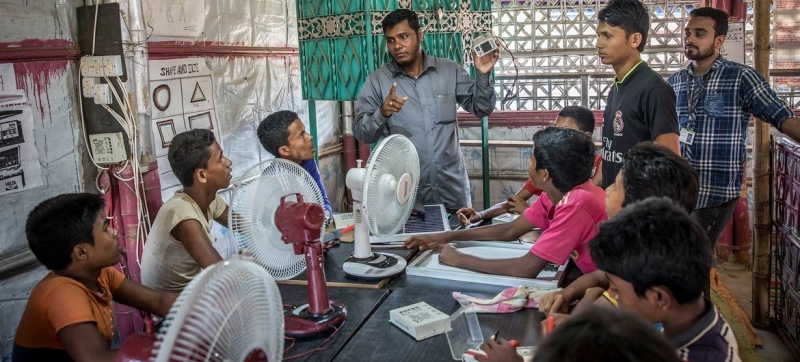

© UNICEF/Z. Modola Young people from the Rohingya community are training to become electricians in a refugee camp in southern Bangladesh. World Bank: 1.2 billion young people will enter the labor market in developing countries by 2035 Economic Development
Developing countries face an unprecedented employment challenge: Some 1.2 billion young people will reach working age over the next decade. This is stated in the report of the World Bank “The Global Employment Problem”.
The authors warn that this wave of youth will be the largest in modern history. At the same time, the global economy is experiencing a period of slowing growth, which limits the ability to create new jobs.
The study estimates that by 2035, only just over 400 million young people will be able to find work. About 300 million more are at risk of being left out of employment, education and training.The problem will be most acute in sub-Saharan Africa. It is projected that by 2035 there will be more than 330 million young people living there—almost two and a half times more than in 2000. Significant growth in the youth population is also expected in the Middle East, North Africa and South Asia.
The report emphasizes that job creation is critical to development. Work provides people with income, a sense of purpose and dignity, promotes social cohesion and stability, and plays a key role in reducing poverty and promoting shared prosperity.
Opportunity for development
World Bank experts note that the current generation of young people is better educated than previous ones. If countries can secure employment, it can be a powerful boost to economic growth, domestic demand, and prosperity.
The World Bank recommends focusing on three key areas: developing infrastructure, creating an enabling environment for business, and mobilizing private capital. According to the study’s authors, these factors were the basis for successful job creation in the past.
Particular attention is proposed to be paid to sectors that can provide large-scale job creation: infrastructure and energy, agriculture and agribusiness, healthcare, tourism and manufacturing industry.
Choice for the decades ahead
The authors emphasize that demographic processes develop slowly, but have a huge impact on the future of countries. The big question is whether governments in developing countries, with the support of the international community, can turn the growing number of young people into a source of economic growth, or whether demographic pressure will become an obstacle to development. The World Bank notes that job creation remains one of the most important tools for fighting poverty and raising living standards. In a changing world, the key challenge is to provide the next generation with not only more jobs, but also better quality employment.