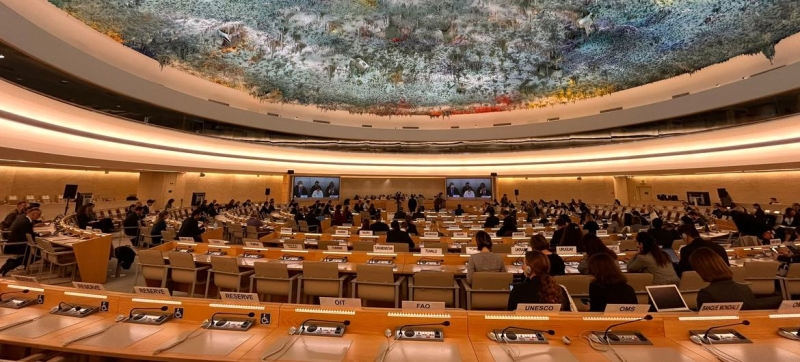

© OHCHR Meeting room of the UN Human Rights Council. UN independent expert: unilateral sanctions lead to humanitarian crises Human Rights
Unilateral sanctions provoke severe humanitarian crises and punish entire nations for political disputes over which they have no influence. This was stated on Wednesday by the Special Rapporteur on the negative impact of unilateral coercive measures on human rights, Zaina Jallad.
She expressed concern about the expansion of sanctions around the world, from Cuba to Iran. The independent expert noted that the current “escalation” in this area was preceded by six decades of the proliferation of unilateral sanctions imposed bypassing the UN Security Council and without taking into account relevant obligations under international law. The consequences of these measures are often exacerbated by “risk reduction” policies and excessive zealous enforcement of sanctions restrictions by third parties, Jallad emphasized when presenting her report at the 63rd session of the UN Human Rights Council.
In Cuba, entire generations live under restrictions associated with US sanctions, the Special Rapporteur recalled. These measures, she said, impede Cubans’ enjoyment of their fundamental rights, including the rights to food, health care, education, international cooperation and humanitarian assistance, and limit their access to critical government services and infrastructure.
“These measures are holding back economic growth and development, increasing debt burdens and worsening the living conditions of entire peoples who have no real say in the political disputes that gave rise to sanctions,” the Special Rapporteur noted. “The population finds itself hostage to a situation in which its fundamental rights are violated, with the most severe impact on the most vulnerable groups, including people with chronic diseases and disabilities.”
The expert’s report presents a conceptual approach that integrates the principles of the universality of human rights, analyzing the experiences of affected populations, the mechanisms of harm to them, as well as obligations for the prevention of violations, reparation, restitution and restoration of rights. This methodology deepens, systematizes and expands the human rights approach developed during the first 11 years of the mandate of the Special Rapporteur on Sanctions (established in late 2014).
“Including these elements as an integral part of the analysis within the mandate is critical at a time of deep crisis in the multilateral world order, when populations suffering from unilateral coercive measures can increasingly rely on the protective mechanisms provided by this system,” Jallad said.
Sanctions “intimidate states,” create a climate of fear throughout the international system, undermine multilateral cooperation and jeopardize the rule of international law,” she added.
Recently, Judges and prosecutors of the International Criminal Court, as well as human rights defenders and the UN Special Rapporteur, also became unilateral sanctions, Jallad recalled. They are part of the Council’s special procedures. Special procedures experts are not UN employees and are not dependent on any government or organization. They work in a personal capacity and are not paid for their work.