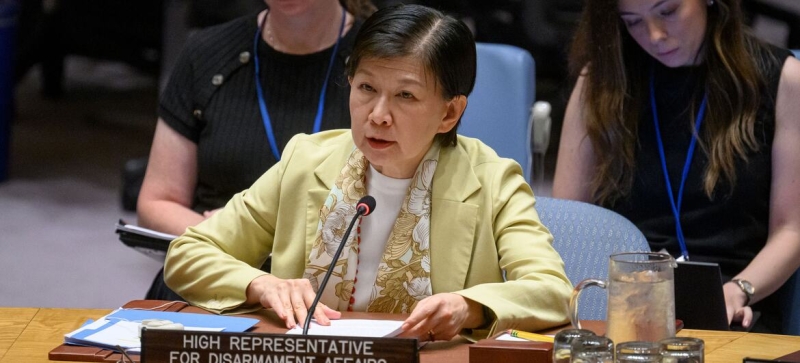

Photo UN/L. Felipe High Representative for Disarmament Affairs Izumi Nakamitsu speaks at a Security Council meeting on the situation in Syria. Top news of the day | Thursday: Syria, El Niño, UN-80, investments UN
The main news of the day in the UN and in the world: the Security Council discussed the situation with chemical weapons in Syria, the El Niño climate phenomenon is gaining strength, the General Assembly approved the merger of two UN structures, the investment boom is bypassing developing countries.
Chemical weapons in Syria
The UN Security Council held a meeting on Thursday devoted to the situation in Syria: several months ago, stockpiles of previously undeclared chemical weapons were discovered in the country. UN High Representative for Disarmament Affairs Izumi Nakamitsu told the Council that cooperation between the new Syrian authorities and the Organization for the Prohibition of Chemical Weapons (OPCW) has made significant progress in addressing the residual elements of the former government’s chemical weapons program.The El Niño climate phenomenon, fueled by abnormally warm waters of the Pacific Ocean, is rapidly gaining strength. According to fresh forecasts from the World Meteorological Organization (WMO), the phenomenon will peak and become “very severe” by the end of the year. The likelihood that El Niño will remain strong until the end of February is now close to 100 percent. The WMO has never made such clear predictions. For the first time in its history, the World Meteorological Organization launched a global mobilization of national hydrometeorological services. The goal is to maximize forecasts and strengthen early warning systems.
Combining UN structures
The UN General Assembly approved the merger of two structures of the Organization – the UN System Staff College and the UN Institute for Training and Research (UNITAR). Secretary-General António Guterres welcomed the decision of the General Assembly, calling it “an important step forward” in the implementation of the UN-80 initiative aimed at improving the effectiveness of the Organization. The merger of UNITAR and the Staff College was the first UN merger approved by the General Assembly under the initiative.
Foreign Investment
The boom in investment in strategic sectors is bypassing developing countries, according to a new report from the United Nations Conference on Trade and Development (UNCTAD). Foreign direct investment grew by 6 percent last year to $1.6 trillion. However, inflows to developing countries increased by only 2 percent. The 20 largest receiving countries accounted for more than 80 percent of total investment. The gap is even more pronounced in industries that drive growth, including artificial intelligence infrastructure, semiconductors, and minerals and energy transition technologies.