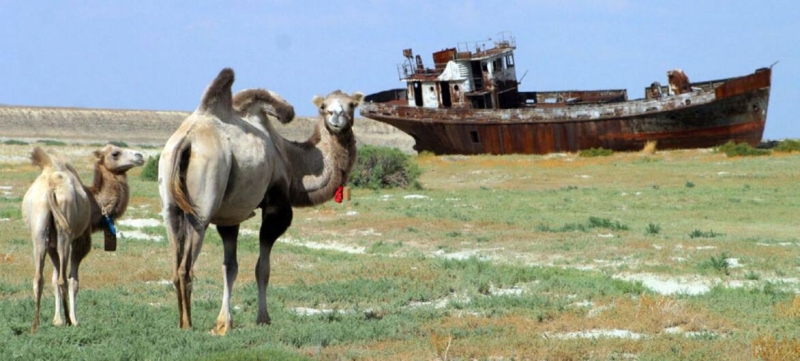

© UNDP The Central Asian region was once famous for its endless steppes and fertile oases. Central Asia is losing land: how to overcome the environmental crisis Climate and Environment
In the vast expanses of the heart of Eurasia, a silent crisis is unfolding. The Central Asian region was once famous for its endless steppes and fertile oases, and is now one of the world’s largest hotbeds of land degradation. This is stated in the new report of the UN Convention to Combat Desertification.
More than 80 million hectares have already been degraded – about a quarter of the region’s territory. For comparison, this is approximately four times the area of Kyrgyzstan. Nearly 30 percent of the population—24 million people—live on land that is literally dying under their feet.
Behind the dry numbers is a very concrete reality. For a farmer, land degradation means crop failure. For a cattle breeder, it is a pasture on which there is less and less grass. For an entire family, it means the loss of a source of income, and sometimes the need to leave their homeland. Annual damage from land degradation in Central Asia is estimated at two to six billion dollars.
And climate is only adding to the pressure. Central Asia is warming about twice as fast as the planet on average. Over the past half century, glaciers – the region’s natural “water towers” – have shrunk by about 30 percent. Rivers and oases that have supported life for centuries in one of the world’s driest areas are increasingly under threat.
When the Earth Turns to Dust
One of the most noticeable manifestations of the crisis is sand and dust storms. Drought and heat dry out the soil, the wind lifts the fertile layer into the air, and with it salt from the dried bottom of the Aral Sea and dust from degraded pastures and abandoned fields.
These clouds can travel hundreds and thousands of kilometers. They destroy crops, disrupt transport, pollute soil and water and pose a threat to human health. In Kazakhstan, almost 78 percent of the territory belongs to zones of increased risk of desertification.
The most dramatic example of what can happen when natural resources are unsustainably used is the Aral Sea. Once one of the world’s largest lakes, it had lost about 90 percent of its volume by the early 2000s. In place of the water, a new desert was formed – Aralkum. The area of the dried bottom exceeds 5.5 million hectares, and every year the wind lifts from there into the atmosphere from 15 to 75 million tons of salt and fine dust.
Saxaul is planted on the drained bottom, which stabilizes the soil and reduces the spread of dust. In the northern part of the Aral Sea, the volume of water has increased from 18.4 to 23 billion cubic meters since 2023, and in the future it is planned to increase it to 34 billion. are testing their own ways to bring life back to the earth. In Kyrgyzstan pastures are increasingly managed by local communities themselves: they determine grazing standards and direct the collected funds to infrastructure. By 2030, the country plans to restore 300 thousand hectares of degraded land. In mountainous Tajikistanon unproductive slopes, gardens are laid out, which at the same time produce crops, retain moisture and help protect populated areas from mudflows.
In Uzbekistan two million hectares of the drained bottom of the Aral Sea have already been planted with saxaul, and drip irrigation is used on a million hectares. Kazakhstan is developing agricultural land restoration and carbon farming. Turkmenistan uses the experience of living in the desert accumulated over centuries – from fixing shifting sands to creating green protective strips.
At the same time, we are talking not only about the environment. More than 80 million people live in Central Asia, half of them are under 30 years old. Land restoration has the potential to create jobs where people live: in forestry, irrigation, rangeland management and climate-resilient agriculture. The report estimates that every dollar invested in land restoration could yield up to a five-dollar return over 30 years. “An investment in healthy lands is an investment in people: it creates jobs, strengthens livelihoods, reduces migration pressures, improves water availability and builds more resilient communities across the region,” she said.
Effective methods to combat desertification are well known, she said, but the key now is to scale them up. “This report is not only an analytical review, but also a call for collective action,” said the head of the UNCCD.
In Central Asia, water, land and people’s lives are too closely intertwined for problems to be solved individually or within state borders. Dust does not stop at border crossings, rivers flow through several countries, and glaciers provide water to millions of people far from the mountain peaks. That is why, as Yasmine Fouad writes, “ecosystems unite countries much more than state borders divide them.”
Today the question is no longer just how many hectares Central Asia can restore. The question is whether it will be possible to preserve the land on which future generations can live.