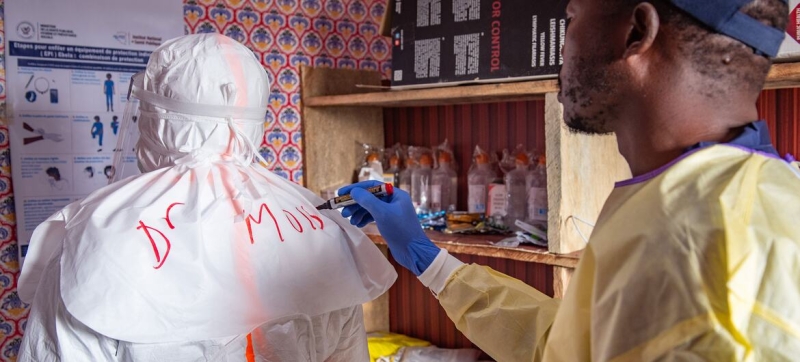

© OCHA/R. Moussa Maz A medical worker writes the name on the back of a doctor wearing a special Ebola protective suit. 70 thousand doses of Ebola vaccine sent to DR Congo Health
The World Health Organization (WHO) and the Africa Centers for Disease Control and Prevention have welcomed the decision to provide 70,000 doses of the Ervebo vaccine to the Democratic Republic of the Congo (DRC) to combat the ongoing Ebola outbreak caused by the Bundibugyo virus.
Last week, the DRC government requested doses from the global stockpile of Ebola vaccines managed by the International Vaccine Coordination Group. On Monday, the group told the country’s authorities it would allocate 70,000 doses in the first phase.
The Ervebo vaccine is licensed and recommended for use during outbreaks of the disease caused by the Zaire ebolavirus. However, it is not yet known whether this vaccine can protect people from the Bundibugyo virus.
Clinical trials
Of the allocated vaccines, 20,000 doses will be used in a phase three clinical trial to determine how effective the vaccine is against this virus, which is spreading rapidly in DRC.
Another 50,000 doses are earmarked for health care workers and others on the front lines of the outbreak. This distribution is consistent with the recommendations of the WHO Strategic Advisory Group of Experts.
Preliminary laboratory and animal studies indicate that Ervebo may provide some protection against Bundibugyo virus. However, there is no data yet on its effectiveness in humans.
The clinical trial is expected to provide important data needed to make decisions about the future use of the vaccine.
Supporting affected communities
WHO emphasizes that everyone who will be offered the vaccine – as part of the clinical trial trials and beyond – must obtain information about possible risks, potential benefits and limitations. Vaccination will only be administered with the consent of the patient.
Amid the ongoing outbreak, WHO and the Africa Centers for Disease Control and Prevention are supporting the efforts of the DR Congo authorities to protect the population. They promote an approach in which local communities play a central role in disease control.
Global Vaccine Supply
The International Vaccine Coordination Group was established in 1997 following large outbreaks of meningitis in Africa. Its mission is to manage and coordinate emergency supplies of vaccines and antibiotics to countries during major disease outbreaks.
The group includes WHO, the International Federation of Red Cross and Red Crescent Societies, Doctors Without Borders, and the United Nations Children’s Fund (UNICEF).