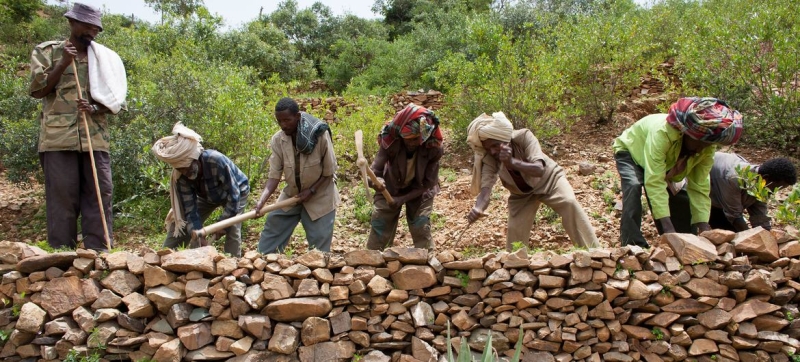

© World Bank/A. Borgarello Planting trees in the Tigray region of Ethiopia as part of land restoration efforts. Mongolia hosts international conference to combat desertification Climate and Environment
Delegates from more than 190 countries gathered in the capital of Mongolia, Ulaanbaatar. The 17th session of the Conference of the Parties to the UN Convention to Combat Desertification (COP-17) is taking place there.
For two weeks, representatives from governments, the private sector, academia and civil society organizations will advance practical solutions, forge new partnerships and mobilize investments to restore lands and improve their resilience to drought.
Initiatives launched at COP 17 are expected to strengthen international cooperation on land management in the coming years – at a time when countries are facing increasing impacts from land degradation, water scarcity and climate change.
Degradation and drought are already estimated to affect up to 40 percent of the world’s land and cost the global economy nearly $900 billion annually. The consequences are felt by some 3.2 billion people.
“Land degradation and drought are no longer distant environmental threats. They affect the food we produce, the water we need, the resilience of our economies and the ability of communities to build their future with confidence,” said Convention to Combat Desertification Executive Secretary Yasmine Fouad.
“That’s why COP 17 should be a conference of practical actions. We already have the solutions – the challenge is to apply them on the required scale. Ulaanbaatar must provide the necessary political impetus, attract investment and bring together partners to move from commitments to measurable results on the ground,” she added.
For Mongolia, as the host country, the issues discussed at the conference are an everyday reality. Almost 77 percent of the country’s land resources are subject to degradation. At the same time, pastoral livestock farming provides the livelihood of approximately every third resident of Mongolia. In 2023 and 2024, severe summer droughts followed by harsh winters killed more than seven million livestock.
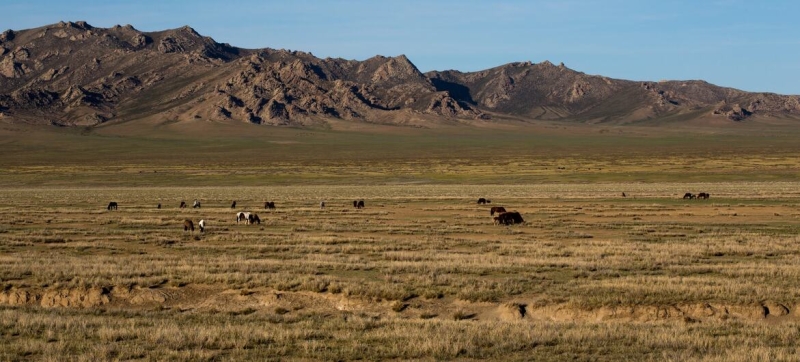
FAO/K. Purevrakchaa Almost 77 percent of Mongolia’s land resources are subject to degradation.
“For Mongolia, the land is inseparable from the life of the people, their well-being and our common future. In our country, pastoralism continues to play a central role in society, and land degradation, drought and harsh winters are placing increasing pressure on local communities,” said Battsetseg Batmunkh, Minister of Foreign Affairs of Mongolia and Chair of COP 17. and pastoral communities is one of the central topics of global discussions,” she noted.
Combating drought
Building on the progress made at COP 16 in Riyadh, at COP 17 governments will continue to discuss the global drought policy framework, while strengthening the practical tools, partnerships and financing mechanisms needed to move drought plans into action. The parties will discuss measures to increase preparedness, develop early warning systems and strengthen international cooperation.
Today, national plans to combat drought have already been developed in more than 70 countries – in 2013 there were only three such countries. This demonstrates a growing understanding that drought risks need to be managed early, rather than acting only when they become a humanitarian and economic crisis.
Every dollar invested in drought resilience can yield up to a $10 return, and the benefits of some nature-based solutions can be as much as 27 times the cost. private investment for land restoration will be a COP17 priority.
An estimated US$355 billion is needed annually to combat land degradation and drought, compared with current investment of only about US$77 billion. This brings the annual funding gap to $278 billion.
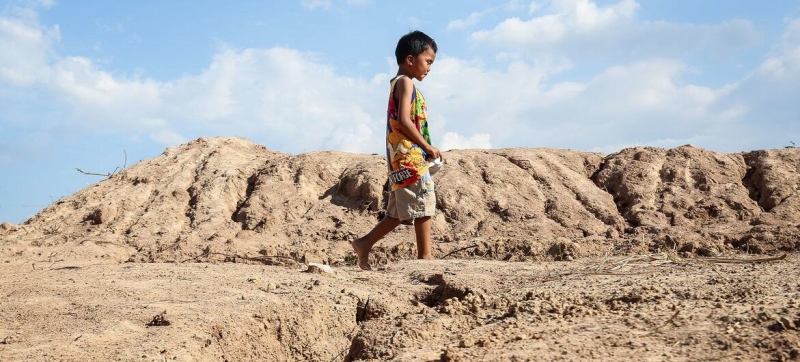
© UNICEF/S. Prichapanich Due to climate change, droughts are becoming more common.
Although businesses rely heavily on fertile land and reliable water supplies, the private sector today accounts for only about six percent of global funding for land restoration and drought resilience.
Public funds alone are likely to be insufficient to close this gap, highlighting the need for greater collaboration between governments, development banks, businesses and investors.
COP 17 will consider opportunities to attract new sources of financing, reduce investment risks and closer cooperation between the public and private sectors in this area. The conference will present the results of initiatives such as Business4Land (Business for Land), aimed at increasing private sector participation in the field of land restoration and increasing drought resilience.
Spotlight on rangeland
COP-17 is underway in the International Year of Rangelands and Pastoralists. It is one of the world’s most undervalued ecosystems and will now be at the center of international debate.
Grassland covers 54 percent of the Earth’s land surface and supports the livelihoods of some two billion people, including the estimated 500 million pastoralists who have cared for them for millennia. lands.
Pasture lands provide a sixth of all food produced in the world and provide about 70 percent of the feed supply for livestock. Their importance goes beyond grazing: they are strategically important ecosystems on which food security, biodiversity, climate resilience and livelihoods depend. However, about half of rangeland is already degraded or under threat. Governments are expected to consider a new policy framework for rangeland and pastoralists and launch the Rangeland Flagship Initiative, a global partnership to increase long-term investment in sustainable rangeland management. lands.