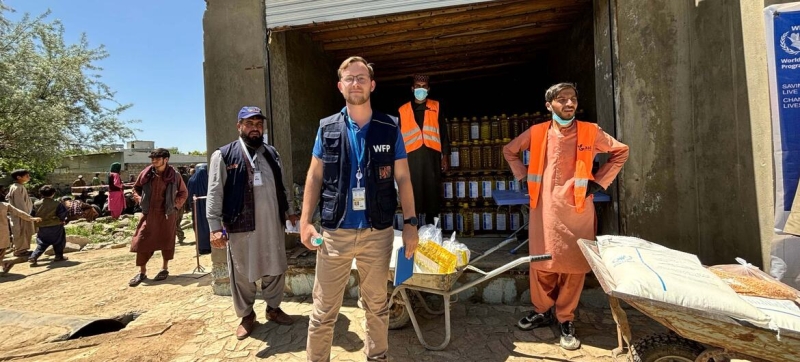

From personal archive World Food Program employee Rinat Kapiev (center) in Afghanistan. From UN volunteer to humanitarian specialist: work that begins long before aid is distributed Humanitarian aid
Humanitarian work is about more than just delivering food and services to people on the front lines of conflicts and natural disasters. Behind every aid distribution operation are contracts with partners, emergency preparedness, risk analysis and the work of specialists in country offices and headquarters. World Food Program (WFP) employee Rinat Kapiev, who began his career in the UN system as a volunteer, then worked in Afghanistan and Gaza, and today at WFP headquarters in Rome helps prepare countries for natural disasters, has seen this from his own experience.
On the eve of World Humanitarian Day, which is celebrated on August 19, he spoke to Evgenia Kleshcheva from the UN News Service about what humanitarian work looks like from the inside and why, after working in crisis situations, his desire to remain in this field has only intensified.
Starting dot
After studying in Russia and the USA and completing an internship at the World Bank, Kapiev joined the Food and Agriculture Organization (FAO) in Budapest as a volunteer. For two years, he assisted country offices in Europe and Central Asia in resource mobilization, program development, monitoring and project preparation in the areas of pandemic recovery, resilience building and community support. This experience, he says, became the starting point of an international career.
Kapiev was selected to work at WFP through a program for training young specialists to work in emergency situations. The selection was not easy – more than 1,700 candidates for 7 vacant positions. The program included rotations in the emergency response department at headquarters followed by trips to country offices.
“I always wanted to be in the field, not at headquarters,” he recalls. Therefore, he accepted the offer to go to Afghanistan immediately.
A year and a half in Afghanistan
Initially, the trip was supposed to last six months, but in the end Kapyev spent a year and a half in Afghanistan. One of the main areas of his work was interaction with WFP partners – organizations through which food and other aid directly reaches population.
It was the work on the ground, says Rinat, that made it possible to see what cannot be fully understood from reports and studies.
“I traveled a lot around Afghanistan, visited 73 partner offices, warehouses, and food distribution points. I saw how the population receives [help], how people live thanks to our help. And I understood that work was beneficial,” he said.
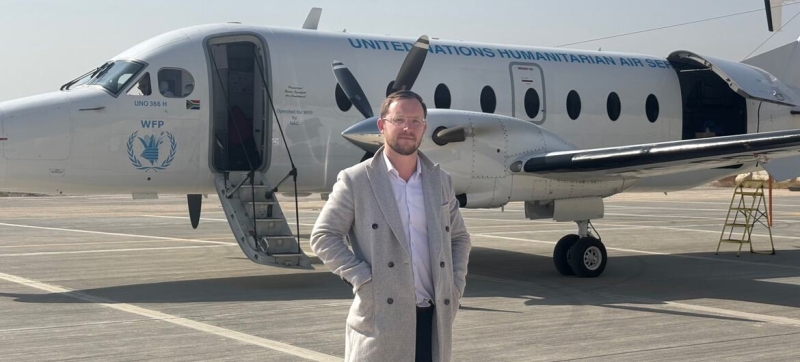
Photo from personal archive World Food Program employee Rinat Kapyev at the UN humanitarian air service plane in Afghanistan.
At the same time, such a business trip is associated with serious restrictions. The employees lived and worked in a guarded complex and could travel outside it only for official needs.
“You live at work,” says Kapyev. Periods of rest outside the duty station, when he could see his family, helped him cope with isolation.
But the main source of motivation, according to him, remained the understanding of why he was in the country: “I understood that here I have such an opportunity – to work and support people who need help.” sent to Gaza. The task was specific and urgent: to coordinate complex negotiations and preparation of agreements with WFP partners for 2026. Such administrative work may seem far from the usual idea of humanitarian work, but without it, help simply cannot reach those in need.
“Even if we have funding, if we have all the resources, if the warehouses are full of humanitarian aid, but we don’t have contracts with partners, they won’t be able to do anything. Humanitarian aid will just lie there,” explains Kapyev.
For three months, Rinat’s team, together with colleagues from logistics and finance, held negotiations, revised budgets and prepared agreements with organizations for the distribution of more than 200,000 tons of products, as well as cash assistance, school meals and hot food for 1.5 million people monthly.
For Rinat, the opportunity to see the end result of the work was one of the most powerful impressions.
“You drive through the streets, you see children walking with boxes of runway, with rations, flour. For me, this made me even more proud of working in this field,” he said.
From Hot Spots to Headquarters
Today Kapiev works again in Rome – in the WFP division that deals with insurance against natural disaster risks. Its mission is to help country offices prepare in advance for emergencies. Such mechanisms make it possible to provide funding in advance and prepare an operation plan in the event of a climate disaster or drought.
After Afghanistan and Gaza, getting used to the headquarters was not easy. However, over time, it became clear that the boundary between “field” and “office” humanitarian work is much less clear than it might seem.
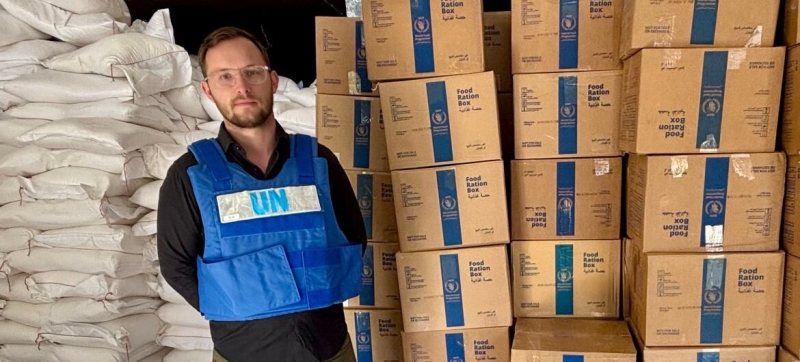
Photo from personal archive World Food Program employee Rinat Kapiev in Gaza.
“The whole system, the whole machine must work harmoniously. Somewhere the process begins at headquarters and ends in the field. At any link in this chain you need to make your contribution,” says Kapyev.
At the same time, the connection with work on the ground has not disappeared. He communicates almost daily with country offices, and travel remains part of his job. It is the experience of Afghanistan and Gaza that now helps the specialist at headquarters: he can use the knowledge gained “in the field” to prepare colleagues in other countries for crises. For example, in July, Rinat worked in Dominica, where, together with colleagues from the WFP Caribbean office, he prepared partners for the tropical cyclone season. In the near future, business trips are also planned to Somalia, Zambia, Zimbabwe, Mozambique – countries susceptible to the consequences of the El Niño phenomenon.Before being sent into difficult and dangerous conditions, employees undergo medical and psychological examinations, as well as specialized training.
In addition to professional knowledge, such work requires a whole set of personal qualities, says Kapiev. Among them are resistance to stress, adaptability, emotional intelligence, diplomacy, communication and negotiation skills. experience of local employees. Many of them have worked in a particular country for many years and have a deep understanding of the local context that a specialist who has been there for a few months may not have.
“I highly value the local knowledge and experience of national staff and consider them the most important resource for an effective humanitarian response,” says Kapiev.
60~p>That’s why he describes his approach to work primarily as support and mutual learning, rather than as management from above. sustainable results even in the most difficult conditions,” says a WFP employee.
“Saving lives and changing lives”
Over the years, Kapiev has seen humanitarian work from different sides – as a volunteer, a headquarters employee and an emergency specialist. Field experience, he said, did not make him disillusioned with his chosen profession. On the contrary, the desire to continue this work has grown stronger. Agreements are signed before aid is distributed, and funding mechanisms and operational plans are created before an emergency occurs. Simply put, humanitarian assistance begins long before the moment a box of food reaches the hands of the person who needs it.