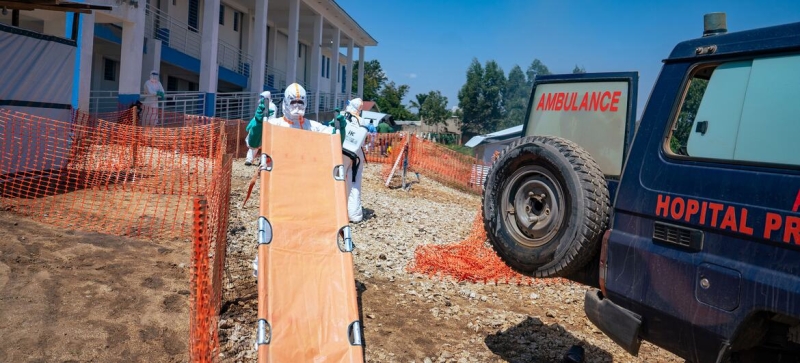

© WHO/J.-M. Raymond The current Ebola outbreak is the country’s largest ever. DR Congo: New clinics open at epicenter of record Ebola outbreak Healthcare
The number of confirmed Ebola cases in the Democratic Republic of the Congo (DRC) continued to rise rapidly over the weekend. Against this background, with the support of the UN, new medical centers are opening in the east of the country to help fight the outbreak of a deadly disease.
As of August 1, DRC health authorities reported 3,748 confirmed cases of Ebola in the provinces of Ituri, North Kivu, South Kivu, Haut-Uélé and Tshopo. Over the past two months, the outbreak has spread to five provinces and now affects 49 zones. The epidemic remains active in 33 of them, with new cases still being reported. Ituri remains the country’s hardest-hit region, accounting for 88 percent of all confirmed cases and 82.6 percent of reported deaths nationwide. “Ebola is spreading quickly, and it is affecting people already facing conflict and famine,” said Karl Skau, acting head of the World Food Program. (WFP), after a visit to eastern DRC. “Local communities hold the key to ending the epidemic, but they need support.” The World Health Organization (WHO) said the current outbreak is the country’s largest and has already surpassed 2018-2020, when 3,317 cases were confirmed. The past week saw the highest weekly number of reported cases (567) and deaths (296), highlighting the exceptionally rapid pace of transmission virus.
Inside the “red zone”
The worst-hit areas are in the “red zone” where rescue efforts are underway. UN agencies and partners, including the United States and the International Medical Corps, helped establish a transit center at a displacement camp on the outskirts of Bunia, the capital of Ituri province. The center will make it easier to identify infections and refer Ebola patients to treatment centers. This week, the UN and its humanitarian partners will also open the DRC’s largest Ebola treatment center, with one hundred beds. But experts warn that efforts will need to be scaled up significantly to end the outbreak. “The confluence of factors such as insecurity and mass population movements is complicating response efforts and increasing the risk of further geographic spread of the disease,” the WHO said, recalling that about 270,000 people fleeing violence are now living in makeshift camps across Ituri province. Living conditions in such camps allow the disease to continue to spread rapidly.
Expanding aid as needs grow
When the previous outbreak was announced late last year, UN agencies worked with Congolese health authorities to open an innovative Ebola treatment center capable of treating 25 patients. Since then, tons of medical supplies have been sent to the DRC, and more number of beds in affected areas. This week, WHO handed over 30 more beds and 38 mattresses to local doctors.