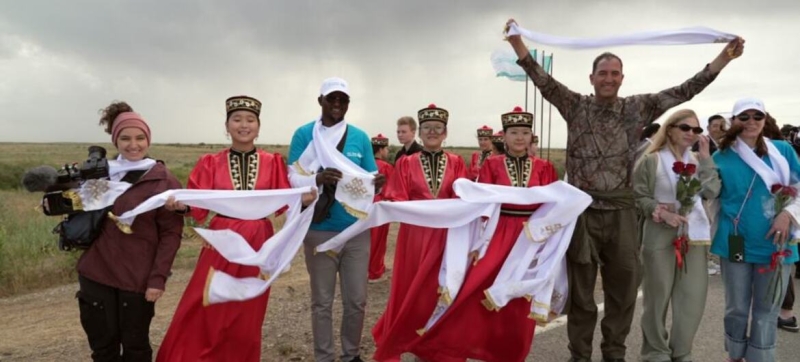

UN Photo The Russian section of the Caravan route is 1,363 kilometers, covering Dagestan, Kalmykia and the Astrakhan region. “Caravan of knowledge”: along the Silk Road through the Russian steppes Climate and environment
The Russian stage of the “Caravan of Knowledge” covered 1363 kilometers – from Makhachkala to Astrakhan, through Dagestan, Kalmykia and the Astrakhan region. It became part of a global campaign in support of the International Year of Rangelands and Pastoralists, bridging the gap from the Conference of the Parties (COP16) to the United Nations Convention to Combat Desertification (UNCCD) in Riyadh to COP17 in Ulaanbaatar under the theme “Restoring the Land. Renewing hope.”
These three Russian regions were not chosen by chance. Dagestan, Kalmykia and the Astrakhan region are among the areas where desertification, land degradation and drought particularly affect the land and people. They are different in geography, culture and tradition, but together they face remarkably similar land-use problems and have accumulated practical knowledge that applies far beyond the boundaries of a single landscape.
Grasslands cover more than half of the Earth’s land surface and support the livelihoods of about two billion people. As climate change, drought and land degradation place increasing pressure on these ecosystems, restoration and sustainable management of rangelands is becoming a top global priority.
Farms, mobile research stations, agricultural exhibitions, processing plants – along the Russian route, Caravan participants saw how the practical work of land restoration takes shape: from soil analysis, breed selection and sand consolidation to supporting small farms and knowledge exchange. Along the way, the centuries-old heritage of pastoral and nomadic culture met with the achievements of modern science, developing into practical models of sustainable agriculture.Dagestan is one of the main agricultural regions of Russia, although about 40 percent of its territory is occupied by mountains. Almost a third of the republic’s population works in agriculture, and the land here is not just an economic resource, but the basis of life.
The Dagestan section of the Caravan became special also because shortly before his arrival the republic experienced a serious natural test: severe floods after heavy rains, the evacuation of thousands of people and dozens of flooded settlements. Despite this, Dagestan greeted the Caravan warmly and cordially, contributing its own experience to the search for common solutions – how to combat desertification and keep the land productive for those who live on its fruits.
For centuries in Dagestan, a guest from a neighboring village brought with him news, stories and knowledge and set off again, this time with a fresh load of news. The guest of honor – kunak – became part of the ancient way of life, based on a code of mutual trust and support. This tradition accompanied the Caravan throughout its visit to Dagestan. Participants were invited not just to watch, but to exchange experiences, knowledge and opinions.
In the Buynaksky region, the Caravan visited one of the large breeding farms, where more than a thousand head of cattle are kept. This is a clear example of how a hardy steppe breed can adapt to mountain conditions, including seasonal migration to pastures at an altitude of 1500–2000 meters. This experience demonstrates a practical approach to pastoralism: raising animals adapted to local conditions, going beyond raw material production, developing local processing, and strengthening the food security of the region.
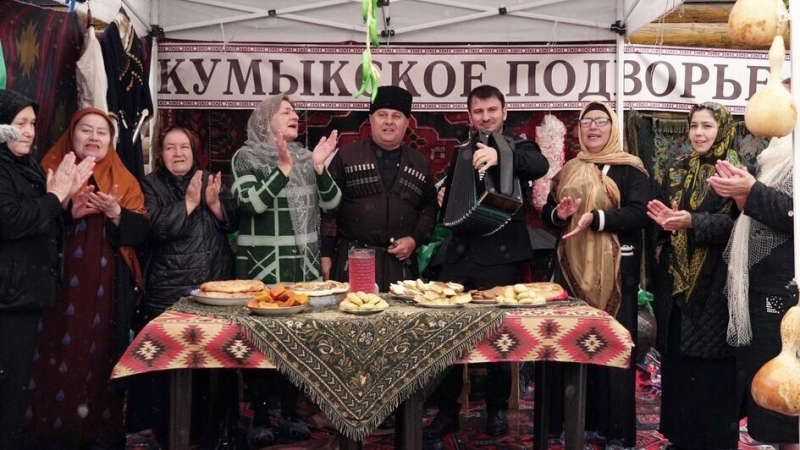
UN Photo In Dagestan, the Caravan received an unforgettable welcome.
Another example of a rural initiative was “Peach Island” – a family project that transformed a site near the Chirkey reservoir into an orchard. Today, about a thousand fruit trees grow here: peaches, apricots, apple trees, cherries, sweet cherries, figs, hazelnuts and grapes. The project reveals another facet of the agricultural potential of Dagestan – the ability of family labor to return fertility to the land, create a place of hospitality and strengthen ties with the native land.
In Dagestan, the Caravan also saw the technical infrastructure without which farm work is impossible, although it rarely comes into the center of public attention. The head of the Dagestan branch of the Russian State Agrochemical Service, Shamil Aliyev, spoke about annual land surveys, soil analysis, testing water and fertilizers, assessing the quality of feed, maintaining vineyards and orchards, and land improvement projects. In 2026, the branch plans to survey 42 thousand hectares in Dagestan.
For a republic where there are almost a million heads of cattle and about five million heads of small cattle, the quality of feed is crucial. It affects animal health, farm productivity and farmers’ decisions about pasture management, feed development and investment.
Director of the Department of Land Policy, Property Relations and State Property of the Ministry of Agriculture Vyacheslav Leonov spoke about support measures intended for small farmers and family farms. This support is extremely practical: grants help those who want to open or expand an agribusiness – a livestock farm, a cheese factory, a winery or a rural tourism project. The Agrostartup grant provides an opportunity to start a business; Successfully operating farms can qualify for larger grants for family farms – provided that the business grows, proves its viability and creates jobs in the countryside. The state does not receive a share in the property, Leonov emphasized. The purpose of this support is to help people who want to work the land finance a viable plan and establish themselves for the long term.
Kalmykia: a green shield against the advancing sands
From Dagestan, the Caravan headed to Kalmykia – one of the driest and most desertified regions of Russia. In the Black Lands, annual precipitation can be only 150–200 millimeters. Grasslands here cover millions of hectares, but shifting sands and desertification remain a daily challenge – a reminder of the growing global pressure on drylands.
It is here that researchers have shown how juzgun, also known as Calligonum, helps restore land and anchor shifting sands. In the area of the village of Artezian, zhuzgun plantings carried out in 2020 and 2024 noticeably slowed down the advance of sand and helped stabilize the soil.
The survival rate of zhuzgun reaches 95–96 percent. This makes it a powerful ally in the fight against wind erosion and provides protection for other plants. Over time, vegetation returns between the rows, including feed plants for livestock. What begins as sand consolidation can be the first step toward making degraded grasslands suitable for agricultural use again.
To further this development, mobile research teams travel to areas affected by desertification: assessing the extent of degradation, preparing restoration plans, and conducting scientific monitoring to understand how the land is responding to restoration measures. Students of the Kalmyk State University also participate in this work – they study land restoration not from a textbook, but right in the field.
When Caravan member Jacob Lekaitogo, a pastoralist and youth activist from Kenya, planted a juzgun sapling during a welcome ceremony, the gesture might at first seem modest: one plant, one patch of sand, one pair of hands. But it precisely expressed the meaning of the entire journey.
“Local residents know best what solution will suit their problems,” said Lekaitogo.
Kalmykia has become a living laboratory for land restoration for the Caravan: here sands hold bush after bush, pastures are brought back to life, and local experience is relevant far beyond the borders. region.
The livestock breeding exhibition in the capital of Kalmykia, Elista, has become another important platform for knowledge exchange. Researchers, government officials, practitioners, students and Caravan participants discussed approaches to combating desertification, pasture management and rural development. The conclusions presented at the round table on combating desertification and land degradation in Russia will also be taken into account in preparing the COP-17 events in Ulaanbaatar in August 2026.
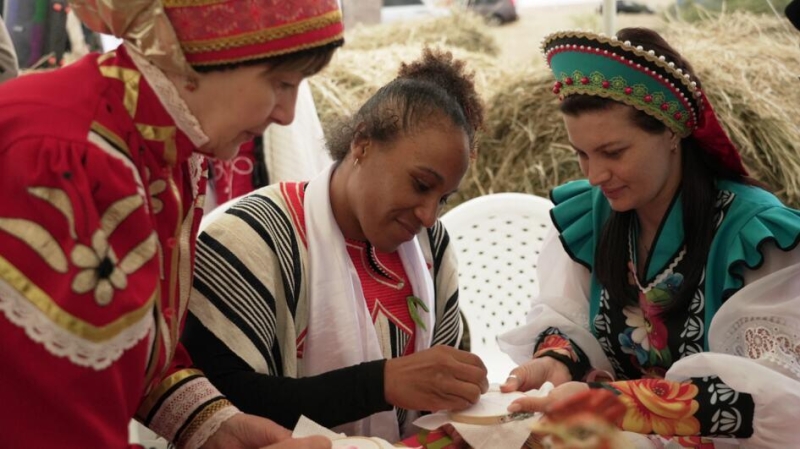
UN Photo The Astrakhan region welcomes Asmaa Niang.
Astrakhan region: when restored pasture feeds the future
In the Astrakhan region, near the Caspian Sea, the Caravan found itself in a landscape where pasture is not just an economic resource. This is the space where generations of people live, take care of the land, raise livestock and build the future.
Throughout the Astrakhan region, pasture lands are closely connected with rural life. First Deputy Minister of Agriculture and Fishing Industry of the Astrakhan Region Andrey Timofeev described these lands as an everyday space of work and the backbone of rural communities, where people raise livestock and invest in food production.
Where shifting sands once left little room for grazing, restoration with the help of zhuzgun has helped make the land productive: grasses and fodder plants are again appearing, and there is food for livestock where to graze, and a new generation of farmers has more reason to stay on the land. Without this work, Timofeev warns, pastures are threatened by desolation, wind erosion and desertification.
This knowledge and experience, collected along the entire route of the Caravan, will be discussed at the UNCCD COP-17 in Mongolia. At the conference, governments, scientists, pastoralists and land managers will exchange practical solutions for restoring land, increasing drought resilience and conserving rangeland. The caravan in the south of Russia showed: land restoration is not a single solution, but a chain of efforts, in which behind each link there is labor, knowledge and responsibility. Farmers breed breeds adapted to local conditions; laboratories examine soils, water and feed; scientists fix the sands bush by bush; students undergo field practice; entrepreneurs create agro-startups; communities store knowledge that no satellite map can replace.
Among the Caravan participants was Asmaa Niang, an activist of the UNCCD Sport4Land initiative to combat desertification. A Moroccan judoka, two-time Olympian and six-time African champion, she brought to the Caravan team the spirit of endurance, the discipline of great sport and the belief that the struggle to restore land also requires strategy, resilience and determination.
The journey also revealed the importance of preserving traditional knowledge. Caravan participant from Kyrgyzstan Kuluipa Akmatova spoke about how deeply culture depends on the living environment. When a local horse breed, an endemic plant or a high-mountain pasture disappears, the knowledge accumulated over centuries goes with it.
According to Akmatova, traditions need to be documented, passed on and applied, and not preserved only as folklore. If young people are to inherit the landscapes of their ancestors, they must be given practical tools to apply inherited knowledge in new contexts.
As the Caravan continued on its way, carrying saddlebags full of stories and wisdom, the image of the zhuzgun remained a symbol of the journey. Its seeds, adapted to life among shifting sands, wander for a long time until they find where to catch on and give support to what should grow next.
Knowledge travels the same way. They can travel vast distances and, having found their place, take root and bear fruit.