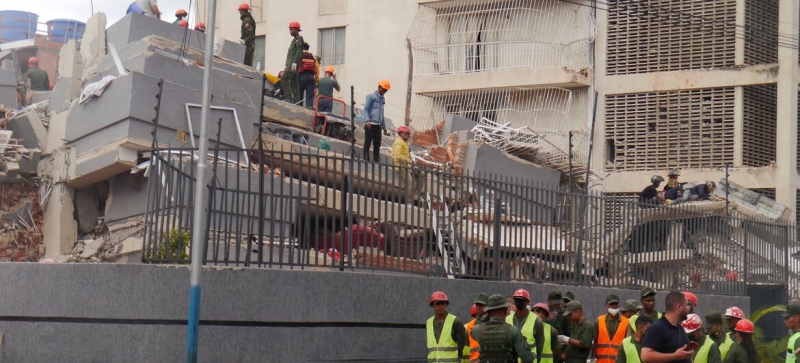

© V. Fermin Emergency workers and rescue workers assess damage caused by earthquakes in Caracas. Earthquakes in Venezuela: The humanitarian situation is rapidly deteriorating Humanitarian assistance
As a result of a search operation in the Venezuelan state of La Guaira, which was hit hardest by the disaster, six days after the double earthquake, a child was rescued alive from the rubble.
Meanwhile, tens of thousands of people in the country remain homeless after magnitude 7.2 and 7.5 earthquakes struck less than a minute apart on June 24. “As the death toll rises, humanitarian needs are rapidly increasing,” the UN High Commissioner for Refugees (UNHCR) said. According to the Venezuelan authorities, almost two thousand people were confirmed dead, more than 6,400 were rescued from the rubble.
UN reaction
The United Nations Children’s Fund (UNICEF) has delivered a significant amount of humanitarian supplies for one hundred thousand people over the next three months. The Office of the United Nations High Commissioner for Refugees (UNHCR) is organizing temporary housing for victims. The UN Office for the Coordination of Humanitarian Affairs (OCHA) is coordinating the work of dozens of international rescue teams. A number of UN agencies and their partners continue to work in the hardest-hit areas, in collaboration with local authorities and humanitarian organizations, helping families obtain temporary shelter, health care, social protection and other vital services. “Every life matters,” OCHA stressed on Wednesday, noting that national and international search and rescue teams continue to work in La Guaira. The United Nations Disaster Assessment and Coordination (UNDAC) team is helping assess the needs of disaster victims to determine where and who needs humanitarian assistance first. According to Venezuelan authorities, about a thousand buildings in the country, including hospitals, as well as more than 400 schools and water systems, were damaged or completely destroyed. In response to the emergency, UNICEF’s first shipment of humanitarian aid, weighing 47 tons, arrived in Venezuela on Tuesday. This delivery complements the cargo that arrived on June 28 from Panama. Collectively, this assistance will support more than one hundred thousand children and their families for three months.
Emergency Funding Appeal
“UNICEF is working around the clock to help as many children and their parents as possible,” UNICEF spokesman Gabriel Vockel said in La Guaira. “We are calling for donations to UNICEF because with more funds we can save more lives, help more children and reach more families.” The European Union-facilitated relief supply through the UNICEF logistics hub in Copenhagen includes emergency kits, supplies for safe childbirth, newborn care, and prevention and treatment diseases. In addition, means for purifying and storing water, tents and wheelchairs were delivered to Venezuela. Play and educational materials are designed to help children continue their learning. “Families in the affected states are in dire need of safe water and access to health care,” said UNICEF Regional Director for Latin America and the Caribbean, Roberto Benes. “Many people are now sleeping in the open air, fearing new aftershocks. These supplies will help provide children and their families with what they need now… But the needs on the ground far exceed what has already been delivered.”
Risk of aftershocks
The agency estimates that in the six states affected by the earthquakes, about 680,000 children are in need of humanitarian assistance. “Communities remain at risk due to ongoing aftershocks, the number of which has already exceeded six hundred,” UNICEF noted. According to the UN Children’s Fund, $52 million is needed to respond to the emergency in Venezuela. This amount is included in a larger humanitarian plan to help children in Venezuela for 2026, which has a total budget of $137.6 million. Before the earthquakes, the plan was only 35 percent funded.