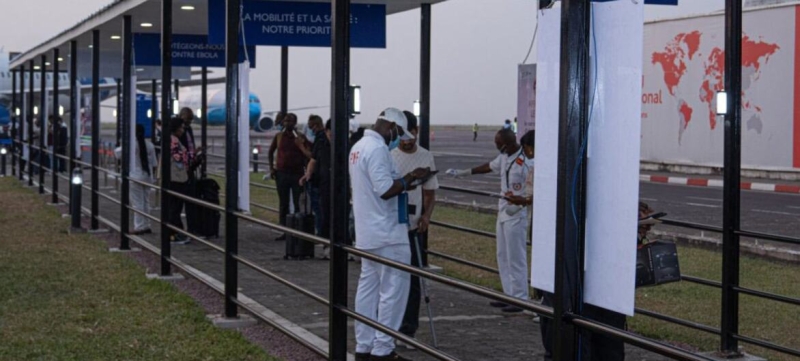

© IOM Passengers arriving in the capital of the Democratic Republic of Congo, Kinshasa, are being screened as part of measures to prevent the spread of Ebola. UN agencies warn: Ebola threat remains in DR Congo and neighboring countries Health Care
The Ebola outbreak in the Democratic Republic of Congo (DRC) continues to spread to new areas of the country. Women, doctors and internally displaced persons are at particular risk. Representatives of UN humanitarian agencies reported this on Friday at a briefing in Geneva.
According to the World Health Organization (WHO), to date, 896 confirmed cases of the disease have been registered in the DRC, including 232 deaths. WHO Emergencies in Africa Marie-Roseline Belizaire, speaking via video link from the city of Bunia in the eastern DRC, noted that specialists continue to identify new cases of the disease in various areas of the country.
According to her, WHO sent more than 115 specialists to the affected regions and delivered over 110 tons of medical supplies. Diagnostic and treatment options are expanding, but significant challenges remain. In some areas, access for aid workers is limited due to security conditions, and contact tracing of cases is still insufficient.
WHO also noted that 75 health workers have already been reported sick, of whom 17 have died. creates the fact that about 90 percent of patients do not have characteristic hemorrhagic symptoms. Many sick people try to treat themselves or turn to traditional healers, which leads to late detection of infection. epidemic.
Along with Ebola, other diseases, primarily malaria, continue to pose a serious threat in the DRC, and the success of the anti-epidemic campaign largely depends on the trust of local communities in medical services. Population (UNFPA) in the DRC Noemi Dalmonte, speaking at a briefing, recalled that the Ebola outbreak poses a particularly serious danger to women. They are the ones who most often care for sick relatives and make up a significant part of the medical personnel in direct contact with patients.
According to UNFPA, the mortality rate among pregnant women infected with the virus has reached 90 percent in past years, and the mortality rate for newborns can be up to 100 percent.
“Women are delaying prenatal checkups, avoiding health care facilities, or giving birth at home even when there are complications. They may die not from Ebola itself, but because essential medical care becomes unavailable or mistrusted,” Dalmonte added.
UNFPA is supporting maternity wards, training health staff in infection control measures, and providing facilities with personal protective equipment. In the eastern part of the country, with the support of the agency, 153 midwives are already working there, and additional personnel are planned to be sent there. violence.
Population displacement increases the risk of spreading the virus
The representative of the Office of the United Nations High Commissioner for Refugees (UNHCR), Allen Maina, in turn, reported that more than two million internally displaced persons live in risk zones, including more than 320 thousand refugees.
Ongoing armed conflict is fueling population displacement and increasing the likelihood of further spread of the virus, he said.
Mistrust in health services also remains a major obstacle. After two deaths from Ebola in the Kpangba IDP camp in Ituri province, its residents temporarily blocked medical teams from accessing the affected area. Maina.
He stressed that the risk of the disease spreading goes far beyond the DRC, as the region is closely linked by trade routes, family ties and refugee flows between Uganda, Rwanda, Burundi, Tanzania and South Sudan.
The International Organization for Migration (IOM) announced an expansion of operations in DRC and neighboring Uganda. IOM spokeswoman Zoe Brennan said the organization has already conducted more than a million health checks at border points and key travel routes in countries in the region.