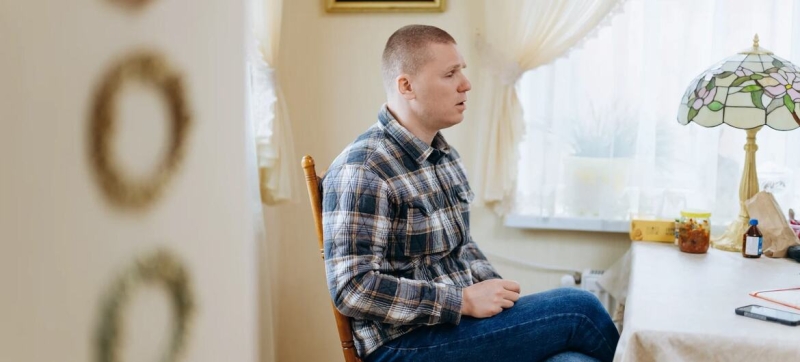

© UNDP-Ukraine/U. Pedorenko During active hostilities at the end of 2022, he was seriously wounded and completely lost his sight. Ukraine: how a blind participant in the war in Ukraine changed approaches to rehabilitation Peace and Security
A native of Vinnitsa, Artem Bondarev managed to work in a variety of fields: as an installer of heating systems, a realtor, an employee of the sales department, and shortly before the start of a full-scale invasion, also as an equipment operator at a confectionery factory.
The beginning of a full-scale war on February 24, 2022 for Artyom began as an ordinary working day at the factory. However, everything changed overnight. “The boss called and said: “Hand over the keys, there’s a war in the country,” recalls Artem. “I got into the car and on the way home I heard an explosion. Then I realized that life would never be the same.”
Learning to live again
Just a few days later, Artem joined the Ukrainian Defense Forces. During active hostilities at the end of 2022, he was seriously wounded and completely lost his sight. From that moment his life changed forever – a long and difficult path of recovery began. Artem learned to live again, undergoing physical and psychological rehabilitation. “I had to relearn everything: use the phone, cook, walk down the street with a cane. All this takes me three times longer than a healthy person,” he says. Over time, Artem adapted to the new reality for him. According to him, the aroma of coffee from coffee shops, the sound of his cane and the noise of cars help him navigate the street. “At first I went through everything in my head – every step, every turn, every sound. This helped me navigate. Now everything happens automatically. Sometimes I think about something completely different, but my legs move on their own,” he says. When it became clear that he would not be able to return to military service, Artem contacted his former employers at the confectionery factory. Soon he was offered a new position in the human resources department. To cope with his work, Artem mastered screen reading programs for people with visual impairments. “Hands remember which keys to press, so I learned quickly,” he said.
The main thing is to give a person the opportunity to be active
Over time, Artem not only adapted to new circumstances, but also began to share his experience with others. He joined a project supported by the United Nations Development Program (UNDP) in Ukraine and funded by the Government of Japan. The project aims to increase access to quality rehabilitation for people with visual impairments, as well as to increase the awareness of health care workers on how to properly support those who have lost their sight. As part of the project, based on practical experience, a manual “First contact with a person who has lost his sight” was developed. In addition, ten trainings were organized for multidisciplinary teams of rehabilitation departments, in which Artem participated as an expert: he talked about the difficulties of the first days after vision loss, showed how to properly accompany a blind person without imposing help. The idea of creating such trainings belongs to Artem himself. When he lay in the hospital after being wounded, he found himself face to face with the unknown – no one talked about canes, or support programs, or where and how he could undergo rehabilitation. “I learned everything myself, by trial and error. And now I want to make this path easier for others,” he shared. © UNDP-Ukraine/U. Pedorenko Artem Bondarev, a native of Vinnitsa in Ukraine, worked in various fields: as a heating system installer, real estate agent, sales representative and, shortly before the full-scale invasion, as an operator at the Roshen confectionery factory. Artem conducted his classes at a rehabilitation center in Vinnitsa. Thanks to the support of UNDP and funding from the Japanese government, the center is equipped with modern infrastructure for the rehabilitation of people with visual impairments. Thus, there are routes for learning spatial orientation, there is an area for practicing skills in using a white cane, a space for playing sports, as well as a special area for learning to use a wheelchair. In addition, the territory of the center was made more convenient and safe: accessible entrances were equipped and tactile tiles were laid to make it easier for people with visual impairments to move around. The center is also equipped with digital devices with adaptive software, and a specially created room that simulates a living space allows participants to learn how to cook, use household appliances and perform daily hygiene procedures. “During the trainings we talked about everything: about the psychological state, about adaptation. Everyone has their own path. But the most important thing is that people are not written off, but supported and given the opportunity to be active,” says Artem. As part of the project, trainers were trained to further disseminate this model of rehabilitation. Medical specialists from ten institutions also received training, and the institutions themselves received basic equipment for the rehabilitation of people with vision loss. Particular attention is paid to psychological support for people with visual impairments and their families, who are learning to support loved ones in new circumstances. Artem believes that a person learns best when he sees meaning in it. “If you want to teach a person to cook, offer him to cook his favorite dish. Some people learn to go to cafes on their own. Some – to hang out with friends again. But it’s best when you get both,” he added Today Artem leads an active life – he goes to work on his own, communicates with colleagues and goes on dates. He does not set limitations for himself and believes that the loss of vision is only a turn in the path, and not its end. Artem’s story is not only about loss, but also about how to find new meaning and new opportunities. Thanks to the support of UNDP and the Japanese government, he not only overcame difficulties, but also became a person who shares his knowledge and experience with those who are just starting their journey in a new reality. His example reminds us that even in the most difficult moments you can find the strength to move forward and become a support for others.
Become a support for others