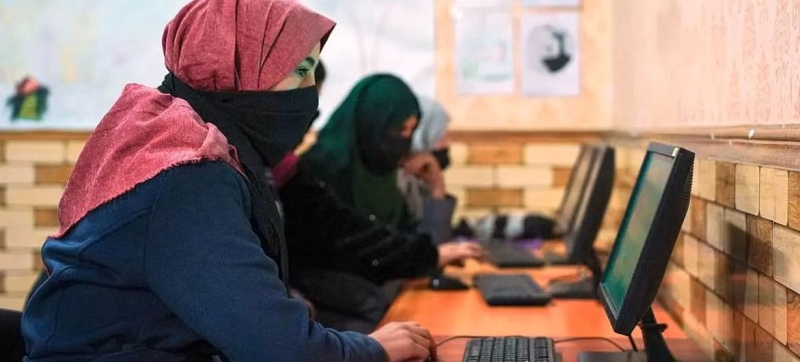

© UN Women/A. Takdisyan Women and girls in Afghanistan are unable to receive secondary and higher education due to Taliban bans. Top news of the day | Tuesday: Gaza, Syria, Afghanistan, hepatitis UN
The main news of the day in the UN and in the world: the Security Council discussed the situation in Gaza and the West Bank, representatives of the UN Human Rights Office spoke about serious crimes in Syria, restrictions on education and employment for women and girls in Afghanistan lead to annual economic losses of $84 million, the incidence of hepatitis in the world has decreased significantly over the past decade.
Security Council meeting on the Middle East
At a high-level meeting of the UN Security Council, Assistant Secretary-General Khaled Khiari said that the situation in Gaza and the West Bank continues to deteriorate. The sector is subject to constant airstrikes from Israel. Hamas and other armed groups have not stopped fighting. The population lives in very difficult conditions. Meanwhile, in the West Bank, settlement expansion and settler violence are undermining prospects for a political process that would resolve the conflict.
Crimes in Syria
Representatives of the United Nations Office for Human Rights (OHCHR) completed a five-day visit to Hasakah province in northeastern Syria. They received first-hand information about serious crimes, including murders, kidnappings and arbitrary detentions, in the past and ongoing. Office staff met with families who cannot find their loved ones who disappeared after being detained by the Syrian Democratic Forces and international coalition forces. The UN emphasized that responsibility must be borne by all parties that have committed serious human rights violations in Syria.
Shortage of female workers in Afghanistan
The UN Children’s Fund (UNICEF) warns that by 2030 there will be a shortage of 20 thousand teachers and almost 5.5 thousand female workers in Afghanistan healthcare systems. This is due to Taliban restrictions on education and employment for girls and women. According to UNICEF, if the bans continue until the end of the decade, more than two million girls will not be able to complete secondary and higher education. Already, the fund has calculated that the restrictions lead to annual economic losses of $84 million. hepatitis C decreased by 12 percent. These gains were made possible by strong efforts at global and national levels, says a new report from the World Health Organization. However, experts emphasize that mortality rates from hepatitis remain high overall. The report’s authors recall the effectiveness of vaccines and treatments and call for accelerated integration of prevention, diagnosis and therapy into primary health care systems.