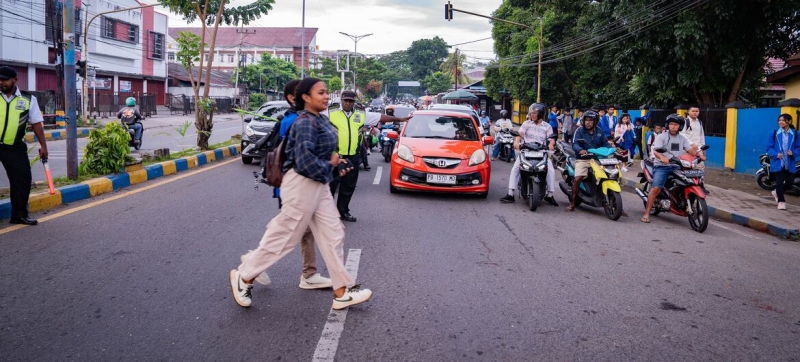

© UNICEF/A. Chair More than half of all road deaths are people who were not in a car at all: they were walking, riding a bicycle or riding a motorcycle. 1.16 million people die in road accidents every year: UN General Assembly pledges to reduce road deaths Sustainable Development Goals
Although the global car fleet increased by more than a billion units between 2011 and 2025, the number of road traffic deaths fell by 21 percent during this period.
However, road crashes killed 1.16 million people in 2025, and road injuries remain the leading cause of death for children and young people aged 5 to 29.
This is according to new data from the World Health Organization (WHO), presented on Monday during a high-level meeting of the UN General Assembly on road safety in New York, which takes place on July 20 and 21.
Read also:
UN Special Envoy: Deaths on roads are possible prevent
Over the past decade and a half, the world has experienced profound changes in the field of road traffic: new modes of transport have appeared, the number of motorcycles has increased sharply.
“This progress shows that change is possible when countries invest in safe road systems. Over the past 15 years, we have made real progress in reducing road deaths, despite the rapid increase in the number of cars and major changes in the way people move,” said WHO Director-General Tedros Adhanom Ghebreyesus. All road deaths are preventable, he said.
New declaration
On the first day of the meeting on Monday, UN member states adopted a new political declaration on road safety. It is designed to accelerate achievement of the global goal of reducing the number of deaths and serious injuries from road traffic accidents by 50 percent by 2030 compared to 2021 levels.
“[The Declaration] calls for stronger national leadership on road safety – while maintaining sovereignty, but with the understanding that together we achieve better results. The best – thanks to the joint collection and use of data. By improving road and vehicle safety, improving post-crash response systems and increasing investment in education in this area,” said the President of the UN General Assembly, Annalena Burbock.
The UN document includes a comprehensive set of commitments to implement national road safety strategies with clear targets, timelines and budgets. These include establishing dedicated road safety agencies, improving data collection and analysis, developing and enforcing stricter legislation, and bringing roads, infrastructure and vehicles up to key safety standards.
The Declaration commits countries to a proven approach that recognizes that people inevitably make mistakes on the road. It involves creating safer roads, infrastructure, vehicles, speed limits and regulations that take into account human factors, so that the consequences of road accidents remain within limits compatible with life. The document also calls on governments to show leadership and take additional action, and the private sector to make road safety a priority throughout the supply chain. Separately, the declaration recognizes the important role of civil society, academia, youth, philanthropic organizations and UN agencies in achieving progress. personal cars. With the rise of taxi and delivery services, the number of motorcycles in the world more than tripled from 2011 to 2025. Motorcyclists today account for almost a third of all road deaths, while wearing a certified motorcycle helmet reduces the risk of death in an accident by more than six times.
New types of mobility – electric scooters, electric bicycles and self-driving cars – create both challenges and new opportunities for transport planning. The WHO is working to close gaps in laws and regulations, promote common safety standards, and bring together leading experts to find new ways to ensure the safety of all new modes of transport and technologies. When roads are designed as if only motorists are important, these people are at risk, said Etienne Krug, director of WHO’s Department of Health Determinants, Health Promotion and Prevention. “We know what works: strong laws and enforcement, safe infrastructure and vehicles, and a focus on reducing speed and combating drunk driving.”
Globally, 10 countries have reduced road deaths by 50 percent in the decade to 2021. More than half of the states recorded a decrease in the number of deaths during this period. However, progress is unevenly distributed: in the WHO European Region, deaths fell by 36 percent, in the Western Pacific region by 15 percent, in the South-East Asia region by 2 percent, in the Americas region there was no change, and in the African Region the death toll increased by 17 percent.
The declaration emphasizes that improving road safety is key to public health and sustainable development in general. Increasing the proportion of pedestrians, cyclists and public transport users can reduce traffic congestion, improve air quality, make cities more livable and contribute to healthier and longer lives.
Funding and new initiatives
On the sidelines of the high-level meeting, a conference was also held to raise funds for the United Nations Road Safety Fund, which was attended by governments, organizations UN, business and public organizations.
As a result of the forum, partners announced the allocation of $5.6 million. Of this amount, about three million are direct financial contributions, another 2.6 million are other forms of support. In addition, the participants announced their intention to provide about seven million more dollars, which are still at the approval stage.
One of the main initiatives of the conference was the launch of the global program “Safe and Affordable Helmets Initiative”, designed to make certified safety helmets more accessible, primarily for motorcyclists. The initiative has already been supported by Honda and Autoliv.
The UN Secretary-General’s Special Envoy for Road Safety, Jean Todt, compared a protective helmet to a vaccine: “If road accidents are a pandemic, then a safe helmet is a vaccine. A helmet that meets safety standards and fits properly on your head is one of the easiest ways to save lives on the road. But today, millions of people still do not have access to the protection that can truly protect them in the event of an accident.”
The conference also announced the creation of the UN Road Safety Lab, developed by the United Nations Institute for Training and Research (UNITAR). The new digital platform will use the power of artificial intelligence to analyze data, share knowledge and support governments in developing solutions in the field of road safety. hosted by the UN Foundation.
According to Molchan, the EEC is organizing a series of expert dialogues on the future of road safety. Their goal is to help states put modern solutions into practice in areas such as vehicle safety technologies, technical regulations, traffic rules and behavior of road users.
“UN legal frameworks in the field of road safety can help countries meet their commitments by 2030,” she emphasized.
We are less than five years away from achieving the global goal. The UN believes that success will depend not only on new technologies and international agreements, but also on the willingness of states to consistently invest in safe roads, modern legislation, quality medical care for victims and effective prevention.