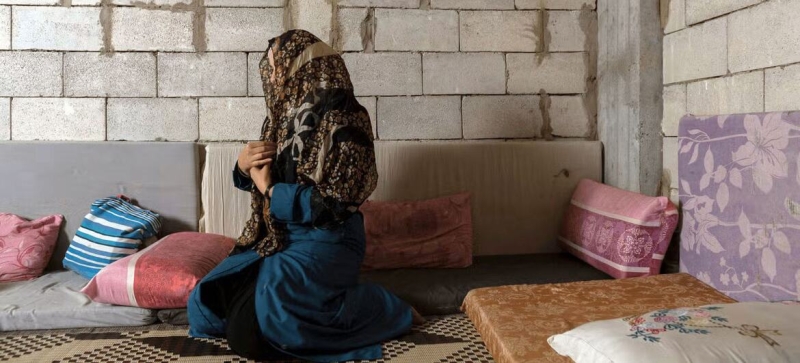

© UNFPA/David Brunetti A woman from Syria who was forced to leave her home. Syria: UN calls for faster political transition and increased support for country’s reconstruction Peace and Security
Syria is experiencing a critical phase of political transition, where opportunities for reconstruction are coupled with serious risks. This was stated by UN representatives at a Security Council meeting dedicated to the situation in the country.
Deputy Special Envoy of the Secretary-General for Syria Claudio Cordone stressed that the political process needs to be further advanced, including the formation of legislative institutions. The Syrian Assembly has not yet begun its work, since the president is expected to appoint another third of the deputies.
“Syria needs the People’s Assembly to begin its work. And it is necessary that all Syrians – including Syrian women and representatives of various walks of life – feel that they are truly represented in it,” he said.
Demands for justice
In recent weeks, demonstrations have taken place in Idlib, Aleppo, Hama, Damascus and other cities demanding that those responsible for crimes committed during the conflict be brought to justice. In some cases, the protests were accompanied by outbreaks of violence.
Cordone stressed the importance of developing a law on transitional justice.
“To ensure confidence in the transition process and build a new Syria, it is essential that the law applies to all those responsible for committing serious crimes, and not just those associated with the Assad regime,” – he noted.
Integration and trust
The speaker reported on progress in implementing the agreement between the government and the Syrian Democratic Forces (SDF), as well as progress regarding the return of Kurdish families. The issues of integration of the police, the status of women’s self-defense units, local government bodies and the educational system remain unresolved.
“At the same time, there has been no progress in the implementation of the roadmap for building confidence and reintegration in Suwayda, adopted in September 2025. The underlying issues that contributed to the outbreak of violence in July 2025 remain unresolved, including issues related to bringing those responsible to justice,” said the Deputy Special Envoy. continues.
“We again urge Israel to respect the 1974 Agreement, to release those unlawfully detained, and to respect the sovereignty and territorial integrity of Syria,” he said.
The UN also welcomes the ongoing efforts of the Syrian authorities to protect Syria from wider regional conflicts. Syrian security forces reportedly foiled attempts to smuggle missiles from Syria into Lebanon and conducted additional operations targeting cross-border smuggling. Indrika Ratwatte, speaking at the meeting, reported that since December 2024, approximately 1.6 million Syrian refugees and almost two million internally displaced persons have returned home. uneven in different parts of the country,” he noted.
According to a representative of the UN Office for the Coordination of Humanitarian Affairs, in the first quarter of this year, about two million people received food aid, and more than three million received access to water and sanitation. Syria was provided with only 20 percent of the required $2.92 billion.
Hot spots of instability
As Ratwatte noted, the situation of the population is of particular concern in Quneitra and Suwayda governorates.
60~p>In Quneitra, years of conflict have been compounded by military operations, travel restrictions and unexploded ordnance. According to the UN, about 80 percent of the province’s residents are in need of humanitarian assistance.
In Suwayda, recent violence has led to new population displacements and limited access to basic services.
Support recovery
The UN emphasizes that Syria has a real chance to move from survival mode to recovery. However, this requires continued humanitarian assistance, political will, investment in rebuilding infrastructure and creating the conditions for sustainable development.
“We must simultaneously meet people’s immediate needs and lay the foundations for long-term stability and prosperity,” Ratwatte said.